Category Archives: badagas

Some ‘burning’ issues facing Badagas

[This article/page was published earlier. But, most of the issues touched upon have a great relevance even today – Wg.Cdr JP]

Badagas as a Hill Tribe

BADAGAS as ST

Many Badagas are under the mistaken impression that if they are brought under the “Scheduled Tribe”, it is a degrading step. I do not think so. Badagas are one of the ‘ORIGINAL’ tribes of the Nilgiris along with Todas, Kothas and Kurumas.

The enormous improvements achieved by Badagas in all social factors, in spite of many impediments, should make us feel proud. This success is attributed to one SINGLE factor. Education. For that we must remember with gratitude the pioneer, visionary and philanthropist Rao Bahadur [Hubbathalai Jogi Gowder] Bellie Gowder who built the first School for Badagas – along with free hostel accommodation in Hubbathalai and his son Rao Bahadur HB Ari Gowder who fore saw that in educating a girl, indeed we are educating a family and hence insisted on education for girls and encouraged it fully.

~~~~

‘Scheduled Tribe’ status for Badagas ?!

March, 2008 : Why the latest Tamil Nadu website, http://www.nilgiris.tn.gov.in/
on the Nilgiris is getting on my ‘goat’ is the fact that till recently Badagas were shown as a tribe along with Todas, Kothas, Kurumbas and others. In fact, the following photograph displayed in my website www.badaga.in [ see the page https://badaga.wordpress.com/badaga-dance/ ] was taken from that portal.

Image

But the same has been removed from http://www.nilgiris.tn.gov.in/ now.

Mind you, calling Badagas as a separate tribe and included with others, does not automaticaly give the status of a schedule tribe. And hence, the champions among ourselves who are opposed to ST status, need not feel small

The above website of TN govt is accessed by many tourists mainly foreigners and they are agast not to find anything on or about Badagas.

Many readers may not know that Badagas were listed as a separate entity in the CENSUS till 1981 but after, that courtesy some ill informed ‘idiots’, Badaga are grouped under Kannada (speaking people). What this has done is the huge loss of information of knowing how many Badagas are there [along with all other details like literacy rate, gender wise population etc]. That, SIMPLY MEANS BADAGAS DO NOT EXIST.

What is highly hurting is the fact we have many Badagas including a minister, MLA, many ex-MPs & ex-MLAs who seem to do nothing. Can they not, ATLEAST, shoot out letters to all concerned ? Or, have they forgotten the fact that they are getting a fat pension because of us? I know of an EX-MP who writes to the local police station every now and then emphasising the EX-FACTOR when it comes to grabbing others land for her own kith, but does nothing about the community welfare.

What about the many self appointed leaders of Badaga community, including ex-MLAs, who claim that they are very close to the DMK party leadership ? Why can’t they initiate some action and show the same enthusiasm when they ‘fleece’ the public for money in the name of donation for the party [but lining their own pockets]?

What about many senior government officers, including the only IAS officer who can influence the party in power to take some action ? Firstly, the IAS officer should correct his mother tongue being Badaga and NOT as Tamil as is given in the government official info { a fact I have mentioned in FIRST BADAGA also}.

It is a well known fact that late Rao Bahadur HB Ari Gowder would seek an immediate appointment, to highlight the problems concerning Badagas, with the Collector as well as the State ministers of his time including the great Rajaji who was the CM. Do you know that Rajaji had to apologise to Ari Gowder when he (Rajaji) was delayed for an appointment and Ari Gowder, as MLA, threatened to walk out. I believe, many Collectors of the Nilgiris, would not only address Ari Gowder’s concern expressed over the phone but would consult him on any issue on Badagas.

Why are we keeping quiet ? Why are we behaving like ‘HEBBATHES’ – cockroaches- running away from light and hiding ourselves in darkness??

Badagas under Schedule Tribes ???

I have very strong views on this subject. Before I elaborate on them, I feel that we should first of all be identified as BADAGAS which is not the case as SANTHOSH has rightly mentioned in www://badaga.com “. . our community’s name is not in the list of communities under the BC category. In fact, it is not mentioned under any of the categories.”

I also agree with the views of ‘bhojvija’ who feels that ST tag for Badagas is humiliating…
“…Badagas living in cities and doing/completed education in cities and are upper middle class family and for them it’s not at all a matter if Badagas are non ST. But we have to talk about our entire badaga community. For example an SC/ST guy simply getting govt job if he passed just degree. And government providing more facilities like scholarship, free hostel, books, notebooks etc… In our community so many have stopped their education due to lack of economical support and their entire life style also has been changed as they have to work just as ordinary labourers…. “.

Most of us feel that getting ST status is demeaning and meant mainly for getting admissions to educational institutions and getting jobs easily. The truth could be entirely different.

Even in our own district of the Nilgirs, do you know that we are not taken as a separate community as BADAGAS but are clubbed with other non tribals??? That is one of the reasons why the exact number of Badags is not available? When census is taken Badags are clubbed under Kannadigas / others.

I am afraid, if this sad state of affair continues, after a few years, we will come under the “extinct” community.

Being from an above average Badaga family – economically [God’s grace], having done my professional studies of engineering and business administration etc and having served in the defence services and having mostly lived in big cities like Delhi, Bangalore & Madras for the past forty odd years or educating my children in the elitist schools, colleges and now abroad, I had no occasion to seek the tag of BC.

BUT.. yes this is a big ‘but’ [no pun intended]…

BUT, NOW THAT I VISIT AND INTERACT WITH OUR PEOPLE IN OUR HATTIS ON A REGULAR BASIS, I AM CONVINCED THAT FOR THE UPLIFTMENT OF OUR COMMUNITY AS A WHOLE (as opposed to city based creamy layers) THERE IS AN URGENT NEED THAT :

  1. First, we should be identified as a separate group as BADAGAS like Todas, Kothas,Kurumas etc when the people(tribes) of the Nilgiris are referred to.
  2. For the larger good of the community, Badagas should get the ST status for the benefits available are too many to go into detail.

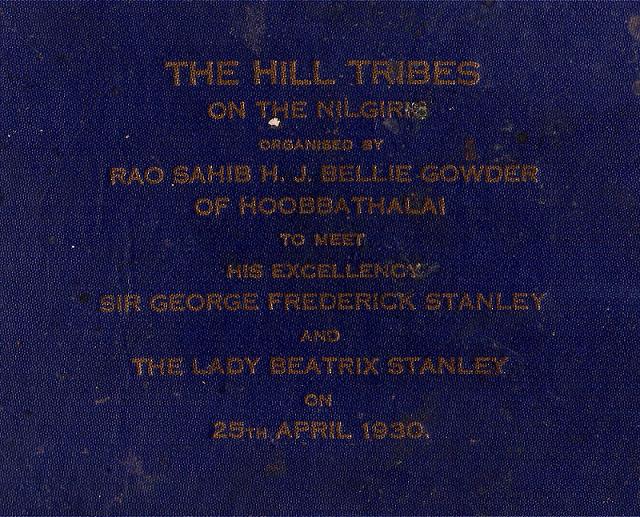
Nearly eighty years back, Nakku Betta Leader, Rao Bahadur (Rao Sahib then) Bellie Gowder on whose invitation the Governor of then Madras Province visited Hubbathalai Village was presented a memorandum on the Hill Tribes of Nilgiris which included Badagas, Todas & Kothas. In a grand cultural show organised on that eve Badaga dance was presented [by school boys] in their ‘DODDA KUPPACHA”.

dodda-kuppacha.jpg

Rao Bahadur Bellie Gowder, incidentally, was not only the leader of Badagas but represented as leader of all the tribes of Nilgiris (a relatively remote hilly & jungle area and unexplored at that time). The folder he presented to the British Governor, on the occassion of his vist to Hubbathalai [on the invitation of Rao Bahadur Bellie Gowder] containg some rare photos of all the tribes of Nilgiris INCLUDING BADAGAS

Badagas as a Hill Tribe

<

p style=”text-align:center;”>What do you think?

:::::::::::::::::::::::::::::::::::::::::::::::::::::

Let us be FAIR to the fair gender

As I sit down to ponder over the ‘burning issues’ that are bothering the Badaga Community, three issues pop up as very important. The FIRST one is the inequality with which we seem to be treating our women today. Though, this malaise is affecting all the communities in our country, I am concerned that the Badagas who treated their women folk with so much respect and love in the olden days, are slowly but surely pushing them into the second class citizens category.

In earlier days, the girls were married off at a much younger age [Kannu Hoottadha Henga] but with the firm understanding that they [the girls] could seek divorce at any time if there was matrimonial disharmony and that they would be accepted back into the society without any blame and reservation. Getting married again was no big issue. She, always, had the backing of her parents and her brothers as ‘guru mane’ gave unflinching support in all respects mainly financial. This was probably the main reason that the girl children were not given any share in the property.

Being brought up in an atmosphere where complaining and cribbing were not considered as routine, the Badaga women accepted life as it came and were always ready to sacrifice their own comforts. But then, the Badaga men, at least a majority of them, were, also, simple and hard working. Then came the curse of ‘drinking’. And with that, the problems and troubles of Badaga woman increased many fold and took a dramatic turn for the worse. The men folk took full advantage of the vulnerable nature of the women who had the additional burden of bringing up the children. Here, it must be mentioned that a Badaga girl was expected to be pregnant within a few months of marriage and invariably, there was a child to ‘celebrate’ the first wedding anniversary. Followed, of course, with many more children. “Mane thumba Makka” – House full of children – was part of the ‘blessing – Harakkay’.

This put the women in a very disadvantageous position. With many children, divorce was not a choice. Thus, they accepted suffering without complaints.

Education changed the fundamental thinking of girls. Though still faced with the compulsion of early marriage, many girls accepted ‘two children per family’ norm as the best option. But, there was and is still discrimination when it came to giving them share of property. The present law of the land is clear. Girls should get EQUAL share of the property.

The Badaga thinking, mainly mandated and manipulated by men, has found the clumsy excuse of not giving share of the property to the girl children by quoting outdated traditions. This is the problem.

I am convinced that one of the most important and burning issues facing us today is GIVING EQUAL SHARE TO THE GIRLS AS THE BOYS. I am firmly of the view that we have to resolve that we will give equal share to the girls if we have to save our community from falling into disgrace. Let us take that resolution, HERE and NOW.

Wing Commander Bellie Jayaprakash B.E.(GCT,Madras Univ).,M.B.A (FMS, Delhi Univ)
Contact : bjaypee@gmail.com
belliejayaprakash©2006-2024

:::::::::::::::::::::::::::::::::::::::::::::::::::::::::::::::::::::::::::::::::::::


Hethey Habba

Hethey Habba is one of the most important Festivals (Habbas) of Badagas. Usually it is celebrated in the last week of December/first week of January every year.

Under the Porangadu Seemay, Hubbathalai Villages (there are two of them known as Dodda (Peria) Hubbathalai and Kunna (Chinna) Hubbathalai, aslo known as Htti & Ooru), the friday before the festival day (always a Monday), is second most important.

This friday is called HANA KATTOVA (payment of money) Jena (day). The complete village joins together around the Suththukallu (the holy triangular stone under the Bikkey (Olive) Mora (tree), where a ceremonial pooja is done along with the Hethey Dhadi (Staff) kept at the altar. A few of the villagers go to Kerban Hethey Temple by walk dressed in spotless white shirt, Dhoti and turban (Mandarey). They are known as Dhadi Kararu.

This year, 2023, inspite of inclement weather, the day was celebrated with religious fervour and joy.

The ‘Mistaken Migration from Mysore’ theory

The ‘Mistaken Migration from Mysore’ theory that Badagas have migrated from Mysore plains.

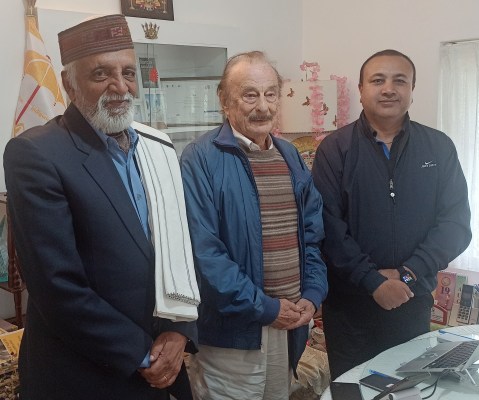
I attended the “In Conversation with Paul Hockings ” meeting, courtesy Ganesh Ramalingam, who is spear heading the movement to restore ST status for Badagas on 19 Aug 2023. Prof. Paul Hockings is on a visit to the Nilgiris.

While giving full credit to Prof. Paul Hockings for writing so much about Badagas and exposing us to the world, I am totally opposed to his view that we are migrants from Mysore.

I had told Prof.Paul Hockings many times earlier through emails and in person in the meeting at Ooty.

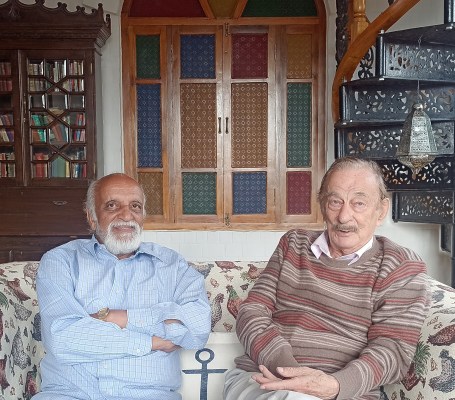
(Wg Cdr Bellie Jayaprakash with Prof.Paul Hockings, in turban)

His argument is “please show some evidence that Badagas were in the Nilgiris for a longer period than a few hundred years, (thousand of years), I will definitely change my view.”

I see a subtle change in his perception now. For a specific question ‘why did you write, in the first place, that Badagas migrated from Mysore, his answer was ‘Badagas, themselves told me and pointed to a village near Nanjangud as their ancestral village ‘.

In 1962, when Paul Hockings first started his research on Badagas, he was about 28 and staying in Ketti village. Prof. Paul Hockings, says that he had visited about 80 Badaga villages.

Prof. Paul Hockings accepts and stated on record that Badagas are as indigenous to Nilgiris as British to Britain to a question by Ganesh Ramalingam. This I consider to be a subtle change in the view of Prof. Paul Hockings though he still seems more inclined towards the migration from Mysore theory.

The argument that Badagas have migrated from Mysore area, in the northern side of the Nilgiris MAINLY based on the meaning of BADAGA and/or some Badagas with whom Paul Hockings interacted, informants as he calls them, told them so, is not convincing. In 1960s, the awareness of Badaga Origin, was not well known to the Badagas. Some Lingayats, among the Badagas he gathered the migration information from, could have been falsely influenced, because of their ties with some villages near Nanjangud.

Now that Badagas, some of them highly educated and well informed, have started questioning this mistaken migration theory, we can feel that there is unease in the minds of many scholars and followers who tend to quote Westerners about migration and calling them wrongly as Hindu Refugees escaping the forced religious conversion by Muslim invaders.

The only way to establish our origin and ancestry, once and for all, is to do carbon dating. Paul Hockings, agrees to this and says he is willing to change his perception about the so called Badaga Migration, as that would be scientific.

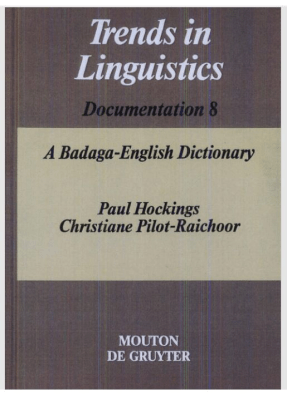
Apart from this important issue of migration, where Prof. Paul Hockings, in my opinion, could have been misinformed, the other research Paul Hockings has done on Badagas, is exemplary. His books on ‘Badaga English Dictionary and Badaga Proverbs‘ along with Christiane Pilot Raichur, are great source of information and should find a place in every Badaga home. 

(Prof. Paul Hockings with Wg Cdr Bellie Jayaprakash at the later’s house in Coonoor. Aug, 2023)

On a personal note, I am willing to sponsor anyone from our community, who can do this carbon dating and also request young Badaga leaders like Ganesh Ramalingam and other friends to initiate a serious attempt on this issue.

Let us prove that we are as old as any other tribe in the Nilgiris and this Migration from Mysore is a big mistake.

Wing Commander Bellie Jayaprakash (Air Veteran, Indian Air Force)

Please also see the page on Badaga Origin


Jakkadha SV Ramachandran comments

Kay Mugadane JP sir

This message should be made loud and clear among every Badaga brothers and sisters. We should get convinced ourselves first.

In my opinion, DNA profiling and DNA mapping would be a better way to scientifically understand the origin of our community.

Regards.

Thank you very much, Ramachandra, I fully agree with you that we, Badagas, should get convinced ourselves first. DNA profiling/mapping could/should also be done. Why not? – Wg Cdr JP

900,000+hits, How do I thank you ?

900,000+hits, How do I thank you ?

Our website https://badaga.co has crossed the 900,000 visits this month, June 2023.

Targeted at a tribal community of about 300,000 Badagas, this website, an one man’s effort, gets about 200 hits a day.

How can I thank you, with mere words!

Wing Commander Bellie Jayaprakash (Coonoor)

bjaypee@gmail.com

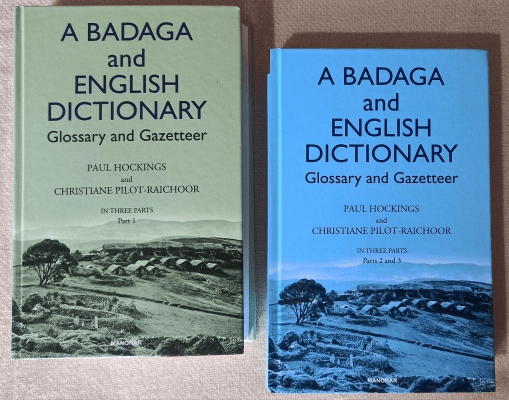
A BADAGA AND ENGLISH DICTIONARY

A BADAGA AND ENGLISH DICTIONARY: GLOSSARY AND GAZETTEER

by Paul Hockings & Christiane Pilot-Raichoor

Badaga/Baduga, spoken by an indigenous tribe of the Blue Mountains, the Nilgiris in the Southern India, is an unique Dravidian language. Though wrongly clubbed and considered as part of old/haliya Kannada due to many similarities, it has been proved to be a separate language by itself. Now it figures as an endangered language in the UN list. The Nilgiris, with its many primitive tribes, has been the centre of many researchers and anthropologists for many centuries now. Most prominent among them is, no doubt, Prof. Paul Hockings. His extensive study/research on Badagas during his stay among them in the hills in the 1960s, has resulted in many books and publications which are a great source of information and reference . I found his book on ” Badaga Proverbs – Counsel from the Ancients: A Study of Badaga Proverbs, Prayers, Omens, and Curses “, quoted extensively in the dictionary very interesting and educative. May be there are a couple of glitches here and there but his work is exhaustive, indeed. I am in touch with him and find him to be very friendly and communicative.

Paul Hockings studied anthropology and linguistics at Sydney, Toronto, Chicago, Stanford and California (Berkeley) universities. He was the editor of the Encyclopedia of the Nilgiri Hills (Manohar 2012), as well as author of several other books on the anthropology of that area. The late Christiane Pilot-Raichoor was a linguist with a doctorate (1991) from the University of Paris – Sorbonne, specializing in the Badaga language. She supervised grammar and etymology in the Dictionary.

The latest edition of “A Badaga and English Dictionary” has been published by Manohar, Delhi and is priced at Rs.3995/- for a set of two books (three parts), 1024 pages, and is available from Amazon at Rs.3076/– (23% discount)

This dictionary is a must for any serious student of Badaga Language and a great guide & reference to know about Badagas and the Nilgiris – Wing Commander Bellie Jayaprakash

Prof: Paul Hockings, one of the authors, in an email, informs me that

This Dictionary, just released by Manohar Publishers, is a much revised and expanded version of the original Badaga Dictionary, published in Berlin in 1992. The authors for each edition were two anthropological linguists, Paul Hockings and the late Christiane Pilot-Raichoor. Together they have compiled a two-volume dictionary which is without parallel in Dravidian studies. For a start, it is the only dictionary that incorporates a Gazetteer of about 2,000 local placenames, including all Badaga, Toda and Kota villages past and present.
Etymologies are given for most entries, linking Badaga words to forms in the Dravidian Etymological Dictionary of T. Burrow and M.B. Emeneau. But a striking innovation here is that Hockings has for the first time shown that in many Dravidian Languages there remain a just a handful of words ultimately derived from Sumerian. This was the first language ever to produce written records, and it spread from Mesopotamia widely across the Western part of the Indian Ocean, some three thousand years ago, reaching as far as Kerala. Thus the Badaga word ūr or ūru (‘head village’) was derived indirectly from the Sumerian uru, ‘town, village, district’, and the Badaga giri (as in Nilgiri) is cognate with the Sumerian giri,meaning a ortress or refuge.
Another novel feature of the book is that Hockings has been able to comb old maps in order to list the Badaga names of 220 Toda hamlets, most of which no longer exist. Wherever he discusses any village or hamlet he gives its exact location, cited as being so many kilometres from points in Ooty, Kotagiri, Coonoor or Gudalur.
This book opens with a short outline of Badaga cultural history, and an essay discussing the relationship of Badaga with other, neighbouring languages. At the back are ten Appendices, with such useful information as the names, Badaga and scientific, of plants and animals, detailed lists of all villages, names of deities, etc. Also of crucial value is Part 3 of the book, a complete English-Badaga glossary, and for most of the nouns, including all plants, animals and placenames, concise references are given to the extensive literature on the Nilgiri region. This means that if a botanist, for example, even if not particularly interested in the Badaga language, wants some technical information about mango, he or she only has to look up ‘mango’ in this English Glossary, and that will give the comparable Badaga word, the entry for which will include concise references to mango in the botanical literature. In this way the book is more than just a Dictionary, it is a ready-reference book.

A Badaga English Dictionary – 1992 Edition

Counsel from the Ancients: A Study of Badaga Proverbs, Prayers, Omens, and Curses

phpro.jpg


Prof. Paul Hockings in his email [3/3/2015] had writen :

Dear J.P., It was really very generous of you to devote so much space to my work in your Badaga website. I do appreciate it.

My reply : Thank you Paul for the email. Since I feel that your books, particularly, ‘Counsel from the Ancients: A Study of Badaga Proverbs, Prayers, Omens and Curses‘ must find a place in every Badaga home, I wished that it was easily available and affordable. Thanking you once again for making Badagas known to the world. – Wg Cdr JP

Aside

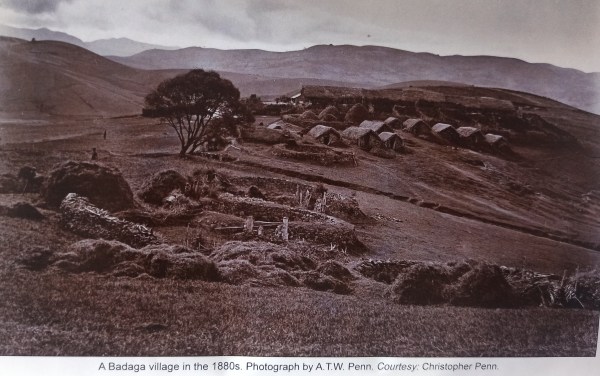
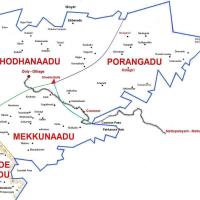
Badaga Villages (Hattis) [All photos are by Bellie Jayaprakash and copyrighted] ~~~~~~~~~~~~~~~~~~~~~~~~~~~~~~~~~~~~ Map Courtesy – Nellikolu Charitable Trust ~~~~~~~~~~~~~~~~~~~~~~~~ Badagas, generally, refer to their village or hamlet as ‘ HATTI ‘ spread around ‘Nakku Betta’ (the Nigiris). Nakku Betta literally … Continue reading

Proud of you, Malliga

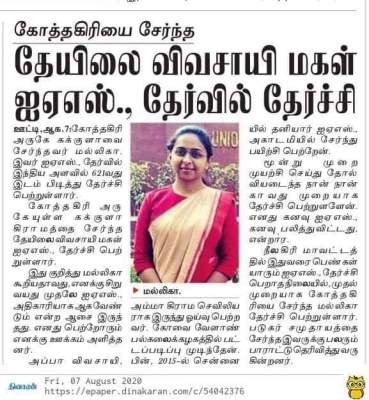
Malliga from Kagguulla, Kotagiri has become the First Badaga girl to have cleared the UPSC (IAS) exam.

(Info courtesy HN SIVAN)

—-+++++++++++——

D.Radhakrishnan in Covai Post
K
aggula, a village of about 150 houses near Kotagiri is in a celebratory mood. Why not!
A daughter of the village has done it proud and in the process brought laurels to the Nilgiris,the likes of which this district in general and the Badaga community,in particular, have been yearning for,for a long time.
Sheer perseverance of S.Malliga, daughter of a small tea grower Sundaran and Village nurse Chithradevi of Kaggula,has put her on the road to becoming the first woman IAS officer of the Badaga community.
A student of the Saint Joseph’s Convent in Coonoor,Malliga, the only child of the couple moved to Coimbatore to get a Bio tech degree from the Tamil Nadu Agricultural University before seeking training in an IAS coaching academy at Chennai to crack the Union Public Service Examination.
Undaunted by the faltering in the initial stages,Malliga clung on to climb the peak.
With this her long standing dream of becoming an IAS officer, has come true .Echoing the sentiments of her village,her cousin Sathish told The Covai Post that going by her track record,”we were certain that she will make it”. She now carries the wishes of the people of the hills to excel in her career and inspire many more Malligas.

Malliga from Kotagiri has become the First Badaga girl to have cleared the UPSC (IAS) exam.

So far the only IAS officers from Badaga community have been M.Devaraj and N.Sundaradevan.

Malliga, we are proud of you.

Dr.Rajma Comments:

Congratulations dear Malliga. We are very proud of you my dear. You are crowned with a title “First Badaga Woman _ IAS” Indeed it is moment of glory. Get ready to serve the nation. The journey of a thousand miles begins with one step. Take a step forward with confidence, determination and dedication. You have miles to go .” Strong women aren’t simply born. They are made by the storms they walk through”. Bring pride to womanhood. At any day Woman power is super power. All the best to you. Special thanks to JP for posting this.

Your words are always inspirational, Dr.Rajma. – JP

Some ‘burning’ issues facing Badagas

[This article/page was published earlier. But, most of the issues touched upon have a great relevance even today – Wg.Cdr JP]

Badagas as a Hill Tribe

BADAGAS as ST

Many Badagas are under the mistaken impression that if they are brought under the “Scheduled Tribe”, it is a degrading step. I do not think so. Badagas are one of the ‘ORIGINAL’ tribes of the Nilgiris along with Todas, Kothas and Kurumas.

The enormous improvements achieved by Badagas in all social factors, in spite of many impediments, should make us feel proud. This success is attributed to one SINGLE factor. Education. For that we must remember with gratitude the pioneer, visionary and philanthropist Rao Bahadur [Hubbathalai Jogi Gowder] Bellie Gowder who built the first School for Badagas – along with free hostel accommodation in Hubbathalai and his son Rao Bahadur HB Ari Gowder who fore saw that in educating a girl, indeed we are educating a family and hence insisted on education for girls and encouraged it fully.

~~~~

‘Scheduled Tribe’ status for Badagas ?!

March, 2008 : Why the latest Tamil Nadu website, http://www.nilgiris.tn.gov.in/
on the Nilgiris is getting on my ‘goat’ is the fact that till recently Badagas were shown as a tribe along with Todas, Kothas, Kurumbas and others. In fact, the following photograph displayed in my website www.badaga.in [ see the page https://badaga.wordpress.com/badaga-dance/ ] was taken from that portal.

Image

But the same has been removed from http://www.nilgiris.tn.gov.in/ now.

Mind you, calling Badagas as a separate tribe and included with others, does not automaticaly give the status of a schedule tribe. And hence, the champions among ourselves who are opposed to ST status, need not feel small

The above website of TN govt is accessed by many tourists mainly foreigners and they are agast not to find anything on or about Badagas.

Many readers may not know that Badagas were listed as a separate entity in the CENSUS till 1981 but after, that courtesy some ill informed ‘idiots’, Badaga are grouped under Kannada (speaking people). What this has done is the huge loss of information of knowing how many Badagas are there [along with all other details like literacy rate, gender wise population etc]. That, SIMPLY MEANS BADAGAS DO NOT EXIST.

What is highly hurting is the fact we have many Badagas including a minister, MLA, many ex-MPs & ex-MLAs who seem to do nothing. Can they not, ATLEAST, shoot out letters to all concerned ? Or, have they forgotten the fact that they are getting a fat pension because of us? I know of an EX-MP who writes to the local police station every now and then emphasising the EX-FACTOR when it comes to grabbing others land for her own kith, but does nothing about the community welfare.

What about the many self appointed leaders of Badaga community, including ex-MLAs, who claim that they are very close to the DMK party leadership ? Why can’t they initiate some action and show the same enthusiasm when they ‘fleece’ the public for money in the name of donation for the party [but lining their own pockets]?

What about many senior government officers, including the only IAS officer who can influence the party in power to take some action ? Firstly, the IAS officer should correct his mother tongue being Badaga and NOT as Tamil as is given in the government official info { a fact I have mentioned in FIRST BADAGA also}.

It is a well known fact that late Rao Bahadur HB Ari Gowder would seek an immediate appointment, to highlight the problems concerning Badagas, with the Collector as well as the State ministers of his time including the great Rajaji who was the CM. Do you know that Rajaji had to apologise to Ari Gowder when he (Rajaji) was delayed for an appointment and Ari Gowder, as MLA, threatened to walk out. I believe, many Collectors of the Nilgiris, would not only address Ari Gowder’s concern expressed over the phone but would consult him on any issue on Badagas.

Why are we keeping quiet ? Why are we behaving like ‘HEBBATHES’ – cockroaches- running away from light and hiding ourselves in darkness??

Badagas under Schedule Tribes ???

I have very strong views on this subject. Before I elaborate on them, I feel that we should first of all be identified as BADAGAS which is not the case as SANTHOSH has rightly mentioned in www://badaga.com “. . our community’s name is not in the list of communities under the BC category. In fact, it is not mentioned under any of the categories.”

I also agree with the views of ‘bhojvija’ who feels that ST tag for Badagas is humiliating…
“…Badagas living in cities and doing/completed education in cities and are upper middle class family and for them it’s not at all a matter if Badagas are non ST. But we have to talk about our entire badaga community. For example an SC/ST guy simply getting govt job if he passed just degree. And government providing more facilities like scholarship, free hostel, books, notebooks etc… In our community so many have stopped their education due to lack of economical support and their entire life style also has been changed as they have to work just as ordinary labourers…. “.

Most of us feel that getting ST status is demeaning and meant mainly for getting admissions to educational institutions and getting jobs easily. The truth could be entirely different.

Even in our own district of the Nilgirs, do you know that we are not taken as a separate community as BADAGAS but are clubbed with other non tribals??? That is one of the reasons why the exact number of Badags is not available? When census is taken Badags are clubbed under Kannadigas / others.

I am afraid, if this sad state of affair continues, after a few years, we will come under the “extinct” community.

Being from an above average Badaga family – economically [God’s grace], having done my professional studies of engineering and business administration etc and having served in the defence services and having mostly lived in big cities like Delhi, Bangalore & Madras for the past forty odd years or educating my children in the elitist schools, colleges and now abroad, I had no occasion to seek the tag of BC.

BUT.. yes this is a big ‘but’ [no pun intended]…

BUT, NOW THAT I VISIT AND INTERACT WITH OUR PEOPLE IN OUR HATTIS ON A REGULAR BASIS, I AM CONVINCED THAT FOR THE UPLIFTMENT OF OUR COMMUNITY AS A WHOLE (as opposed to city based creamy layers) THERE IS AN URGENT NEED THAT :

  1. First, we should be identified as a separate group as BADAGAS like Todas, Kothas,Kurumas etc when the people(tribes) of the Nilgiris are referred to.
  2. For the larger good of the community, Badagas should get the ST status for the benefits available are too many to go into detail.

Nearly eighty years back, Nakku Betta Leader, Rao Bahadur (Rao Sahib then) Bellie Gowder on whose invitation the Governor of then Madras Province visited Hubbathalai Village was presented a memorandum on the Hill Tribes of Nilgiris which included Badagas, Todas & Kothas. In a grand cultural show organised on that eve Badaga dance was presented [by school boys] in their ‘DODDA KUPPACHA”.

dodda-kuppacha.jpg

Rao Bahadur Bellie Gowder, incidentally, was not only the leader of Badagas but represented as leader of all the tribes of Nilgiris (a relatively remote hilly & jungle area and unexplored at that time). The folder he presented to the British Governor, on the occassion of his vist to Hubbathalai [on the invitation of Rao Bahadur Bellie Gowder] containg some rare photos of all the tribes of Nilgiris INCLUDING BADAGAS

Badagas as a Hill Tribe

<

p style=”text-align:center;”>What do you think?

:::::::::::::::::::::::::::::::::::::::::::::::::::::

Let us be FAIR to the fair gender

As I sit down to ponder over the ‘burning issues’ that are bothering the Badaga Community, three issues pop up as very important. The FIRST one is the inequality with which we seem to be treating our women today. Though, this malaise is affecting all the communities in our country, I am concerned that the Badagas who treated their women folk with so much respect and love in the olden days, are slowly but surely pushing them into the second class citizens category.

In earlier days, the girls were married off at a much younger age [Kannu Hoottadha Henga] but with the firm understanding that they [the girls] could seek divorce at any time if there was matrimonial disharmony and that they would be accepted back into the society without any blame and reservation. Getting married again was no big issue. She, always, had the backing of her parents and her brothers as ‘guru mane’ gave unflinching support in all respects mainly financial. This was probably the main reason that the girl children were not given any share in the property.

Being brought up in an atmosphere where complaining and cribbing were not considered as routine, the Badaga women accepted life as it came and were always ready to sacrifice their own comforts. But then, the Badaga men, at least a majority of them, were, also, simple and hard working. Then came the curse of ‘drinking’. And with that, the problems and troubles of Badaga woman increased many fold and took a dramatic turn for the worse. The men folk took full advantage of the vulnerable nature of the women who had the additional burden of bringing up the children. Here, it must be mentioned that a Badaga girl was expected to be pregnant within a few months of marriage and invariably, there was a child to ‘celebrate’ the first wedding anniversary. Followed, of course, with many more children. “Mane thumba Makka” – House full of children – was part of the ‘blessing – Harakkay’.

This put the women in a very disadvantageous position. With many children, divorce was not a choice. Thus, they accepted suffering without complaints.

Education changed the fundamental thinking of girls. Though still faced with the compulsion of early marriage, many girls accepted ‘two children per family’ norm as the best option. But, there was and is still discrimination when it came to giving them share of property. The present law of the land is clear. Girls should get EQUAL share of the property.

The Badaga thinking, mainly mandated and manipulated by men, has found the clumsy excuse of not giving share of the property to the girl children by quoting outdated traditions. This is the problem.

I am convinced that one of the most important and burning issues facing us today is GIVING EQUAL SHARE TO THE GIRLS AS THE BOYS. I am firmly of the view that we have to resolve that we will give equal share to the girls if we have to save our community from falling into disgrace. Let us take that resolution, HERE and NOW.

Wing Commander Bellie Jayaprakash B.E.(GCT,Madras Univ).,M.B.A (FMS, Delhi Univ)
Contact : bjaypee@gmail.com
belliejayaprakash©2006-2024

:::::::::::::::::::::::::::::::::::::::::::::::::::::::::::::::::::::::::::::::::::::


Badagas of the Blue Mountains

Welcome to this site which is all about the

Badagas of the Blue Mountains

‘Baarivi, Odhivi, Nodivi & Ohridivi’ in Badaga means ‘Come, Read, See & Listen’

1.Badaga Origin [What we DO NOT know about Badagas is more than what we know about them. Such is the mystery of Badaga Origin. Read the complete article here]

2.Badaga Language [“It appears that there are none who know ‘PURE’ Badaga. This is not due to lack of words in Badaga. Lot of Badaga words have been forgotten [due to the influence of Tamil and English] and hence become extinct”.]

3.Badaga Names [What is in a name, a rose smells the same by any other name” so said a great poet. But is it so ? In the context of preserving the culture of a community, the names given to both persons and places can play a very crucial part.]

4.Badaga Songs [Music and Badagas are inseparable. Be it the ever green dance (aatta) numbers, the sad savu (funeral) songs or the beautiful ballads…sky is the limit. For some nice Badaga songs click here

5. Badaga Villages – Hattis [Badagas, generally, refer to their village or hamlet as ‘ HATTI ‘ spread around ‘Nakku Betta’ (the Nigiris). Nakku Betta literaly means four (Nakku) Mountains (betta) though there are many hills around which the villages are located]

6. Hethay Amma History [Hethay Amma is the deity of all Badagas. Hethai Habba is always on the first MONDAY (SOVARA), the most sacred day of Badagas, after the full moon (paurnami – HUNNAWAY ) that falls in (Tamil) Margazhi month, that is the 9th day after eight days of ‘Kolu’]

7.Badaga Jewellery [The main ornaments are the nose ring called ‘ MOOKUTHI ‘ and the ear ring known as ‘CHINNA’ . Chinna , literaly means gold but usually refers to ear rings. The type shown above is worn both by men and women. Of course, the ‘ BELLI UNGARA ‘ [silver finger ring] has a special place in Badaga tradition and considered to have medicinal / health benefits]

8.Badaga Wedding [Badaga customs and traditions are known for their simplicity, adaptibility and practicality. In this respect a Badaga wedding follows a set of simple rules that has been almost the same over the centuries. But for a minor change here and there, it has been almost the same in all the villages spread across the Nakku Betta or the Nilgiri Hills]

9.Badaga Funeral [Ever since I became aware of the verses of ‘Karu Harachodhu’, I felt how nice it would be if these beautiful words could be given in English [ both in script and as translation] so that the present day youngsters could understand one of the most important and significant part (prayer) of Badaga funeral rites]

10.All about Ari Gowder [Rao Bahadur H.B.Ari Gowder, the first Badaga graduate, first Badaga M.L.C & M.L.A for a long time who had brought many reforms in/to Badaga Community including ‘prohibition’ (no alcohol – kudi to Nilgiris in British days itself. Ari Gowder lead the Indian contigent (yes, “INDIAN CONTIGENT) to World Scouts Jumboree held in Europe in the 1930s]

11.First Badaga It will be very interesting [I hope as well as informative & motivating] to list all those BADAGAS who were / are the ’FIRST’in any field.Where I am not sure, I have put a question mark, so that someone may supply the correct or corrected info

12. Rare Photos [..The title says it all ..]

13. Badaga Day [May 15th is celebrated as Badaga day, every year. Many may not be aware that this has been done from 1993 onwards. The Porangadu Seeme (Mainly Kotagiri Area) has been celebrating this day as ‘Ari Gowder Day’ also, in honour of Rao Bahadur H B Ari Gowder…]

14.Badaga Poems [One of the enchanting aspects of Badaga Language is its disarming simplicity. But though the sentences are swathed in sweetness of simple words, it can contain deep expressions of emotions conveyed in the proper usage of rhymes [holla – alla] or pair words [huttu – nattu] apart from other attributes]

15.Badaga Elders [There are a few elderly Badagas spread among our Hattis and Cities who are so well informed about us. May be due to their age or the personal interest and individual atrributes, they know about our origin, customs, culture or anything connected and concerning Badagas. It is a shear blessing to meet them.]

16. Badaga Recipes [Badagas usually grow vegetables in their small patch(es) of land called ‘HOLA’ (see photo) for their regular use apart from other commercial crops like potato, cabbage, carrot and cauliflower etc. These would also include many varities of beans, peas, greens, corn etc]

17.Badaga Proverbs [One of the fascinating and interesting aspect of Badaga [both people & language] is the free use of delightful but deep meaning proverbs called “ DODDARU SHLOKA”. When you engage an elderly Badaga into any conversation, you are sure to hear a lot of these proverbs thrown in to make / emphasis a point]

18.Badaga Calendar [Badaga month should start on the 10th of an English month as far as possible and also to ensure that the number of days in a month is either 30 or 31 days. Since Badagas consider ‘Sovara’ (Monday) as the most auspicious and ‘holy’ day, they have attached a lot of importance to that day]

19.Badaga Script It has always been felt that for a language to survive, it should have its own script. It cannot remain only as a spoken language for long. But of course, the script need not be peculiar and specific one pertaining to that particular language. So too is the necessity of a script for Badaga. Many have attempted to achieve this objective with various degrees of success. But unfortunately, to my knowledge, no records exist. I am no expert on phonetics or languages or much less innovating an unique script. But the urge to have a separate script has convinced me that it is very much possible to ‘ADOPT’ an existing script and ‘ADAPT’ it to Badaga language.

20. Badaga Poetry

21. General

~~~~~~~~~~~~~~~~~~~

******************