A VERY HAPPY TEACHERS’ DAY

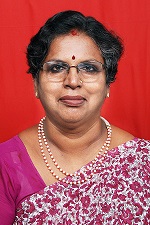
MRS.R.RAJAMMAL,B.Sc, MA.M.Ed. (Kehtorai Rajma)

A President’s award winning teacher (KV2, AFS, Tambaram) whose name has been recommended for PADMA SHRI

4411

Salutations to the teachers of our glorious nation

“ The mediocre teacher tells.
The good teacher explains.
The superior teacher demonstrates.
The great teacher inspires.” William Arthur Ward

The concept of being a teacher in the Indian context is predominantly divine and socially a source of inspiration. Even from the ancient times, the significance of a teacher has been approved by the vedic order. That’s why we say, “Matha, Pitha, Guru, Devo Maheshwaraha.” Teacher, the guru, is given a place superior to God, the creator Himself. The role of a teacher in Indian society has been recorded and regarded as the custodian of culture, tradition and heritage. Teacher stands as the embodiment of virtue, repository of immaculate kindness and the fountainhead of gentility and generosity. In fact, in no other social system of the world, teachers have been treated with utmost dignity, stupendous esteem and marvelous identity.
A teacher in the school plays a multi-faceted role – responsible mentor, a second parent, a good friend a philosopher, a guide and a true counselor. In this electronic era where the students become ultimately restless due to various pressures of life, a teacher becomes the compendium of colossal endurance. A student is like a shapeless raw clay handed over to the teacher with hopes of being beautifully moulded. A good teacher is like a candle who burns to illuminate the way for others. An earnest teacher guides the students their way, but does not escort them to their destination.
Teachers’ Day is celebrated as a tribute to the valuable contribution made by the teachers to the society by imparting knowledge and the enlightening and shaping the carrier of students. Every year on 5th September, we gratefully remember the great educationist Dr. Sarvapalli Radhakrishnan, whose dream was that “Teachers should be the best minds in the country.” Teachers play an influential role in the life of every student. They are like the beacons of light, guiding student’s right from the formative years of their lives. Teachers mould them and in the process of their future, what they learn from their teachers remains with them forever. Teaching gives self satisfaction for the teacher. The entire teaching community should render their services for the upliftment of the student community.
If the triangular bond among the Students, Teachers and Parents is strong and meaningful, then the nation’s future is secured.

Tidbits

[Reproduced]

Badaga Inspiration

I love watching the Badaga dance in Coimabatore. Two years back when Amma last was here, and again during Amma’s 53rd birthday celebrations in Amritapuri, they also enchanted the crowd – inspiring westerners, students, and Ashramites to join in . The same happened again this year. Young and old, men and women. Their rhythmic movements, graceful flowing hands and bodies, the beating of drums and call and response voices calls to the dancer inside us. It’s so primal, so natural, and so beautiful. 

One wonders how long these people have been dancing like this – how far back in time? How wonderful that India has been able to preserve these
timeless traditions.

For a while, I was content just taking photos, or watching from the sidelines – focusing on their movements. But I found my inner self wanting to join in. I stood there – conflicted – trying to overcome my inhibitions – people would look at me – a westerner in white awkwardly throwing his body around. But then some westerners did join in, the Badaga happy to show them the movements even as they were ‘throwing a wrench’ into the coordinated movements of those already dancing.

Still, I stood by the sidelines. Then, at the end of the first night, as Darshan ended, and the Badaga still playing, Amma Herself stood up to leave the stage – and made a full circle – turning round with the beat, no inhibition, no concerns. Just dancing…..

The next day, I knew the Badaga would be there again. Would I join in?

Around 2am, they were singing and dancing again. Again, I stood by the sidelines, thinking about how Amma was so natural, innocent when She danced. I recalled how Amma says it’s just not enough to stand at the shore of the ocean and just get your feet wet. You have to dive in. I recalled how I overcame my fears when I used to go firewalking (walking on hot coals) – I would stand there trying to convince myself that it would be fine. It just takes a leap of faith…

In a moment of surrender, I joined the line. I found myself behind a Badaga man who was more than happy to call out the movements and changes as we made our way around the circle. I loved it. At times, it was awkward, but once I got the jist of it, it seemed so natural, so beautiful. When we were in synch -hands, legs, arms, – it was so nice – like a huge drum circle when they reach that magical moment when all the drummers are connected and the music just flows. So did our bodies-around and around, faster and faster.

I can’t wait till the next time..

Sri Pati, USA
Coimbatore, 23 January 2007


Enna Alli Mutta Beda…

A couple of days back I received the following email  from David McCreedy :

I’m looking for translations for four sentences in Badaga to add to my web site:

Currently the site lists over 500 languages in their own writing systems, everything from Afrikaans to Zulu, ancient Egyptian hieroglyphics to Braille.

I realize this request is rather odd…  Please let me give you some background:  My best friend from college has, since graduation, traveled extensively for her employer.  So much in fact that she JOKES she only needs to know four phrases in the local language to get by:

1)  Where is my room?
2)  Where is the beach?
3)  Where is the bar?
4)  Don’t touch me there!
I am hoping that you can provide me with translations preferably using the native/normal writing system for the language as well as the Latin alphabet.
I will appreciate any effort you can make. Thank you,

And here is my reply :

Your email to me. Quite interesting. Here are the Badaga – equivalents –
1)  Where is my room? – Enna Roomu ellie? என்ன ரூமு எல்லி?
2)  Where is the beach? – Beechu ellie hadadhey? பீச்சு எல்லி ஹடதெ?
3)  Where is the bar? – Baaru ellie hadadhey? பாரு எல்லி ஹடதெ?
4)  Don’t touch me there! – Enna allie mutta beda! என்ன அல்லி முட்ட பேட!

You can ‘see’ the Four Essential Travel Phrases at http://www.travelphrases.info/languages/badaga.htm

~~~~~~~~~~~~~

<strong>~~~~~~~~~~~~~~~~~~~~~~~~~~~~~~~~~~~~~~~~~~~~~~~~

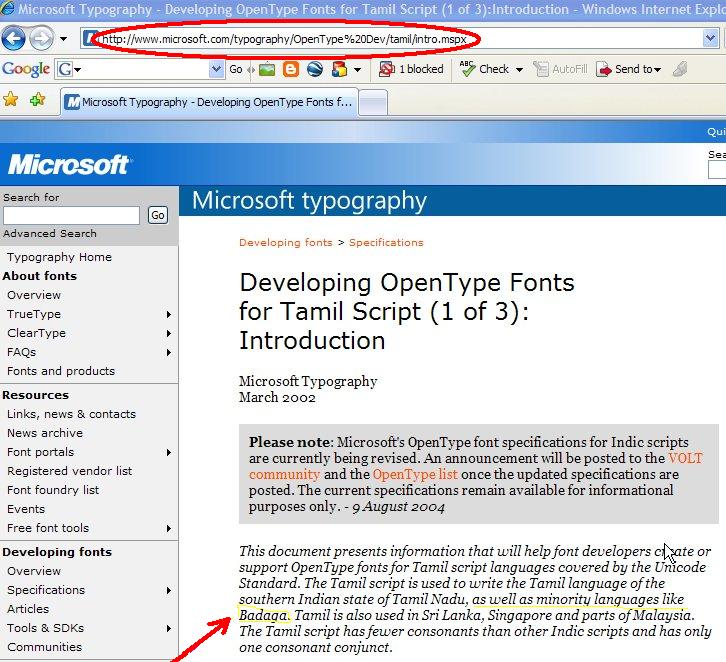
Microsoft on Badaga Language….

ms-onbadaga.jpg

@@@@@@@@@@@@@@@@@@@@@@@@@@

Limerick on Badaga

[found on the net]

screenshot.jpg

___________________________________________

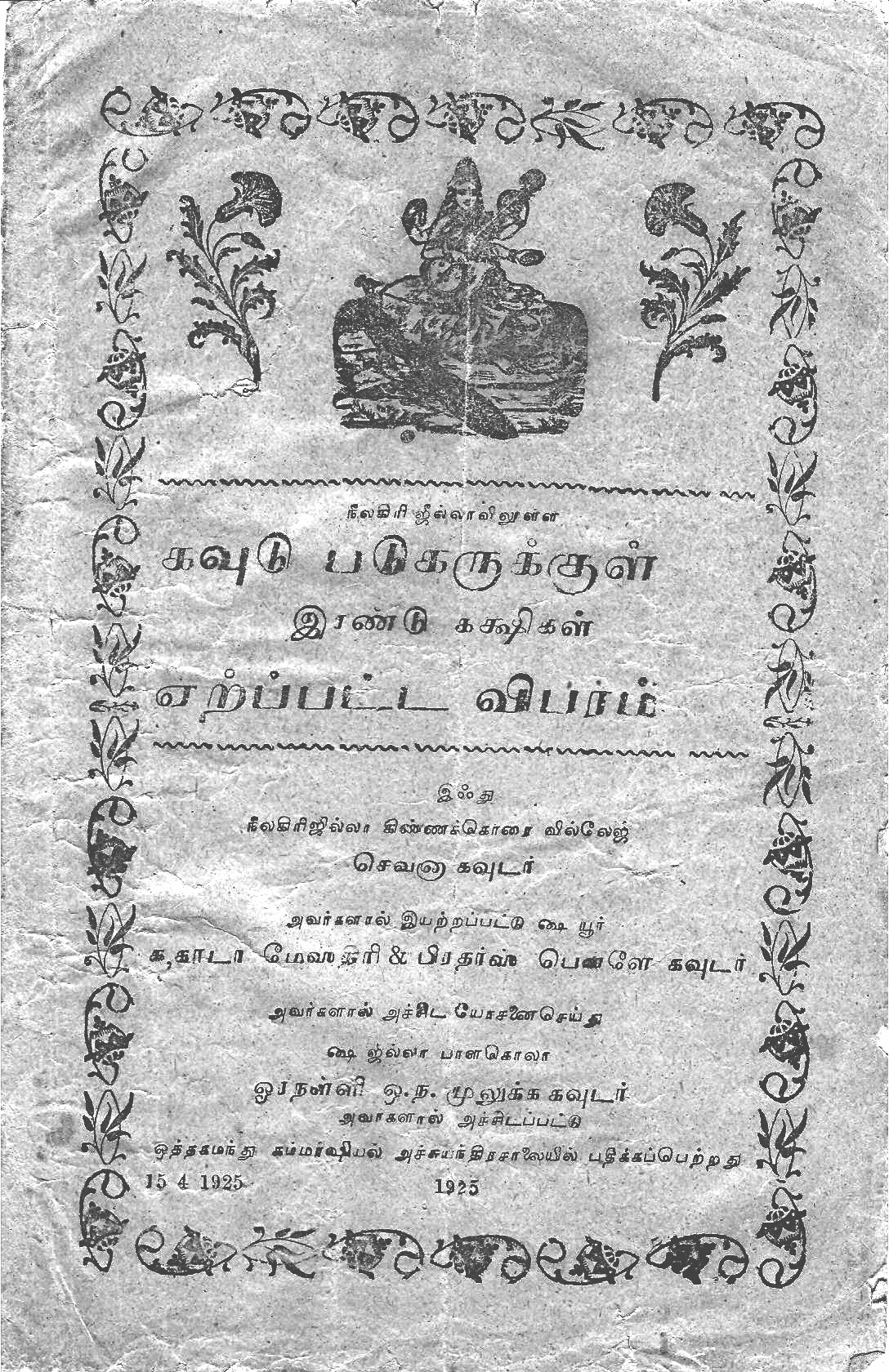
This must be the first book(let) published in 1925 about a very pressing and serious problem that split the Badagas vertically

[Original Cover page in Tamil ]

firstbadagapublication.jpg

firstbadagapublication5.JPG

[English translation interposed]

~~~~~~~~~~~~~~~~~~~~~~~~~~~~~~~~~~~~~~~~~~~~~~~~

I came across this interesting article while searching about Badaga music that goes with the unique dance form,

[H]ethai amma in Kovai [by Sakshi]

Seventy kilometers north of Coimbatore, in the Nilgiris hill town of Ooty, resides a community of people known as the Badaga. The Badaga trace their ancestry back to Ethai Amman, a pious woman from Mysore who fled the city when a Muslim king wanted her as his prize. Theirs is a somewhat cloistered community, stretching across some 500 villages in the Nilgiri Hills, which make the border of Kerala, Tamil Nadu and Karnataka.

The Badaga have their own customs, codes, traditions and language. Dharma, faith, compassion and service—these are the hallmarks of the Badaga. They will proudly tell you that one will not find a single beggar among their “brothers and sisters” and rarely are any of their children born handicapped. (They attribute both of these to their culture, which nurtures service-mindedness.)……

…..A central element of Badaga culture is music and dance. When inspired, the Badaga will spontaneously begin improvising melodies and lyrics. “It is our way of expressing our fondness for someone,” explains Smt. Sivagami, [a Badaga teacher].

Their often-ecstatic music comes in the form of call-and-response, and some say the Badaga even have a form of telepathy, which enables them to improvise cohesively. The words and melodies are ever new, but the dance steps remain the same, regardless of the occasion. The Badaga sing and dance at weddings, births, funerals and nearly all other occasions……..

The music was an onslaught of drums and cymbals. It was an earthy, powerful and glorious ruckus to which the Badaga’s synchronized slow-motion dance served as a stirring and poignant counterpoint……

Read the complete article here

<><><><><><><><><><><><>

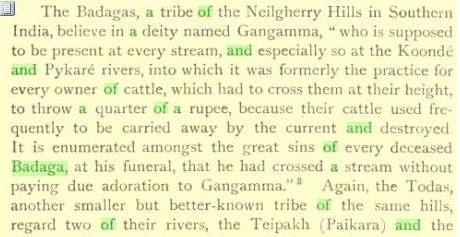
GANGAMMA

[from the book FOLK-LORE IN THE OLD TESTAMENT]

by James George Frazer – 1918

The Badagas, a tribe of the Neilgherry Hills in Southern India, belieive in a deity named Gangamma, “who is supposed to be present at every stream, and especially so at the Koonde and Pykare rivers, into which it was formerly the practice for every owner of cattle, which had to cross them at their height, to throw a quarter of a rupee, because their cattle used frequently to be carried away by the current and destroyed. It is enumerated amongst the great sins of every deceased Badaga, at his funeral, that he had crossed a stream without paying due adoration to Gangamma.

gangamma.jpg

Crossword in The Hindu about BADAGA

In ‘The Hindu’ newspaper of June 17,2008, crossword No.9252 carries the following clue for a six letter word for 5 Across:….. ” SHEEP’s CRY CAPTURES GADABOUT, A TRIBAL (6)”….. Yes. your guess is correct. Sheep’s cry is ‘BA’….. [Of course, as usual the answer to the crossword 9252 was given the next day June 18, 2008 in crossword no.9253]. Info Courtesy – my wife who is more fond of crosswords and sudoku than me – sob sob !! ….. See the crossword here !

No articles, images and other material in this website can be reproduced without the written permission of
Wing Commander Bellie Jayaprakash B.E.(GCT,Madras Univ).,M.B.A (FMS, Delhi Univ)
Contact : bjaypee@gmail.com
belliejayaprakash©2014

:::::::::::::::::::::::::::::::::::::::::::::::::::::::::::::::::::::::::::::::::::::

Happy Birthday, Hethey [Grandma]!

2nd September,2014

Idyammal Bellie Gowder

Mom, you would have been 104 years today and we would have celebrated your birthday in style.

Your children and grand children would have called from all over the world to wish you Happy Birthday – a daughter from Kundey Kettchigatti, another daughter from Chennai/Madras, grand son from South Africa,  a grand daughter from Ooty, a grandson from Bangalore, a grand daughter from Australia, another grand daughter from New Delhi….. and from many other places

Your sons and daughters in law would have celebrated the day with you along with a Birthday Cake brought in by another grand daughter from Coonoor and her son/your great grandson would have bowed his head and said,’Somee hethey, harachu’. You would hold him and blessed him as you would have blessed us all, ‘Somee, harachava kottu, sogava kottu , hoppa edey bappa edey ella olliththay aagali’ / Oh Almighty, give them health and happiness and , let there be only good things wherever they go‘.

You would have in typical style said with a smile ” ennu aesu kalaththa ebbadhu – how long you want me to live?

And, suddenly one night, you chose to leave us WITHOUT REALLY SAYING ‘Hoyittu Bannu – good bye!’

You were everything for us in all those glorious 99 years and 10 months when you were ‘here’. Your blessings still guard and guide us in all our endevours.

We miss you , Mom / Hethey

Elle idhale’yu engava harachu

[Bless us all from wherever you are]

MOM 5.jpg
Idyammal Bellie Gowder
Born September 02, 1912
Hubbathalai, The Nilgiris
Died July 13, 2011 (aged 99 years 10 months)
Parents Rao Bahadue HJ Bellie Gowder and Nanji Hethe
Sister of Rao Bahadur HB Ari Gowder
Spouse B.K.Bellie Gowder [Bearhatti]


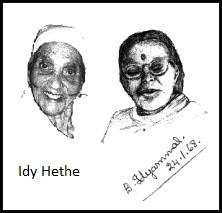
[A pencil sketch of Mom by  son JP in 1968 while she was reading an issue of Femina]

<

p style=”text-align:left;”>~~~~

Rajma

|[President’s award winning KV Teacher]| comments :-
Memories of this great and royal lady will remain eternally in the hearts of all who have known her. Happy Birth Day Hethey. Brilliant eyes and flawless smile. She looks stunning in photograph.Blessed are her children ,grand and great grand children who live around the world..

Badaga Chant – “Eay, Ah How” – [ ‘Athikkodhu’]

“Eay, Ah How” – Badaga ‘Athikkodhu’

The beauty about Badaga community is not only the unique customs specific to the community but the steadfast belief with which atleast some of them are followed by Badagas with fervour. one of them is the loud chanting of ‘Athikkodhu – saaying of EAY AH HOW – on certain but specific occasions.

Three occasions come to mind immediately,

1)During “hethay Habba’ – both when from every village the devotees go to Hethay temples at Beragani and Peddhuva as well as when the Hethay deity is taken to ‘Madi Halla -river’ for change into new dress once a year [and also whenever is a temple deity is taken on procession during habbas in hattis],

2)during weddings when the bride and groom are brought to the ‘Madhuvay Mane – wedding house,and the newly weds are taken to the temple and

3)on funerals when the widow is brought for ‘olay Kattodhu’ and the ‘akki eththuva ‘ procession starts from the ‘dhodda Mane’ to ‘saavu hanay ‘ where the corpse/body is kept before being taken for burial.

This loud ‘cry’ is made from the bottom of the stomach by a few leading the procession and repeated by the rest following them.

Listen to ‘Saavu Aathikkodhu’ recorded live in Ketchigatti here
http://soundcloud.com/bjaypee/athikkodhu-saavu

Listen to ‘Maduvay Aathikkodhu’ recorded live in Thambatty here http://soundcloud.com/bjaypee/athikkodhu-madhuvay

Badaga Songs on the web

Badaga Panjayats…?!

In the olden days, Badagas lived a very simple but highly cohesive life. Evey village -hatti, consisted of one or two ‘families or Kudumbas’. Each kudumba, as the name indicates, consisted of brothers and they usually lived in the same street – ‘thara’. The ancestral home was given to the youngest son and, due to space constraints, the elder brothers moved out to build separate houses.
 
The youngest son  [when married] was expected to take care of the elderly parents. The sister(s) married off to other hattis were always welcome to the parents house and for the children of the these females, their parents house was a source of great safety and security and the brother’s house was a sacred house known as ‘GURU Manay’. Though the property was given ONLY to sons, the married daughters could come back to the parents house anytime in case of any matrimonial discord. The daughters were given all the respect and they never felt neglected. Mind you, this was a time when girls were married off at a very young age and in most of cases, not educated.

Every family lived a contented life with total cooperation. This, of course, was the time when the undivided Hindu family wealth and property was given to only sons in our Country.
 
But all that changed over time. Material lust took control over conventional matters. The daughters, more often than not, were not welcomed by the brothers (generally due to their wives pressure). This combined with lack of education and absent of other alternatives, forced many daughters to suffer in silence. If they had children and a wayward husband who indulged in wasteful life with drinking being an eternal curse, the life was not only miserable but unbearable. Like in all other communities in our great country, the girls were forced to live a condemned life.

This is the time visionaries and forward looking Badaga leaders like Rao bahadur Bellie Gowder and his son Rao Badahur Ari Gowder high lighted the impoetance of education, the former built the first school along with a hostel that provided free education to Badaga boys and the latter insisted that the girl child should be educated and equal rights and property be given as the boys among Badagas. Empowering women. Now, even the laws in our country has been amended wherein the boys and girls have equal rights on the property of the parents.
Sadly, even in this day and time, in many hattis, the property is recommended to be given ONLY to sons by the so called hatti ‘elders’ in what can be termed as ‘kapp’ panjayats to sort out property disputes. As you may be aware KAPP panjayats are popular male dominated forums in Hariyana and wester UP who had given the ‘OK’ for honour killings, acting as extra constitutional authorities and are in trouble as Supreme Court is looking into their actions.

The problem is, in olden days a complaint was made to the common wisdom of hatti elders when the disputes could not be solved within the family – Kudumba. The Badaga proverb – doddaru shloka – ‘manay ya maathaadi, mandaga hogu’ aptly describes this. Also, in olden days, the options of going to the court or seeking remedy through legal channels were not easy. Tthe ‘core committee’ of elders looking into complaints was made up of non partisan, experienced and where available educated people and their rulings were acceptable to all.
 
These days, in most of the hattis the ‘Gowda’ chosen is the one who does not have a permanent or regular job as he has to attend to a lot social functions both in his as well as in other hattis.  Other members of the ‘problem solving’ group are youngsters selected for collection of tax – wari and to organise temple festivals – habbas etc. By no stretch of imagination, they can can be considered as competent or qualified and least of all experience which is a must.

And, most importantly, when it comes to property allocation to daughters, how can these panjayats go against the law of the land? The feeble argument that only a son can be called a ‘WARISU’ is blatantly brutal, one sided, gender biased and ‘anti-female’ like many other social issues in our society.

|*|*|*|*|*|


For a change – to relax on a weekend

Can you crack these codes and find out the ‘hidden messages’?

Yes, it is better to stand on your head and clear all DO(ub)TS ?!


Art in WORDS or Words in ART ? !

Original works of ‘ Bellie Jayaprakash ‘ [No reproduction permitted]


~~~ A picture is worth… a thousand words ~~~

Photos by Bellie Jayaprakash ©2014

Dhoddaru Shloka – Badaga Proverbs

One of the fascinating and interesting aspects of Badaga [both people & language] is the free use of delightful but deep meaning proverbs called “DHODDARU SHLOKA”. When you engage an elderly Badaga into any conversation, you are sure to hear a lot of these proverbs thrown in to make / emphasise a point. Prof. Paul Hockings, probably the most authentic researcher on and of Badaga lists nearly two thousands Badaga proverbs, 1730 to be precise. He feels that 1730 could be a complete figure containing all the proverbs there are. See his book,’Counsel from the Ancients: Study of Badaga Proverbs, Prayers, Omens and Curses’. He has given the meaning in English as well as making it easy to understand, in a beautiful manner.

Though I find his collection extremely interesting and educative, I do not agree with some of the conclusions he draws on certain proverbs. For example, on the proverb, ‘Odhidhama Niddhana, Oddidhama Erandina’ Prof.Hockings interpretation is quite different to what I feel is the correct meaning. I think ‘a person who spends time learning and ponders (over a problem) is better than the one who runs away (in a hurry) and thus trips over. [Odhidhama – one who has learnt (spent time learning), Niddhana – stops to ponder over[think], Oddidhama – one who runs, Erandina – trips over]. We can hear mothers telling their young children ‘Oda beda , Erandire’ – Donot run, you will trip over (a stone or any obstruction). That is ‘ do not be in a hurry and take a hasty decision’.

Another one is ‘Michidhavaga Morande Kolu Bangara’. In my opinion . the lady who does not listen to any one (Michidha Hemmathi) is bound to land up as a widow (when ‘Morande Kolu – a small stick of morende tree – replaces her jewellery (bangara) during the Ole Kattuva ritual of husband’s death / funeral ceremony). Prof.Hockings feels Mechidhavaga (see the difference between michidhava – one who does not listen- and mechidhava – one who is appreciated by all – even a morende kolu is enough as jewellery. Is it a case of wordplay (pun) by our ancestors??

I have listed a few of the proverbs below and hope to add more in future.

[Sources : Interaction with Fellow Badagas, ‘Naakku Betta’ monthly (1979) –Edited by K H Madha Gowder, Achanakal, Ketti Post , ‘Naakku Seeme’ monthly – May 2006, Edited by K.M Nanjan, Kil Cowhatty Village, Muthorai Post,

Counsel from the Ancients: A Study of Badaga Proverbs, Prayers, Omens and Curses By Paul Hockings]

Continue reading

Echo of First World War in the Nilgiris

Dharmalingam Vengopal [Nilgiri Documentation Centre, Kotagiri]

dv2dv 1

As the centenary of the First World War is being solemnly observed world over, the beautiful BEM Neethi church on the slopes of splendid Kalhutti valley in the Nilgiris also silently observes its centenary as a victim of the global war.

The Basel Evangelical Mission (BEM) was established in Basel in Switzerland in 1815 by German and Swiss missionaries who worked in Africa, China, South East Asia and south India. Their work began in 1834 in the Malabar area and spread to Karnataka and south Maharashtra.

Basel Mission came to the Nilgiris in 1845 at the invitation of retired judge G.J.Casamajor who donated his entire property at Ketti to the mission. The first missionary to arrive was Michael Buhler, a gifted linguist, who was the first to document Badaga folklore including the Badaga forefather sayings and ballads. He was the first to put, ‘Badaga language and culture on the scholarly map’. Buhler died young at the age of 37. Several  Badagas attended his burial at St. Stephen’s church at Ooty where Judge Casamajor was  also buried.

‘Thanks to the missionaries, many Badaga villages have had primary schools for longer than thousands of comparable small communities in Canada, the United States, South Africa or Australia’ says Prof.Paul Hockings, an authority on Nilgiri studies.

Exactly one hundred years after the mission was founded its missionaries were unceremoniously sent out of India and their properties confiscated as ‘enemy property’ after the outbreak of First World War in 1914.

dv3

The BEM Neethi Church stands a mute witness to the global war which had its echo as far as the peaceful Nilgiris.

Baduga or Badaga – which website ?

Baduga or Badaga …well both are the same!

While, http://www.baduga.co has more plugins that allow greater flexibility with animations and easier accessibility & ‘ad’ support [since it is based on wordpress.org], http://www.badaga.co [based on wordpress.com] is updated with the ‘latest’ on and of Badaga almost on a daily basis.

For a quick update and ‘faster glance’ visit www.baduga.co

badugaDOTco~~~~~~~~

You can easily access the websites that is

‘ALL ABOUT THE BADAGAS OF THE BLUE MOUNTAINS’

in your smart phones and read/see the posts/pix !

In excerpts that can be expanded !!

Take a look !!!

The websites www.badaga.co and www.baduga.co are  ‘mobile friendly’ !

Join In the Nation Building

One of Prime Minister Modi’s initiatives ‘MyGov’ is to make the citizens to be a ‘part’ of Nation Building’.

Let us Join In to make this country the best

MyGov –  ‘The citizen-centric platform empowers people to connect with the Government & contribute towards good governance’.

Click here

~~~~~~~~~~~~~^^^^^^^^^^^^^^^^~~~~~~~~~~~~~