‘Kurinji – Nilgiris’ by the famous photojournalist Raghu Joghee
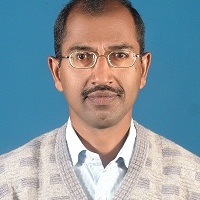
Raghu Joghee from Yedapalli Hatti and is personally known to me. He is simple, humble but a great person. He is actively involved in promoting for Badaga Tribal status along with Ganesh Ramalingam. – Wg Cdr JP
The village of Kattae-bettu, nestled in the Nilgiri Hills of Southern India, holds a name deeply intertwined with the natural world and the cultural heritage of the indigenous Badaga community.
The etymology of “Kattaebettu” is derived from “Kattae Hu Bettu,” a phrase that directly
references the unique and ephemeral Strobilanthes kunthiana flower, commonly known as Kurinji or Neelakurinji. This rare bloom, which blankets the hills in a vibrant purplish-blue hue once every twelve years, has profoundly influenced the Badaga people’s traditions, calendar, and sense of place.
The Kurinji Flower and its Significance
The Badaga community, an indigenous group primarily residing in the Nilgiri Hills, the Kurinji flower is more than just a beautiful plant; it is a significant marker of time and a symbol deeply embedded in their cultural fabric. The twelve-year flowering cycle of the Kurinji has historically served as a natural calendar for the Badagas, influencing their agricultural practices, social events, and even their oral traditions.The blooming of the Kurinji signifies a period of renewal and abundance, often associated with specific rituals and celebrations within the community.
Kattaebettu: A Name Rooted in Nature
The name “Kattaebettu” is a testament to this profound connection.”Kattae Hu Bettu” can be broken down to understand its meaning: “Kattae” likely refers to a specific type or characteristic of the flower or its growth, “Hu” means flower in Badaga and other Dravidian languages, and “Bettu” signifies a hill or mound. Therefore, “Kattaebettu” can be interpreted as “the hill of the Kurinji flower” or “the place where the Kurinji flowers bloom.” This naming convention is common among indigenous communities, where geographical features are often named after prominent flora or fauna, reflecting their intimate knowledge and reverence for their environment.
Cultural Influence on the Badaga Community
The influence of the Kurinji flower extends beyond the naming of a village. For the Badaga community, the cyclical blooming of the Kurinji has been integrated into their oral histories, folk songs, and traditional knowledge systems. Elders often recount stories and prophecies linked to the flower’s appearance, and its bloom is sometimes associated with specific agricultural cycles or even significant historical events within the community,
(This article was written in 2008/2019. I am adding a separate post on the Badaga script developed by Kadasolai Yogesh Raju, which has a wider acceptance. In that post I have mentioned about how to install his script/fonts in the system and use it – Wg Cdr JP}
It has always been felt that for a language to survive, it should have its own script. It cannot remain only as a spoken language for long. But of course, the script need not be peculiar and specific one pertaining to that particular language.
So too is the necessity of a script for Badaga. Many have attempted to achieve this objective with various degrees of success. But unfortunately, to my knowledge, no records exists, if any.I am no expert on phonetics or languages or much less innovating an unique script. But the urge to have a separate script has convinced me that it is very much possible to ‘ADOPT’ an existing script and ‘ADAPT’ it to Badaga language.
Three languages/scripts come to mind straight away – Tamil, English and Kannada. Tamil – because a majority of us know how to speak and write due to the simple fact that we belong to Tamil Nadu, English – since most of us choose to learn as well as put our children in English medium schools and Kannada – due to the fact that Badaga is more akin to Kannada than any other language [though I firmly beleive that Badaga is a separate language on its own merit and not a dialect of Kannada].
But when trying to choose a script for Badaga, Kannada script is ruled out for the basic reason that most of us do not know the language or familiar with the script and no scope to learn it in our schools in the Nilgiris.Hence the choice between Tamil and English. Badaga ,like many other Indian languages, has very definitive and distinctive sounds/words [I do not know the exact English equivalent] that distinguishes one word from another. Even a small change in pronunciation could result in an entirely different meaning in Badaga. For example,a subtle change in context of the word ‘BAE [bay]’ could mean mouth, bangle, lentil, crop etc. Bella [jaggery] or BeLLa [ a male name] are two entirely different things. So are ‘kallu – stone’ and ‘KaLLu – a drink’.So, what could or should be the choice?
In Tamil script we cannot differentiate ‘K’ from ‘G’ or ‘T’ from ‘D’. This makes a huge impact when Badaga words are written in Tamil script. ‘Gaasu – potato’ is totally different from ‘Kaasu – coin, remove’. Or ‘Ettu – eight’ and ‘Eddu – getup’. Another drawback could be the absence of ‘Ha’ in classical Tamil. On the other hand, in English, we cannot clearly bring out the difference of ‘na’ from ‘Na’ [anna – food, aNNa- elder brother] or ‘halli – lizard’ from ‘haLLi – name, village’. ‘Kalla – a male name’ sounds the same as ‘ kaLLa – a thief.
Yes, it is indeed a little tricky to choose between Tamil and English. But, taking into consideration the younger generation who are going to be the future hope and the irrefutable fact that they are all more familiar with English than Tamil, the choice is English.Keeping in mind the successful adaptation of English script for Malay language (Malaysia) I would plump in for English. With a few minor modifications to overcome the grey areas mentioned above, English script can be easily used in Badaga.
Remember Devanagiri (Hindi) is the script for Nepali.The ‘minor’ modifications that can be undertaken to overcome the drawbacks I referred above could be by using an extra ‘a’ – thus milk can be written as ‘haalu’; ‘dhadi – stick’ can be different from ‘dhaadi – beard’. So on and so forth.We may use ‘capital’ letters to differentiate between ‘bella and beLLa’ as I have done above.What if a complete sentence is in capital letters ? – We may use ‘bold’ letters or underline the words to give the emphasis.Innovative use of – ‘ – [apostrophe] can bring out the difference between “soppu – green ” and “so’ppu – soap” or “kodi – flag” and “ko’di – crore”.
It is said that Indians [read Badagas] will reject 50% of anything without even hearing it, another 50% without understanding it; and if ‘anything is left behind they reject it just for the sake of rejecting it. Like what is happening in many hattis with ‘young gowdas’ ruling the roost.
BUT, ALL YOU TRUE BADAGAS – LET US START SOMEWHERE TO HAVE A SCRIPT FOR OUR LANGUAGE. IMPROVEMENTS AND INNOVATIONS CAN FALLOW. IF MICROSOFT CAN ACCEPT BADAGA AS AN UNIQUE LANGUAGE , THERE MUST BE SOMETHING .SARI THAANE?
How the numbers are mentioned in various South Indian Languages is given below. This is from the :WWW -> NET : What I am trying to highlight is the use of English script !?
For numbers in more than 5000 languages go to zompist.com
BELLE BENGUVE – GARLIC [in whatever language you say, is always good for health – though may not be for “LOVE”]
Notice : belle[white] is written as be!!e at the end Sanskrit लशुन laśuna yields Hindi लहसन lahsan, Urdu لہسن lahsan (but also سیر sīr from Persian), Nepali लसुन lasun, Marathi लसूण lasūṇ, Bengali রসুন rasuna, Gujarati લસણ lasaṇa, Oriya ରସୁଣ rasuṇa, Punjabi ਲਸਣ lasaṇ, Konkani लोसुण losuṇa. Tamil has வெள்ளைப்பூண்டு veḷḷaippūṇṭu ‘white herb’, less commonly வெள்ளுள்ளி veḷuḷḷi, like Malayalam വെളുത്തുള്ളി veḷuththuḷḷi and Kannada ಬೆಳ್ಳುಳ್ಳಿ beḷḷuḷḷi ‘white onion’, and வெள்வெங்காயம veḷvengkāyam, like Badaga beḷḷe benguve ‘white onion’. Sanskrit लशुन laśuna yields Hindi लहसन lahsan, Urdu لہسن lahsan (but also سیر sīr from Persian), Nepali लसुन lasun, Marathi लसूण lasūṇ, Bengali রসুন rasuna, Gujarati લસણ lasaṇa, Oriya ରସୁଣ rasuṇa, Punjabi ਲਸਣ lasaṇ, Konkani लोसुण losuṇa. I wanted to include a choice quote from The Bower Manuscript (better description in this review of Hoernle‘s publication) on the Origin (and folk etymology) of Garlic (quoted in English in The Book of Garlic from an article by von Strubing in Ernährungsforschung), but even the inexpensive Indian edition is a bit steep. So if I manage to track it down, it can be part of the next garlic post. Tamil has வெள்ளைப்பூண்டு veḷḷaippūṇṭu ‘white herb’, less commonly வெள்ளுள்ளி veḷuḷḷi, like Malayalam വെളുത്തുള്ളി veḷuththuḷḷi and Kannada ಬೆಳ್ಳುಳ್ಳಿ beḷḷuḷḷi ‘white onion’, and வெள்வெங்காயம veḷvengkāyam, like Badaga beḷḷe benguve (வெள்ளெவெஙுவெ?) ‘white onion’.
As far as the English script used to show Badaga, I am giving below two examples of 1) the UCLA Phonetics Laboratory [for over half a century, has collected recordings of hundreds of languages from around the world, providing source materials for phonetic and phonological research] and 2) Prof.P Hockings ,From the UCLA Phonetics Lab Archive
(The unicode entry tool was developed by the Linguist List. To obtain it for use in other web pages click here)
Entry
Badaga
English
(Note on transcriptions: rhoticity (e.g. i˞, e˞, etc. ) indicates half-retroflexion; underdot (e.g. ị, ẹ, etc. indicates full retroflexion)
Badaga is a Southern Dravidian Language (Tamil-Kannada branch) spoken by approximately 250,000 people in the Nilgiris hills in Southern India. There are several dialects, only the most conservative having the complete set of contrasts illustrated here.
>Badaga has five vowels /i e a o u/ , all of which can be contrastively half and fully retroflexed.
Half retroflexed vowels are indicated by the diacritic for rhotocity :[a~], fully retroflexed vowels with a subscript dot [a]
This is how Prof: P Hockings depicts the Badaga Words in English script
Some more thoughts on adopting English script for Badaga
Picking up from what Prof.Paul Hockings has mentioned – rather the unicode[?] used – in the example shown here from his book Counsel from the Ancients: Study of Badoga Proverbs, Prayers, Omens and Curses (page 54. Outline of Badaga Language – 2.1.2 Vowel Contrasts ) , I am suggesting a simple and straight forward work around.
The words ‘to stand’ & ‘paddy’ are written as ‘nillu & nellu’ . No problems with that.
But ‘whistling’ & ‘to cook’ are written as ‘bi:su & be:su’ . My suggestion is use ‘beesu & baesu’ as they are pronounced.
(FootBall is FUTBAL and Photo is Foto in some languages that go by the pronounciation and thus making it easy).
‘To wander’ ‘suttu’ is used. But to me ‘suttu’ sounds more like ‘to burn’ . I would suggest ‘suthu’ for wandering. [ ‘SUTHUGAL or SUTHUKAL’ sounds familiar, is it not?]. Same thing for ‘property’ – ‘sothu’ ‘ instead of ‘sottu’ which sounds more like ‘sottu’ – ‘drop’ .
To blow ‘oodu’ – udu’ sounds and looks better than ‘u:du’ and ‘odhu’ instead of ‘o:du’ which to a novice like me is ‘run’ or ’tile’ – ‘odu’ .
‘To shine’ – it could be ‘michu’ instead of ‘miccu and ‘muchu’ instead of ‘muccu’ for covering. ‘Muccu’ sounds or looks more like ‘mukku’ – to gobble or swallow .
‘hennu’ [ ‘girl’ ] could be written as ‘heNNu’ [girl] and ‘hannu’ as ‘haNNu’ to bring out the emphasis on ‘N’.
‘nadu’ for ‘middle’ or plant is OK but for ‘country’ it could be ‘ naadu ‘ than ‘na:du’ .
Similarly, my suggestion : – for ‘now’ – ‘ ‘eega’ , ‘bamboo’ – ‘oede’ , ‘village’ – ‘ooru’ ‘
The main and only creteria should be the ease of use and understanding and yes, without the use of , what I would like to term as, ‘dots’ and ‘quotes’.
(I would like to repeat that I am no expert on languages and no intention is implied to hurt the purists and followers of UNICODE etc]
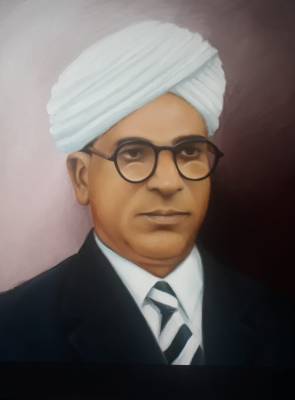
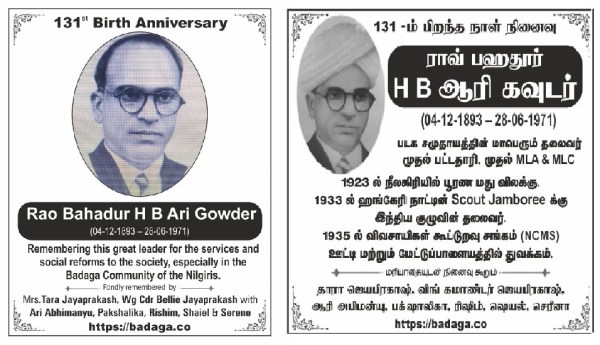
Rao Bahadur (Hubbathalai Bellie Gowder) ARI GOWDER, was the greatest leader of the Badaga tribal community so far. Apart from being the first Badaga graduate, MLA & MLC from British days, leading the Indian Contingent to World Scouts Jumboree in 1933 at Budapest, Hungary, established the Nilgiris Cooperative Marketing Society (NCMS) in 1935 at Ooty and Mettupalayam to save the innocent farmers, especially the Badaga pototo & vegetable growers, from the exploits of middlemen and traders.
(04 Dec 1893 – 28 Jun 1971)
Rao Bahadur Ari Gowder bought about six acres of land with his own money and efforts in early 1930s, now worth hundreds of crores of rupees, in the main area in Ooty, In the branch at Mettupalayam, rooms were built near the NCMS complex for the comfort and stay of farmers going to Mettupalayam to sell their produce. He remained as the President of NCMS till his death in 1971.
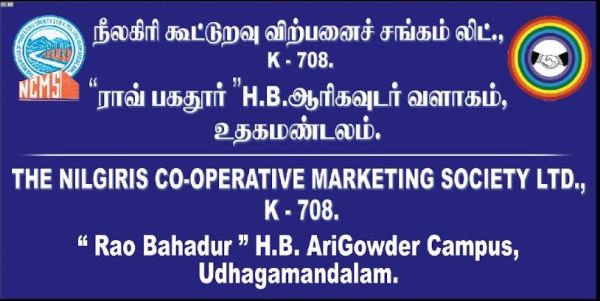
After consistent request from the public, especially the Badaga Desa Party Founder Leader Manjai Mohan, the NCMS & District authorities have named the Campus as Rao Bahadur H B Ari Gowder Campus,
Rao Bahadur H B Ari Gowder’s 131st Birth Anniversary is being celebrated on 4th December 2024
A lot of young friends who visit this website ( truly humbled and thrilled that there are more than 627,000 hits – JP) ask me whether there are any books to 1) learn Badaga language and on 2) Badaga Dictionary.
There are some books on Badaga Language and you can find the list on the page ‘Books on Badaga‘ .
Prof.Paul Hockings
Christiane Pilot-Raichoor
Prof.Paul Hockings has brought out ‘A Badaga English Dictionary‘ way back in 1992 along with (late) Christiane Pilot-Raichoor.
Prof.Paul Hockings informs me that the book A Badaga – English Dictionary was published in 1992, and is 865 pages long. Moreover the fully revised expansion of it is now ready for publication, and will be about 1000 pages long. A shorter and cheaper Student Edition is also planned (13 Feb 2019)
I understand that Nelikolu Trust is bringing out a Badaga – Tamil – English (authored by Dr.Haldorai) soon. It must be very interesting since Tamil, understood by many Badagas, is included.
Sir, I used to mail you 4 to 5 years back. My father is in Army[Subedar Major].I wanted to ask you is there any translation of the book – “History of Hethey Amman“, either in English or if possible in Hindi.
Then sir, I am really happy to see your interest towards our community.Really it feels good to see such an interest and effort.Hope this effort will try to reveal the feelings that we teens have towards our community. Visiting the site after so many years it feels as if it is your obsession.Please don’t let this obsession get dormant.We youngsters actually need someone to tell our identity and tell us who we are.
Hello Deepak, I am very glad and feel thrilled to see your email. Unfortunately, there is no translation of the booklet on Hethey in English or Hindi.
I feel extremely happy that this website and its contents make youngsters like you to learn about us, ‘tell our identity and tell us who we are‘ as you have beautifully put it. As I keep repeating, ‘there is plenty to learn and know about ‘Badagas, the beautiful people of the Blue Mountains‘.
My motivation to keep going with this website is due to the encouraging words like yours. Thank you very much. – Wg Cdr JP
Many mistakenly claim that Badaga Origin is nothing but Badaga migration from Mysore [now in Karnataka state] during Tipu’s time only because of the name Badaga (meaning northerner). It is very debatable. Unfortunately many Badagas have believed it in the absence of any convincing and conclusive evidence to the contrary. But the latest revelations and links about the language, especially from the epics and writings during the Tamil Sangam period tell a totally different story (see below).
I am firmly of the view that our history is much older- may be a thousand years or more older – and my initial ‘research’ confirms that. There is a lot written about the migration from Mysore theory by many anthropologists, researchers and others. For obvious reasons, most of them are/were ‘outsiders’ – like the early European missionaries and British. The one person who has done a lot to highlight about Badagas, in 1960s, Prof.Paul Hockings has chosen to go along with his predecessors in concluding that since Badaga means north[ner], they have migrated from southern Mysore during Tipu Sultan’s rule over Mysore to avoid being forcibly converted to Islam. Also sited in support of migration is the resemblance/similarity of Badaga (language) to Haleya [old] Kannada.
But, B.Balasubramaniam, a highly educated Badaga, in his book“ Paamé ” – The history and culture of the Badagas of the Nilgiris, feels that Badagas migrated from Southern Karnataka [then Mysore State] about 700 years back, much before Tipu’s time, around 1311 AD during the plundering raid of Malik Kafir.
I am, also, firmly of the view that it is possible that Badagas have lived in the Nilgiris for thousand of years like the Thodas [Thodhamaru ] or Kothas [Kotharu] and migration theory is an attempt by historians and anthropologists to explain away a ‘historical puzzle’. The mystery of migration needs to be solved once and for all.
In his book, THE GOLDEN BOUGH – A STUDY IN MAGIC AND RELIGION (1922) Sir James George Fraser (1854 – 1941) mentioned the following :-
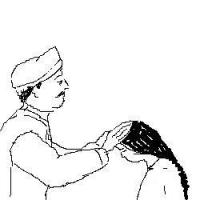
Among the Badagas of the Neilgherry Hills in Southern India, when a death has taken place, the sins of the deceased are laid upon a buffalo calf.For this purpose the people gather round the corpse and carry it outside of the village. There an elder of the tribe, standing at the head of the corpse, recites or chants [known as - "KARU HARUCHODU"] a long list of sins such as any Badaga may commit, and the people repeat the last word of each line after him.
The more I listen to the song 'Kappu Uttileyu', the more fascinated I become. All the 12 Badaga months starting with Koodalu [given in Capital Letters] are beautifully integrated within the song.
Bugiri Music Academy presents Videos/Songs to bring about mindset change to Badagas
Hethegu Dhukkaththa - by Porthy SJ Mani
A great song that describes the evil practice among a few Badagas who despise other Badagas, known as Nattaru, settling in a village which is not native to them but probably have married from that same hatti (Vilage). Great lyrics, haunting music and a video with mainly Thooratti Village people in the cast.
Sholur G Raman is one of the greatest Badaga singers. Gifted with a golden voice, he composes his own songs and adds a lot of punch to the lyrics. His dance number " Mele Kerioge" is the hottest song for atta in any Badaga Function. A great singer and a simplton, music is in blood and has done a a yeoman service to spread Badaga songs far and wide,
Badaga dance is all about grace and style. It is a wonderful sight when a group of ladies dance together. During the funeral, the ladies of the parental village [hatti] of the deceased woman, dance going around the cot [kattalu] to the music provided by the 'host' hatti musicians.
English Translation of the above poem by Bellie Jayaprakash
My Mother
Even when I was down with poverty and sat at the front court yard,
Even when the near and dear ones despised and deserted,
My mother who gave birth, cared for and brought me up,
Did not blame me and did not reject me- her son, as bad
Even when I toiled as a Cooli with a bent back,
Even when I sat down with my looks dulled and dirty,
Even when I wore patched up old clothes,
My mother never said that I was down ; never rejected me as poor!
Even when I entered the stables and cleaned the dung,
Even when I sat on the rock and tendered the cows,
Even when I lifted loads to earn so as to suppress the hunger,
My mother never found any fault ; never scolded me as ignorant.
Dhoddaru Shloka
Some Badaga Proverbs [Dhoddaru Shloka]
~~~~~~~~~~~~~~~
1.Akka Ghandana koda dhukka hegile, Makka maria buttu baa ennana (When
sadness is shared with elder sister’s husband, his advise is to
come to him) 2. Aandama ellade Haandi Beya, Ullama ellade Gulla
beya 3. Kiviga elladadu kombuga aeththaga 4. Guttige [Kuttige?]
bathavu arai aaga beda, kunna thammanu mella aaga beda 5. Kumbala
kaaya [Kumbakkeya] saaki handiga kottenge (Growing pumpkins only to feed wild boar) 6. Gumboonda Mola edda enge [like a hare jumping out of the bush -element of surprise] 6a.Eragi holaga mola hugga enge [ like a rabbit getting into a wheat field -destruction by deceit] 7. Sadiga madi elle 8. Saththu biththa kaaye 9.Saththaduga hinde etha holae eana? (After death, how does it matter where you go?) 10.Saththa Koyee, baththa mukkirava ? (Can a dead hen feed on grains?) 11. Gollaru mada kattida enge 12.
Ghandu gundu, hennu helavu 13. Ghandu kulidu ketta, Hennu thirigi [hisithu] ketta (The boy wasted his life by idling/lazying around
(sitting), the girl wasted her life by smiling (turning around) at strangers 14. Ghanda thoorile, kandamanu thoorina [when the
husband neglects, everybody follows] 15. Ghanda ebbane buddi elle,
buddi bappane ghanda elle (Wisdom did not come when husband was alive, when wisdom came husband was not there) 16. Gana ellade
sande aaga, sangadhi ellade daari sameya (Evening does not end without gossip, way does not end without some news) 17. Koyigu
kothigu maake (Like a hen and a cat [always fighting]) 18.Koy(iy)a Kaethaa maasu arappadhu (Do you ask the hen [being
killed for dinner] for grinding the chilli paste?) 19. Kona neeruga baggiravo, neeru konaga baggiravo [Will the bull bend to
drink water, or, water bends for the bull? -Implying
impossibility] 20. Kothi aatta, eliga prana sangada (The antics of a cat are matters of death to a rat) 21. Kothi kaala baase
denge (Like the cat licking its leg) 22. Savi kanda kothi attalu hathidenege 23. Koduva cooli nodu, kathuva olaya nodu [keep a watch at the wages being paid (and hence get work done) and keep a watch at the burning embers in the kitchen] 24.Kodalia kaavu, kolava kedu maadira 25. Kotta hennu nela arige 26.Kotta saalava kaeyade ketta, bithida holava nodade ketta (Suffering
by not asking the loan to be returned, nor looking after the planted[with seeds] fields) 27. Kai yoge kannaadiya beethindu neerunamoga nodidha enge (looking for the reflection of the face on thewater when there is a mirror in the hand) 28. Kai eelu aaga guddili masiya [the implement not bend as per the shape of bones in the hand] 29. Kaiga bandadu bega elle (What came to the hand did not reach the mouth) 30. Ketta arasa buda beda mikka
kannava eda beda 31. Kulidhu athamaga kulidhu avvu, niddhu athamaga niddhu avvu (Cry sitting with the one who cried sitting
with you, cry standing with the one who cried standing - pay in the same coin- –
proper and equal reciprocation 32. Kuradaga hagalu ena er uena (How does it matter whether it is day or night for a blind
man?) 33. Sandhe jaamana meiyu, saaku hoththu bandha nattan uhoga (The evening rain and the guest who had come with a hessian
cloth[bag] covering will not go easily) 34. Sappodu saare, Haagottudoora 35. Chiikkavanaalayu Sivana buddi (Even though he is veryyoung, has lot of wisdom like Lord Siva) 36. Ollitha ethi hollava
thallu, olagodho ellava gellu (Take only the good leaving behind the bad and win all in this world) 37. Hallana neeru hattaleyu
baavi neeru hechu 38. Thaaya palichileyu neera pallicha beda (Even
if you [have to] show scorn to mother, never do it to water [the
source of life]) 39. Kasa aaleyu rusi maadi thinnu (Even if it
is rubbish, eat it after making it tasty) 40. Natta maneye
hattaleyu, ghanda mane hesara ethu 41. Kicha muttile attira (If
you touch the fire, it will burn you) 42. Hottiya kitcha beethale
kettara 43. Aaru kaasuna sambuva aaleyu, aranmaneya gelacha
maadu 44. Adhista mooru p(b)aala, harakke aaru paala 45. Kitcha
thindama karia Hedana (One who eats fire, excretes charcoal) 46.
Nanga belli holladale thattana koda horatta ena 47. Ghandana
ollithundhu undia dhottadhu ekka beda 48. Maneya nududhu mandhaga
hogu 49. Maathu hetchi mane ketta, bithu hetchi hola ketta 50.
Aadindu holae maathu, agadundu holae mannu [Agadhale mannu, Nudidhale
maathu] 51. Hanja theedhara(theegira) maathu niddara 52.
Thandeya koddamana paadhava hidi 53. Thindhu santhosha aappadhuna,
nodi santhosha aagu 54. Avvaiya halladha nodile magava nodudhuga
mane enaga 55. Huttone anna thamma, hoppane dhayada kaara 56.
Sandhe aappile endhu hoga beda, baaga aappile endhu era (oraga)
beda 57. Kathu potti, hethu baradi 58. Ethu elladhamaga edha
elle, makka elladhamaga mane elle 59. Nangaga bandhale allu
thundhu, Ooruga bandale opedha kai 60. Hasanooru haala
kudipadhuna, Neelagiri neera kudhi 61. Moladha kanna neera, bettai
kara aradhaneya 62. Hadadhe endhu hatta maada beda, kette endhu
kaeda thora beda 63. kette endhu kaeda thora beda, baddendhu bava
thora beda 64. Sikkanuna badakku batta baiyilu 65. Niri
chikkira, hari chikka 66. Huttu daridharaga kottu dhandodhu
daara 67. Thale thatty nela nodi nade 68. Aandama illade aandi
bethadava, ullama illadhe gulla bedharava 69. Hitta andhu kondu,
battaya nidhu kondu 70. Balla beethu baddiga hoga beda 71.
Arasana makkaga hurikallu muthu 72. Aeye pyla moyae nodu 73.
Anai koodi halla, theni koodi batha 74. Thitta thevara otha
beda 75. Anna thammana agala maada beda 76. Thaaya maatha kethu
nodadhey nyaya hadadheya, thandhya maatha kethu nodadhey handhi
hadadheya 77. Madi buddu maaruga sedhara, hennu buddu nattaga
sedara (Madi buddale maaruga, ele buddale meduga) Added :- 78.
Badagava makka huttu , Badegega Athu AAgha Beda 79. Hothu Banda
Kathiya , Ooruna ebba Kathe othara 80. Badavaga Badukku Bandale,
Thinguva Beesiluna Kode Hidithana 81.Bendhamana Hunna, Nondhama
Ariyakku 82.Usara Kotta Kothi , Nosala Nakkira 83. Thalaiyamana
Maathu, Mundhuga Uppu – Hinduga Bella 84.Appana Maathu,
Aneya Bala 85. Bae Aadileyu Bae ga Kedu, Seegi Aadile yu Bae ga
Kedu [A word play-pun- on Bae which means both the mouth and crop
[vellamme] 86. Mundhileyu Mookku Hagga, Hindileyu Kaal
Kanni 87.Akka Ellade Natto, Avare Ellade Uttavo
On your Mobile
Now you can access our website www.badaga.co on your smart phone.
Remember to access many multi media posts like Badaga Songs and Dance.
The beauty about Badaga community is not only the unique customs specific to the community but the steadfast belief with which atleast some of them are followed by Badagas. One of them is the loud chanting of ‘Athikkodhu – EAY AH HOW – on certain but specific occasions. It is said that in earlier days [hundreds of years back], when the Badaga villages [hattis] were separated by thick jungle forests , 'athikkindu Hoppadhu ' - traversing the forest with loud athikkodhu chant - kept the wild animals away.
Three occasions, when this loud chanting takes place, come to mind immediately,
1)During “Hethay Habba’ – both when from every village the devotees go to Hethay temples at Beragani and Peddhuva [as well as when the Hethay deity from Hethai Gudi is taken to ‘Madi Halla -river’ for change into new dress once a year].Also, and whenever a hatti temple deity is taken on procession during habbas in hattis],
2) During weddings when the bride and groom are brought to the ‘Madhuvay Mane – wedding house' and the newly weds are taken to the temple and
3) On funerals when the widow is brought for ‘olay Kattodhu’ and the ‘akki eththuva ‘ procession starts from the ‘dhodda Mane’ to ‘saavu hanay ‘ where the corpse/body is kept before being taken for burial.
This loud ‘chanting /cry’ is made from the bottom of the stomach by a few leading the procession and repeated by the rest following them.
I have given the ‘live’ recordings of this unique chanting (recorded during a wedding [the band playing in the background] at Thambatty
That is a lot of hits for a website [weblog] on BADAGA that is focused on a small community of the Blue Mountains - the Nilgiris, in the southern part of India. Is it due to...
the urge to know the unknown about ourselves....
to sift the truth from fiction....the satisfaction that we have a very unique history.....the mystery about the mistaken migration.....the traditions that are still steadfastly followed.....the great language that has survived for centuries without a script...
The simple fact that this site's motto of 'Proud to be a Badaga ; Proud to be an Indian' has become an accepted norm...
You all, my dear friends, have made me bow my head in gratitude.
Proud to be an Indian and proud to be a Badaga, indeed.
Hope to say - 'thanks a million' soon...
Wg Cdr Bellie Jayaprakash, is the 'All-in-One' of this site. He started this site as a hobby but now, it has become an obsession. This website crossed the milestone of 100,000 visitors on 8-3-2010, 150,000 visitors on 20-4-2011, 200,000 visitors on 6-4-2012 , 250,000 on 22-1-2013, 300,000 hits on 6-1-2014, 350,000 on 6-1-15 and 400,000 on 13 -11-2015550000 hits on 1 Jan 2018. Feel humbled but proud
Once in a way, we get to hear a song which instantly registers both in mind and heart. The golden voice you hear in this saavu [funeral] song is, beyond any doubt, excellent and haunting.
Thomas Chandy (thomaschandy@gmail.com) writes:-
"This is my first visit to this site and was surprised to know how ignorant I have been about the Badaga community. All that I have read makes me hang my head in shame for I have been growing up in the Nilgiris, among the Badagas and I was so ignorant about their origin,culture and so on. This write up is very informative and useful and may the Badaga community grow and spread through the whole world and prosper".
"Thank you Thomas. I am humbled at your kind words. May I hope that the Badagas will live up to your hopes, and thank you once again on behalf of the Badaga community – Wg Cdr JP"
Learn Badaga
” Ollenge iddiya ? - How are you ?”
‘Suddi saddha ella olliththa ? (Roughly) Hope everything is ok ‘
1. Are you a Badaga ? - Nee ondu Badagana?
Yes, I am a Badaga - Ha, Na ondu Badaga
2. What is your name ? - Ninna hesaru aena ?
My name is .... Enna hesaru .....
3. Which is your village ? - Ninna Hatti edhu ?[3a. Amme / Thamma, nee ai hatti ? - Girl/ Boy, which is your village?]
My village is Bearhatti - Enna Hatti bandu Bearhatti
4. Whose son/daughter are you ? - Nee dara maathi / hennu ?
This is the the first time I am visiting this site.... It took 5 hours to go through this site, you have done a fantastic job. Its just like a bible for our next generation. Thanks for your commitment!
Badaga
From the heart
Do you feel very strongly about any issue concerning Badaga Community? Have the urge to pour your heart out ? Feel free to express yourself without any inhibition and send them tobjaypee@gmail.com
~~~~~~~~~~~~~~~~~~~~~~~
Save the TIGER
Tiger is HULI in Badaga Lanuage
Read any Indian Newspaper
Read any Indian Newspaper. [ In all Indian Languages]
CLICK HERE
------------------------
Bhuvaneshwari R writes :- This website is one of the best I have seen. Didn’t think I would find so much detail about our culture.
The history of origin of Badagas is quite fascinating. Photos are also really great.
Really good to see someone do an effort to spread awareness.Thank you…
~~~~~~~~~~~~~~
Learn Badaga
Welcome, one and all!, Baarivi, Ollengay Iddhara?
Ninna hesuru aena?- what is your name?,
Nee Ae hatti? - which is your village?,
Appana hesuru? - Father's name?],
Maduvey aai buttava?- [Are you] married?,
Ganda,Elliya gelcha gheedhana?- where is [your] husband working?,
Here's a question that was posed to the Dalai Lama:
"What thing about humanity surprises you the most?"
His answer is : "MAN - Because he sacrifices his health in order to make money. Then he sacrifices his money to recuperate his health. And then he is so anxious about the future that he doesn't enjoy the present,
And as a result he doesn't live in the present or the future. And he lives as if he's never going to die and then he dies having never really lived".
Once in a way, we get to hear a song which instantly registers both in mind and heart. The golden voice you hear in this saavu [funeral] song is, beyond any doubt, excellent and haunting.
Dedicated to my mother Mrs.Idyammal Bellie Gowder [1912-2011] who gave everything to me
That is a lot of hits for a website [weblog] on BABADAGA that is focused on a small community of the Blue Mountains - the Nilgiris, in the sosouthern part of India. Is it due to...
the urge to know the unknown about ourselves....
to sift the truth from fiction....the satisfaction that we have a very unique history.....the mystery about the mistaken migration.....the traditions that are still steadfastly followed.....the great language that has survived for centuries without a script...
The simple fact that this site's motto of 'Proud to be a Badaga ; Proud to be an InIndian' has become an accepted norm...
You all, my dear friends, have made me bow my head in gratitude.
Proud to be an Indian and proud to be a Badaga, indeed.
Hope to say - 'thanks a million' soon...
Wg Cdr Bellie Jayaprakash, is the 'All-in-One' of this site. He says that he started this site as a hobby but now it has become an obsession.This website crossed the milestone of 100,000 visitors on 8-3-2010, 150,000 visitors on 20-4-2011, 200,000 visitors on 6-4-2012 , 250,000 on 22-1-2013, 300,000 hits on 6-1-2014, 350,000 on 6-1-15 and 400,000 on 13 -11-2015550000 hits on 1 Jan 2018.600000 hits on Sep 2018 Feel humbled but proud










 Mookuthi
  Chinna




 ==
==




 Badagas of the Blue Mountains