Nilgiri Activist Venugopal to attend Global Meet on Mountains

Nilgiri Activist Venugopal to attend Global Meet on Mountains

Nilgiri Documentation Director, Dharmalingam Venugopal has been invited to attend the UN Mountain Partnership Global Meeting at the Head Quarters of Food and Agriculture Organization at Rome, Italy from December 11th to 14th, 2017.

DV Coinciding with International Mountain Day and the 15th anniversary of the Mountain Partnership, the Global Meeting will raise awareness of the need to place mountain ecosystems and peoples at the centre of international negotiations, policies and investments.
The Global Meeting will launch a Framework for Action to support concrete actions to strengthen the resilience of mountain peoples and environments.

It will also aim to ensure that sustainable mountain development is integrated into the 2030 Sustainable Development Goals and in the implementation of the Paris Agreement on climate change.

Almost one billion people live in mountain areas, and over half the human population depends on mountains for water, food and clean energy. Yet mountains are under threat from climate change, land degradation, overexploitation and natural disasters, with potentially far-reaching and devastating consequences, both for mountain communities and the rest of the world.

The Mountain Partnership is an official United Nations partnership and international voluntary alliance dedicated to improving the lives of mountain peoples and protecting mountain environments around the world.

Currently its membership comprises, 58 governments, 7 Subnational Authorities, 16 International Organizations and 237 Major Groups from civil society, NGOs and the private sector.

India is a new member of the Mountain Partnership. NDC is the only member from south India.

Small Mountains

“I have already launched a campaign to make the Global Meeting inclusive by giving due attention to Small, Significant and Sensitive mountains like the Nilgiris” says Venugopal and adds that “several members have expressed their support to the campaign”.

“We need to push for inclusiveness of all mountain regions,  which have major and neglected needs”, Mr. Andrew Taber, Executive Director of The Mountain Institute, USA and a key organizer of the Global Meeting had said in a mail sent  to Venugopal.

 “UN recognition of the significance and problems of mountains like Nilgiris will greatly help in drawing central and state government attention to the issues” according to Venugopal and recalled how the timely UNESCO recognition to the Nilgiri Mountain Railway rescued the Heritage Train from closure.

(Venugopal is from Kannerimukku Village)
Image

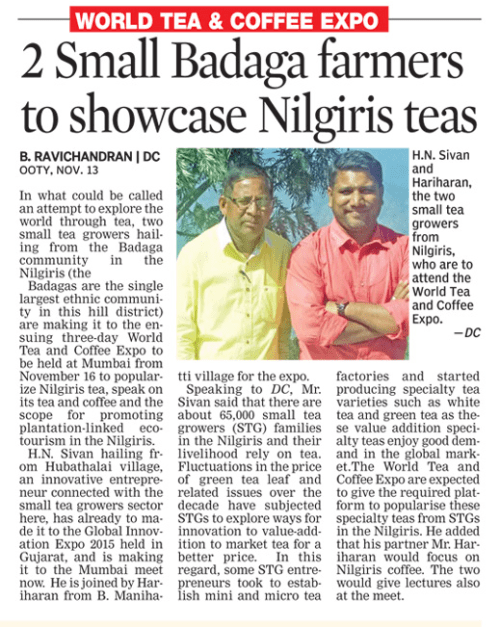
Keep it up Siva & Hari

CBE_2017-11-14_maip2_7-2.jpg

Badagas Can Do It…

A couple of actions taken by a group of volunteers for the past few months have proved that Badagas can be truly enterprising.

Lead by a group leader from Kodumudi and implemented by a husband wife team from Pudugamandu and volunteers from many hattis – villages have launched a successful cooperative movement. To make vegetables available to the  villagers at very much affordable prices that are much cheaper than in the market at their door step.

These young volunteers, take their pickup vans and and buy fresh vegetables from Mysore in the north and and Karamadai in he south. They buy onions, tomatoes and potatoes along with curry leaves (benguvay, dhomba, gaasu and karambay soppu) in bulk and bring it to Nattakallu, near Kotagiri where the sorting out of the vegetables takes place. The people of Nattakallu, famous  for its Koottu Haada (meeting ground), have made their community hall available to the volunteers.

A number of volunteers both men and women, apart from sorting out, pack one kg each of these vegetables with curry leaves into an eco riendly cloth bag. Based on the request made, the men take these bags to villages and deliver them directly to the villages, some times through a volunteer who takes charge of distribution and collection of money.

Each bag (3 kgs plus Curry leaves) is given for a price of Rs.100 ( the same quantity costs around Rs.160 in the market these days).

This is done every day of the week.

Bravo Badagas, God helps those who help themselves.


Badaga Photo Journalist – Raghu Joghee

Raghu Joghee

It was a great pleasure to meet and get to know photo journalist Raghu Joghee (Yedapalli) who is with  the Tamil Daily Dinamalar.

His photos are treat to eyes. One of them has been selected and published by the National Geographic

RJ

The photo below of a 94 yrs old Singhi Hethe (grand old Badaga lady) from Ebbanadu Village is sheer pleasure to see. Fist time I am seeing a body tatoo. Also see the page about tatoo by Badaga women

Photo by Raghu Joghee

Proud of you Raghu

The Great Revival of these abandoned schools

In the Nilgiris, Nakkubetta to Badagas, many schools started many decades ago, even during the British period, are in the final stages of being closed down due to lack of students. They were/are Tamil medium schools.

Lack of students, in this age and time of substantial population explosion? Therein lies the sad story of how clueless politicians and through them the government insisted that Tamil and only Tamil would be given the status of medium and English was given the go by.

Apart from the lack of job opportunities, the inherent ego and prestige issues ensured that even comparatively poor families sent their children to English medium schools spread around the district ignoring the government run Tamil medium schools.

And hence, many of these Tamil medium schools located in the hattis have ten/twenty students and are in the verge of being closed.

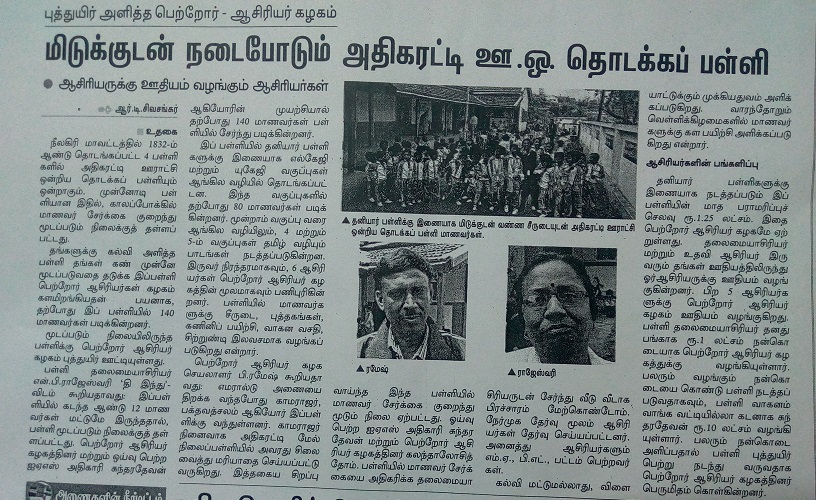
One of the oldest schools, started by Rao Bahadur Bellie Gowder in Hubbathalai has only around 30 students and may be closed soon.

But some Badagas who are old students of these schools did not want to see their alma mater going to seeds. People like Dr.Sundraradevan , the first and so far only IAS officer among Badagas, gave a serious thought to the problem and identified that the medium of teaching was the main source to this issue. They decided to take the issue hands on literally. Why not start teaching in English?

With consultation among the villages and taking personal interest, Dr.Sundaradevan succeeded in converting the school in Adhigaratty, started in 1832, to function again in full bloom with  highly qualified teachers being paid by the parents/ association.

Prakash (Heera Masi) of Godalatti informs me that they have also revived the school in his village being inspired by the Adhigaratty example.

We are very proud of these people whose interest is for the community, by the community!

Image

Disaster Can Strike…D.Venugopal

Wake up call for Ooty Botanical Gardens
Dharmalingam Venugopal

The piece de resistance of Nilgiri tourism, the Government Botanical Gardens at the east end of Ooty town could be sidelined by the fast emerging new garden by the Karnataka government at the west end of the town if the GBG authorities do not wake up in time, the Nilgiri Documentation Centre has warned.

The widely acclaimed botanical gardens was created 170 year ago in 1848 by the expert hands of W.G. McIvor who converted a primitive jungle into a beautiful public garden. He turned the swamps into streams of water and ornamental ponds and wild growths into grassy slopes and beds of flowers. Nurseries of vegetable, fruit and ornamental trees were created. He started the famous annual Flower Shows at the gardens to encourage the public grow good varieties of vegetable and flowers with a competitive spirit. The agricultural and horticultural products of the botanical garden and farms were displayed in the Dasara Festival of Mysore.

In the past three decades or so, the gardens have not only been steadily losing their botanical importance but were replaced by unbecoming artificial trappings such as cement statues, garden benches and so on. The exotic trees and plants which were uprooted naturally were never replaced. The popular glass houses have been allowed to deteriorate into disuse. The buildings and foot paths inside present a picture of neglect and indifference. Public conveniences and food stalls are shabby and insufficient. The once immaculate entrance has became bizarre, filthy and an unregulated bazzar. The gardens have almost lost their botanical significance and become an amusement park.

The authorities seem to have taken the visitors for granted and bothered only about the gate collection. Ironically, the gate fee was imposed after great resistance for better upkeep of the gardens.

The new gardens coming up in an idyllic ambience away from the din and bustle of the town with ample parking and amenities could easily divert the cream of the tourist crowd leaving only the sundry to GBG.

The GBG badly needs another professional McIvor to reinvent itself.

‘Consider Badagas as the indigenous people of Nilgiris’

‘Consider Badagas as the indigenous people of Nilgiris’

From The Times of India| Aug 11, 2017 

The Nilgiri Documentation Centre (NDC) has appealed to society for managing the Tribal Cultural and Research Centre (TCRC) in Ooty to considerBadagas as indigenous people of the Nilgiris. It said that separating the Badagas from other indigenous people would not only violate the well-documented Nilgiri history and the UN Declaration on the Rights of Indigenous People (UNDRIP), but will also harm the proverbial communal harmony of the hills
The appeal came even as an estimated 370 million indigenous people of the world celebrated the 10th anniversary of the UN declaration on Wednesday, the International Day of the World’s Indigenous People. Stating that the UNDRIP was adopted by the General Assembly on September 13, 2007, by a majority of 144 states, including India, Dharmalingam Venugopal, honorary president and founder of NDC, says, “Given the complexities in India, the government is yet to declare the list of indigenous communities in the country.”
Over 370 million indigenous people are estimated to be spread across 70 countries. Practising unique traditions, they retain social, cultural, economic and political characteristics that are distinct from those of the dominant societies in which they live, said the NDC letter.

The appeal also quotes the first Commissioner of Nilgiris, J.W.Breeks, who wrote the monumental work, ‘An Account of the Primitive Tribes and Monuments of the Nilgiris’ in 1873 that classified the Todas, Badagas, Kotas, Kurumbas and Irulas who inhabited the upper Nilgiris as ‘Hill tribes’. But he described the other tribes except the Badagas as ‘primitive tribes’ or ‘jungle race’ depending on their level of development.
However, while Todas, Kotas, Kurumbas and Irulas were included in the list of scheduled tribes in 1950, the Badagas were listed as backward class. In recent decades the government of Tamil Nadu had recommended inclusion of Badagas in the list of scheduled tribes.
Whatever be the economic classification of the five tribes it has been well established they were interlinked culturally for hundreds of years in an exceptional and exemplary manner and that the same relationship and harmony continues even to this day. And the Badagas need an ethnic status as an indigenous Nilgiri group, says Venugopal.

Gone but not forgotten


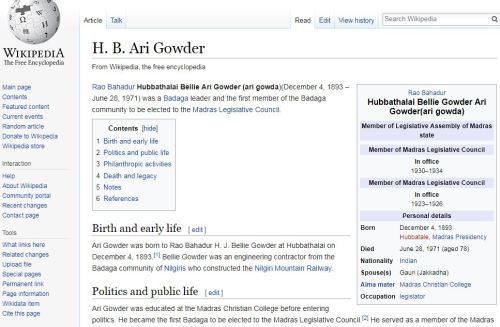
H.B.Ari Gowda

Gratefully remembering all the selfless service done to the society, Badagas and the family !

Ari Gowder

04 Dec 1883 – 28 Jun 1971

46th Death Anniversary !

Ottukudi – Bamboo Shoots

Badagas go gaga over tender bamboo shoots

DECCAN CHRONICLE.Jun 19, 2017
RAVICHANDRAN
More so, the edible bamboo is a veggie wonder during late summer or in the early southwest monsoon season in the Nilgiris.

View of edible tender Bamboo shoots, popularly known as "Ottakudi" in Badaga language in Nilgiris. (Photo: DC)

View of edible tender Bamboo shoots, popularly known as “Ottakudi” in Badaga language in Nilgiris.

By all accounts it is very hard to resist buying tender bamboo shoots, popularly known as “Ottakudi” in the local Badaga language. For this green, crunchy delicacy from the semi-wild areas is always a jungle vegetable to relish.

More so, the edible bamboo is a veggie wonder during late summer or in the early southwest monsoon season in the Nilgiris. Though this ancient jungle vegetable still brings the taste of the wild, its availability is becoming scarce now.

 The gravy of Ottakudu, called as “Ottakudi Udhaka” in the hills, is a
tempting delicacy with a taste of different kind and flavor that make
the bamboo shoots, which is also called as “bamboo sprout,” a much sought after vegetable of semi-wild origin during its annual season in the summer and early monsoon periods.

Ms. Bannari, a vegetable vendor, said that this year ‘bamboo shoot’ fetches around Rs 140 per Kg.  There is good demand for “Ottakudi” in the Badaga villages as every Badaga home generally shows interest in buying it at least once during its season.

Quite a few of them buy and gift them to their kith and kin living in  other places and other districts.  “Bamboo shoot was abundant in the hills, especially along the water sources in the jungle fringes in the hills in the past.

Now, its availability had become scarce and mostly confined to Pykara area,” she said, adding, that one needs to remove the outer dark-red coloured peel to extract the young bamboo shoots that is the edible part of the plant.

Though this annual semi-wild vegetable is known for its taste, the
fleshy and crunchy tender bamboo shoot is said to be good for keeping a good digestive health due to its good fibre content, besides helpful in tackling cold-related ailments during the monsoon, say gourmets here.

Mark this day and be present with all your like minded friends of Ooty
Date : June 15, 2017 (Thursday)
Time: 11-30am
Place: Birla House, Pudumandu ( below Birla Mandir)
Direction: Take Marliamund Road, adjacent to St.Stephens Church near the Collector’s Office.  About 3 kms.
Occasion: Centenary of the House Arrest of Dr. Annie Besant  during the Home Rule struggle. (see below for details)

Image result for annie besant

Centenary of Ooty’s link to Freedom Movement

Dharmalingam Venugopal

The demand for Home Rule or Self Rule  in 1917 was an important  milestone and a turning point in the struggle for Indian independence. The Home Rule movement was launched by the Irish activist Dr. Annie Besant  and Bal Gangadar Tilak.

Unable to silence Dr.Besant , the British rulers decided to arrest her on June 15, 1917. She and her two supporters G.S.Arundale and B.P.Wadia were kept in house arrest at Ooty.

Dr. Besant choose to stay at Gulistan at Pudumand which was built in 1890 by  H.S. Olcott, the founder president of the Theosophical Society as  his summer home.

The property now renamed Stokebridge Birla House is the property of Gwalior Rayons. A plaque commemorating the historic connection of the building to the historic event is displayed in front of the house.

Dr. Besant designed and unfurled a Home Rule Flag at Gulistan. She also started a local branch of the Home Rule League at Ooty.

Protests broke out across India and abroad condemning the arrest. All top leaders including  Gandhi and Jinnah joined the protest. Gandhi suggested a 350 km mass padayatra  from Madras to Ooty protest the arrest but the idea was given up due to practical difficulties.

Fearing the spread to the protest, the British declared in August 1917  its policy for  “increasing association of Indians in every branch of the administration and the gradual development of self-governing institutions with a view to the progress of responsible government in India as an-integral part of the British Empire”.

Dr. Besant and her supporters were set free in September 1917 by which time Dr.Besant had moved to Coimbatore for health reasons.

The whole of India celebrated her freedom and success. Dr. Besant was made the President of the Indian Naitonal Congress session at Calcutta that year by Tagore.

Besant thundered from her Presidential Chair that, “India shall soon be seen, proud and self-reliant, strong and free, the radiant splendour of Asia, the light and blessing of the world”.

Her dream came true three decades later in 1947 although Dr. Besant  passed away in 1933.

It is a proud coincidence for Ooty that nearly a 100 years before Dr.Besant gave the call for Home Rule, a fellow Irishman, John Sullivan, the founder of Ootacamund, had given a similar call at the UK parliament 1832.