Badaga Calendar

Badaga Calendar
by Dr.R.K.Haldorai

Badagas can boast with their own time-reckoning calendar. Once they followed their own full-fledged time-reckoning system and they practiced it even for their day to day life. But, it is to our dismay that at present most of the Badagas have only a little knowledge about that. Due to the easy accessibility of universally adopted Gregorian calendar and the arrival of panjaangam calendar at local market Badagas gradually disused their calendar system. However, it is to our surprise that still few have not forgotten the names of twelve months of the Badaga calendar. 1. kuuDalu, 2. haalaani, 3. nallaani, 4. aani, 5. aadire, 6. peeraaDi, 7. aavaaNi, 8. peraTTaadi, 9. doDDa diivige, 10. kiru diivige, 11. tay, and 12. hemmaaTTi are the twelve Badaga months. The basic unit of computation in a calendar is the day. Badagas used to dawn to dawn reckoning.

At the outset that the Badaga month begins always on a new moon day. For the Badagas the period between one new moon and the next new moon is a month. tinguva is the Badaga name for both moon and month and it expresses lunar month unequivocally, is roughly thirty days (Actually it consists 29. 5306 days). So, it is apparent that Badaga new year too begins on new moon day. It falls on different day every year because Badaga calendar is a lunisolar calendar. Every alternative year consists of thirteen new moon days . So one new moon day should be discarded without counting during every alternative year.

On which new moon day Badaga year begins? And which new moon day is be discarded without counting during alternative year? If we answer to these questions the doubt persists on Badaga calendar will disappear once for all.

“Exact time-reckoning is not a vital requirement for pastoral nomads. On the other hand, the correlation of lunar and solar time-reckoning was a necessary component of the urbanization process of the early agriculture societies. The solar year is roughly 365 days and lunar months make roughly 354 days, so a purely lunar time-reckoning is out of step with the season, which are determined by the yearly course of the sun. A lunisolar calendar was an essential instrument in administration and religion; it enabled the co-ordination of trade and agricultural activities (forecasting of seasonal yearly monsoons and floods) and the celebration of seasonal feasts at the proper time.”(Asko Parpolo). Badagas were pastorals comparatively for a longer period and they undertook the agriculture profession later on. Hence their time- reckoning consists of lunar months and solar year.

Badagas consider the bright half of the lunar month as auspicious and they prefer these days for religious activities. “muuru jena here” is considered as one of the most auspicious day in the Badaga religious beliefs. It falls on the third day after new moon. Considered as a holy day, it is the ideal day for conducting puujaas and celebrating festivals. It is believed that whatever new venture one makes on this day (or the waxing moon period days) will be tremendously successful. Badagas prefer marriage and other ceremonies on these days and they see even the milking the first time of a buffalo or cow on these days.

Badagas follow the south Indian lunisolar calendar. yugaadi or ugaadi festival marks the new year day for the south Indian people who follow the south Indian lunisolar calendar. It begins on the day after the first new moon after the sun crosses equator from south to north on spring equinox*, i.e. after March 21. meelsiime Badagas celebrate honneeru or doDDa habba (first ploughing) festival of a year on yugaadi day. With this one can assume that the first ploughing festival marks the new year day for the Badaga people too. On yugaadi new moon day the Badaga month aani begins. However most of the Badagas consider kuuDalu is the first month of a year. As yugaadi falls on the day after new moon day, it is easy to find the new moon on which kuuDalu month begins. We have to go back three new moon days from the yugaadi new moon. This year Badaga new year began on 1st January, 2014.

The yugaadi time- reckoning itself unaccounting a new moon during alternative years. So when we follow the yugaadi era the unaccounting an extra new moon day during alternative years goes along with it. For Badagas, the alternative year which bears thirteen new moon days is saribarusa. saribarusa goes along with an intercalary month i.e. an extra month ( or days) inserted in particular year. The intercalary month precedes the month that bears the same name. It is said that this calendar (yugaadi) reckons dates based on the Shalivahana era, which begins its count from the supposed date of the founding of the empire by the legendary hero Shalivahana.

* equinox = time or date at which sun crosses equator and day and night are equal (March 21, September 23). March 21st is spring equinox day .

In the page on Badaga Calendar, I have taken 10th of English month as the first day of a Badaga month. Dr.Haldorai’s article above, throws a different but more convincing argument.
As I have mentioned, one of the puposes of this website is to learn our old traditions [that are slowly vanishing] and come to a consensus on any issue where there may be more than one possibility. Differences of opinions are bound to be there but they can be easily solved. One such in my view is ‘Badaga Calendar’. – Wg Cdr JP

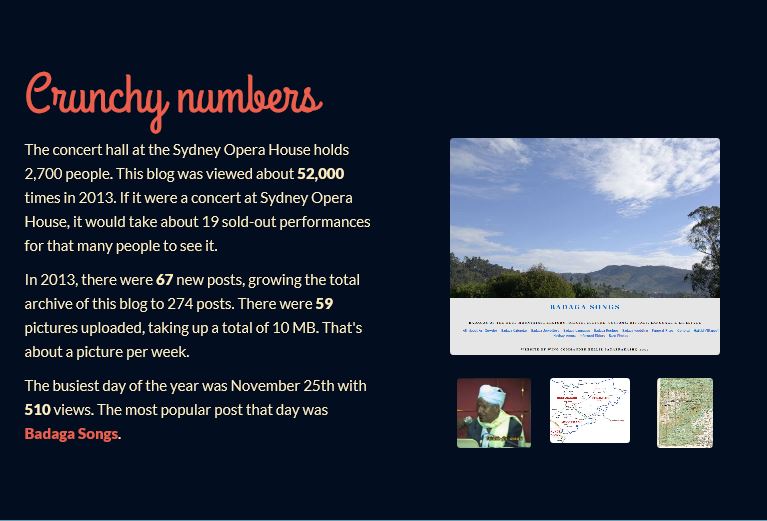
Proud to say we got 300,000 hits !

WP Hits

Extremely grateful to one and all for ‘HITTING’ us 300,000 times.

This landmark was reached on – 6th January, 2014 !!

Thanks again for the new year gift !!!

Uri Hogi, Siri Barali

Happy New Year !

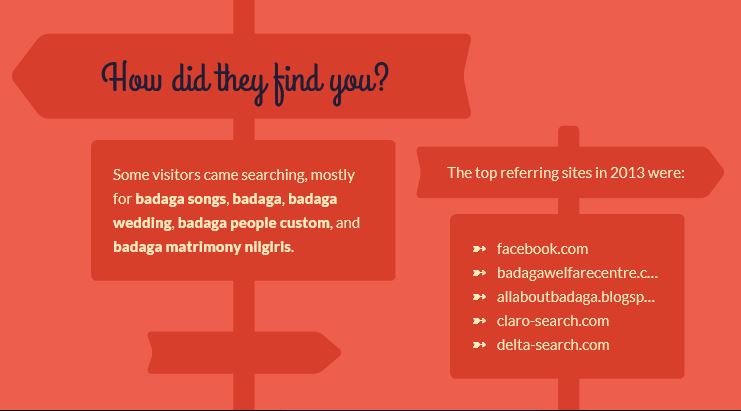
Click to read WORDPRESS annual report about our website
2013BMwp

HNYWishing all the visitors to this website, a very Happy New year!

May I, also, take this opportunity to thank all the 261 friends who  regularly follow and have made this  the Number One website on Badaga!!

Nearing the milestone of 300,000 hits.

Wing Commander Bellie Jayaprakash

Click to read WORDPRESS annual report about our website

WP
WithBMs
WP2
WP3
WP4
WP5

This slideshow requires JavaScript.

All India Workshop on Sustainable and Inclusive Mountains Development

‘Save the Nilgiris’ fame, Dharmalingam Venugopal, [Honorary Director, Nilgiri Documentation Centre, Kotagiri] is a man devoted to the development of the Nilgiris – the Blue Mountains known to the Badagas as ‘Nakku Beta’

Dvenu

He is ‘on a mission to put the beleaguered Nilgiris on the world map. Dharmalingam Venugopal is an angry man and is an anguished one too. A Badaga, he has grownup with stories woven around his beloved hills’  [ Read the full article published in The Hindu here].

He is organizing an ‘All India Workshop on Sustainable and Inclusive Mountains Development’ at Ooty from 29th to 31st December, 2013.

[Though he has been kind enough to invite me to this workshop, I am unlucky to miss this great opportunity being out of the mountains – Wg Cdr JP]

In the concept note , it is mentioned that

The object of this workshop is to evolve a framework for such a National Mountain Policy, which may pave the way, among other things, for: 

Undertaking a mountain-state-wise inclusive inventory of the natural and cultural diversity and development challenges of Indian mountains;

Creating a mechanism for continuous and coordinated monitoring of mountain areas;

Providing for appropriate policies and programmes to prevent, mitigate and adapt to climate and land-use  change;

Formulating mountain-specific sustainable development policies based on appropriate emulation of global and domestic ‘good practices’ while at the same time  avoiding corresponding ‘bad practices’;

Ensuring adequate plan and budgetary provision for economic and social infrastructure in mountain areas;

Ensuring adequate funding/compensation for conservation activities in mountain areas based, where appropriate, on payment for ecosystem services or other such fiscal instruments;  and

Launching a massive and effective awareness campaign for conservation and sustainable development in mountains.

The broad-based workshop will bring together a compact group of senior officials, professionals, social and natural scientists, environmentalists, writers, journalists, economists and corporate leaders’ like Dr.T.S.Tolia, [Former Chief Secretary, Uttarakhand] , Dr. N.Sundaradevan,[Former Addl. Chief  Secretary, Tamil Nadu], Shri. Sudhirener Sharma [Climate  Himalaya]’ Mrs. Rohini Nilekani,[Chairperson, Arghyam], Dr. SM. Ramasamy [Former Vice Chancellor, Gandhigram Rural Institute],  Dr. O.P.S. Khola [Principal Scientist, Central Soil and Water Conservation and Training Institute, Ooty], Dr. Biswajit Banerjee [Director (Forestry) Planning Commission],  Dr, P.A.  Azeez [Director, Salim Ali Centre for Ornithology and Natural History], Shri. Ramachandra Guha [Environmental  Historian], Dr. Sarala Khalling [Regional Director, Atree, Gangtok]’

For complete details of the Concept Note of this workshop Continue reading

Hethe Habba – 23 Dec 2013

Hethai J

Hethai J2

[photos from Dinamalar -24-12-2013]

Hethe Habba  celebrated at Jakkadha on 23/12/2013

~~~~~~~~~~~~~~~~~~~~~

Wishing you all

a very happy and blissful

Hethe Habba !

May Hethe’s choicest blessings

be showered on all !!

URI HOGI, SIRI BARALI !!!

~~~~~~~~~~~~~~~~~~~~~~~~~~~~~~~~~~~~~~~

***************************************************

|||||||||||||||||||||||||||||||||||||||||||||||||||||||

Do You?

See below the latest response  ‘From the Heart – from Sengamalam  ]

Do you have something to say?… a thought, a feeling , a comment or for that matter anything straight from your heart.

The direction our community is heading towards?
The “MORAY” system that seems to be a hindrance for many marriages to be fixed?
The ‘fight’ over control of YBA?
The UNFAIR treatment still extended to the fairer sex in our community?
The controversy surrounding equality to NATTARU in out hattis?

[Only request is – to follow the secret of  KISS – ‘Keep it SHORT sweety’]

I have added below the contact/comment ‘form’ where you can fill the details and give your thought or feeling …… a free expression. Please keep it short and do not be offensive.

← Back

Thank you for your response. ✨

Responses :

From: Sengamalam [ j_senga@yahoo.co.in]

A feeling
Badaga , the innocent soul
Bagaga, the village joy
Badaga, the sweet raga
Badaga, the NA2
Badaga, the badaga dance
Badaga, the best of all……

~~~~~~~~~~~~~~~~~~~

A thought

BABU.M [ byangi_babu@yahoo.co.in]
1.MORAY should be liberal to some extend.
2.STRONG & GOOD DEDICATED Leader is to be found.
3.All are BADUGAS nobody should be seperated.
BADUGU KALACHARA THALAIVARU (like DALAI LAMA) is to be found.

Thank You, Haldorai (Principal Correspondent, New Indian Express)

R Haldorai, Principal Correspondent, New Indian Express,
[Kammandu Village, Ketti Post, Nilgiris ] writes :

At the outset, I thank the Badagas of the Blue Mountains for uploading Badaga history without changing the traditional nature of our unique community. I like the word “Ari Gowder-undisputed leader of  Badagas”. We need such kind of  leaders now. This reminds me about unwanted events happened in Young Badaga Association recently. We pray to Hethe Amman through the Badagas of the Blue Mountains to give good leaders like Ari Gowder.

It gives me great pleasure and encouragement to receive such comments from the Principal Correspondent of a National Daily. Thank you very much, Mr.Haldorai for the kind words. As I had explained elsewhere, if this website is able to convey the correct information about the Badagas of the Blue Mountains, then, we have truly achieved our aim. Thanks for all the kind words that give real motivation to do more – Wg Cdr JP

Ari Gowda, a great Indian, a great Badaga

Rao Bahadur H.B.Ari Gowder

Birth anniversary 4th December

Ari Gowder2

Ari Gowder2

For more details about Ari Gowda go here or see Wikipedia

Ari Gauda

Ari Gauda

[ Ref : Hockings, Paul; Christiane Pilot-Raichoor (1992). A Badaga-English Dictionary. Walter de Gruyter. p. 47. ISBN 311012677X, ISBN 978-3-11-012677-8]

Ariya_Gowda_road_1069606fAir Gowder Street in Mambalam, Chennai

The GIRL CHILD

I was watching the programme on ‘Girl Child’ on NDTV. It was about the mind set of Indian men, rather the society. The mind set that is biased against the girl child. Against women.

(Talking about NDTV, I have the pleasure of knowing both Prannoy Roy and his graceful wife Radhika Roy right from the days when Prannoy used to be  hosting ‘The World This Week’, a great weekly serial  on DD. Have met them over dinner both at our place as well as his, along with other charming couples Prakash Karat and Brinda Karat [ CPM leaders] and Kishore Chandra Deo and Preeti [Union Minister for Tribal affairs]).

Though, Badagas, do not have a bias AGAINST girl child as such, the fact remains, that the Badaga men, still, do not consider Badaga women to be EQUALS.

This is greatly due to the fact that daughters are not given equal share of the property. In fact, no share at all. For centuries, this bias carried on making the daughters to be dependent on the ‘mercy’ of the brothers. And, the reason for the brothers not willing to share the property with the sisters, well, you guessed, is due to their wives.

Unfortunately, for these men to have a bias against women, is the result of the fact that many women do not consider others of their own sex, to be equals. Confusing ? Not really. Every mother in law considers the daughter in law to be a step lower.

Every woman hopes that the entire property will come ONLY to her husband and not given to  his sisters.

There have been enough and more Katta Panjayats – Koottu [consisting of mostly men] in both village-hatti level as well as Seemay levels. But mostly these Koottus have  not been successful in ending property disputes. Many have gone on to seek legal remedy – a lengthy process in our country.

Luckily, now that there is a law that gives equal share of the property to both sons and daughters, the importance of these kootus on property, is becoming irrelevant. This law is applicable even to daughters married after 1987(?).

Prannoy Roy concluded in the ‘Girl Child’ programme, “men are the problem and women – the SOLUTION’. True ? Or, is it the other way round?

It is time that we, who consider HETHE as the greatest  Goddess, to ponder about this and change our mindset against girls and daughters!?

Learn Badaga

A couple of days back, I received the following email from a young mother [name withheld] who wrote to say :

 Dear Sir,
 
It gave immense pleasure for me to visit your website. I was always amazed to know about the community and the culture.

I am a Non Badaga and married last Dec to a Badaga from ………..

And Recently on the ….. of this month I gave birth to
a baby. My husband and my in laws want me to learn Badaga  as I have to talk to the baby in Badaga for her to pick up the language.

Please help me learn the language by sending me some day to day conversations .

Thanks in Advance. Best Regards.

My reply :-
Thanks a lot for your email. I am delighted to learn that you find my website[s] interesting and informative.
 
I have given a few ‘lessons’ about LEARN BADAGA in my websites/blogs. ….
 
When you meet any elder, especially your in-laws and hubby’s grand parents, bow your head and say, ‘Kumbidichivi – meaning bless me. They are expected to touch your head and say, “Badhukku” – long live. You will find that any elder Badaga will be thrilled with this gesture as many do not follow this wonderful custom and your day will be made.
 
As a new mother, for about 40 days after delivering a baby, you are a ‘baththya hemmathi’ with some diet and other restrictions.
 
 “Hosa koosuga, ondhu muthu kodu’ – give the new born baby a kiss.
The following have been taken from my earlier posts

Let us learn Badaga

” Ollenge iddiya ? – How are you ?”

‘Suddi saddha ella olliththa ? – (Roughly) ‘ How is everything ? ‘

1. Are you a Badaga ? – Nee ondu Badagana?

2. Yes, I am a Badaga – Ha, Na ondu Badaga

3. What is your name ? – Ninna hesaru aena ?

4. My name is Bhoja – Enna hesaru Bhoja

5. Which is your village ? – Ninna Hatti edu ?

[5a. Amme / Thamma, nee ai hatti ? – Girl/ Boy, which is your village?]

6. My village is Bearhatti – Enna Hatti bandu Bearhatti

7. Whose son/daughter are you ? – Nee dara maathi / hennu ?

8. I am Mela thara (top street) Joghi Gowder’s son / daughter – Na Mela thara Joghi gowdaru maathi / hennu

~~~~~~~~~~~~~~~~~~~~~~~~~~~~~~~

Numbers in Badugu /Badaga

1. Ondu (One) 11. Hannondu (Eleven)

2. Eradu (Two) 12. Hanneradu (Twelve)

3. Mooru (Three) 13. Hadimooru (Thirteen)

4. Naakku (Four) 14. Hadanaakku (Fourteen)

5. Iidu (Five) 15. Hadanaidu (Fifteen)

6. Aaru (Six) 16. Hadanaaru (Sixteen)

7. eizhu (Seven) 17. Hadarizhu (Seventeen)

8. Eattu (Eight) 18. Hadarettu (Eighteen)

9. Ombathu ( Nine) 19. Hathombathu (Nineteen)

10. Hathu (Ten) 20. Eipathu (Twenty)

30. Moovathu (Thirty) 40. Nalavathu (Forty)

50. Iivathu (Fifty) 60. Aravathu (Sixty)

70. Elavathu (Seventy) 80. Embathu ( Eighty)

90. Thombathu (Ninrty) 100. Nooru (Hundred)

Days In Badugu/Badaga

1. Aadivaara (Sunday)

2. Sovaara (Monday)

3. Mangavaara ( Tuesday)

4. Bodavaara (Wednesday)

5. Chikkavaara (Thursday)

6. Bellie (Friday)

7. Sani (Saturday)

Months In Badugu/Badaga

It is said that Badaga month usually, starts on every 10th of the English month. Like for example the first Badaga month Koodalu  starts on 10th January.

1. Koodalu (Jan)

2. Aalaani (Feb)

3. Nallaani (Mar)

4. Aani ( Apr)

5. Aadire (May)

6.Aadi (Peraadi) (Jun)

7.Aavaani (Jul)

8.Perattadi (Aug)

9. Dodda Deevige (Sep)

10. Kiru Deevige (Oct)

11. Thai (Nov)

12. Hemmaatti (Dec)

Pleasantly surprised to hear all the Badaga Months being mentioned in this song called ‘Kappu Huttileyu’ . See the widget on the right and click to listen to this great dance number

**************************************

Hindu-Arabic numeral Badaga and pronunciation
1 ஒந்து   (Ondu)
2 எரடு (Eradu)
3 மூறு (Mooru)
4 நாக்கு  (Naaakkuu)
5 ஐது (aidhu)
6 ஆறு (aaru))
7 எழ்ழு (ézhu)
8 எட்டு (ettu)
9 ஒம்பத்து  (Ompathu)

Certain peculiarities of Badaga .

Haalu [haa – as in hospital and lu – as in Zulu] means milk

Hallu [ ha- as hurt and llu – as in loo] means tooth [teeth]. note – there is no plural term.
Haasu – spread [the bedding], Haasike – bedding
Hasu – hunger

Maana – Pride, Mana – heart

Kaanu – see, Kannu – eye[s] (example – Doctor-a Kaanu, kanna pathi hegina – See the Doctor, he will tell about the eyes]

~~~~~~~~~~~~~~~~~~~~~

Peculiar Words

There are some words in Badaga that are truly peculiar. for example :

1. GIJI GIJI ( as in Give & Jinx) – Confusion , mess up / disorderly

GIJI GIJI maada beda – Don’t create confusion

Room aekka ethe GIJI GIJI (ya) hadadhe ? – Why is this room in such a mess?

2. MURUKKU(LU) (Mu ru ku) – Foul mood / mild anger

Amme Ekka maathaduvadu elle ? – Why is sister not talking ?

Ava murukkindu endhave – She is in a foul mood

3. BADAYI (Ba daa ee ) – Show Off (proud)

Appara badayi maadiya – She shows off a lot

~~~~~~~~~~~~~~~~~~~~~~~~~~~~~~~~~~

Birds (Hakkilu)

  1. Haddu (Eagle)
  2. Kakke (Crow)
  3. Soray (Dove)
  4. Kili (Parrot)
  5. Emme Hakkilu
  6. Bikkola
  7. Karia(n)chitta (Black bird)
  8. Gubbachi (Sparrow)
  9. Mayilu (Peacock)
  10. Koi (Poultry hen/cock)
  11. Kaadu Koi (Wild hen)
  12. Baathu(koi) – Duck

Mari (chic) –{Koi Mari – chic(ken)}

Also for calf [ for eg) Nei mari – puppy dog]

Animals

  1. Aanay (Elephant)
  2. Kaade -Kaadu Emme – (Bison)
  3. Ottaga (Camel)
  4. Kudire (Horse)
  5. Kaththe (Donkey)
  6. Dana (Cow)
  7. Emme (Buffalo)
  8. Yethu (Bull)
  9. Karu (Calf)
  10. Huli (Tiger)
  11. Singa (Lion)
  12. Siruthe (Panther)
  13. Karadi (Bear)
  14. Maanu (Deer)
  15. Pulli Maanu (Spotted Dear)
  16. Kadamay (Sambar)
  17. Handi (Black Pig)
  18. Kaadandi – kaadu handi – (Wild Pig)
  19. Mullandi – Mullu Handi – (Porcupine)
  20. Seeme Handi (White Pig)
  21. Koda, Korangu (Monkey)
  22. Mola (Rabbit)
  23. Nari (Fox)
  24. Nei (Dog)
  25. Koththi (Cat)
  26. Eli (Rat)
  27. Aame (Turtle)
  28. Nalli (Crab)
  29. Halli (
  30. Haavu (Snake)
  31. Kappe (Frog)
  32. Meenu (Fish)

Insects

  1. Hoo (general for insect)
  2. Nona (Fly)
  3. Selandhi (Spider)
  4. Kunni (Bee)
  5. Eruppu (Ant)
  6. Kosu (Mosquito)
  7. Bendu (Moth/Butterfly)

Anatomy

  1. Mande (Head) – also refers to Hair though there is specific word – Orama
  2. Heddakku (Back of the skull) – usually Badagas have a long heddakku as they donot use cradles. The reason for not using cradles for babies is a story by itself. It is due to the fact that when they left Mysore to escape from the King (Thipu Sultan ?) in the night in a hurry, they had forgotten the baby which was sleeping in the cradle,each thinking that the other person wiould pick up the child.
  3. Moole (Brain)
  4. Nethi (Forehead)
  5. Kenni (Cheeks)
  6. Kannu [eye(s)]
  7. Kivi (Ear)
  8. Mookku (Nose)
  9. Bae (Mouth)
  10. Thudi (lip)
  11. Hallu (Teeth)
  12. Naalenge (Tongue)
  13. Dhaade ( Chin)
  14. Thonde (Throat)
  15. Gaththu (Neck)
  16. Maaru – Nenju – (chest)
  17. Mole (Breast)
  18. Hiththalu – Bennu – (Shoulder)
  19. Kai (Hands)
  20. Mutti (Elbow – also for knee)
  21. Beralu (Fingers)
  22. Hebbatte – Katte (beralu) – [Thumb]
  23. Ugilu (Nails)
  24. Hotte (Stomach)
  25. Mollu Kudi (Naval)
  26. Nadu (Hip)
  27. Pitti (Buttocks)
  28. Thode (Thigh)
  29. Monakkaalu (Knee)
  30. Kaalu (Leg)
  31. Midi (Heel)
  32. Angalu (Foot)

COLOURS (BANNA)

1.Kappu – Black
2.BeLLay – White
3. Keppu (Kechay) – Red
4. Pachchay – Green
5. Neela – Blue
6. Arichina (Manja) – Yellow

Also see http://badaga-language.blogspot.in/