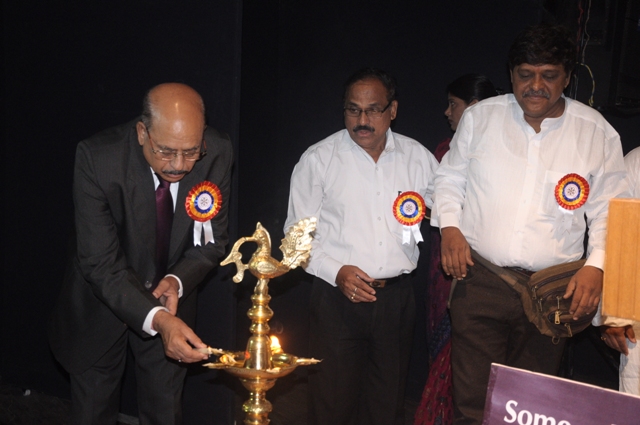
K.R.Arjunan [photo from Dinamalar]
Will he be the First Badaga to become a M.P (Rajya Sabha)?
Congratulations to Arjunan.

K.R.Arjunan [photo from Dinamalar]
Will he be the First Badaga to become a M.P (Rajya Sabha)?
Congratulations to Arjunan.
Posted in badaga
Read in the news papers about the announcement of General Body Meeting on 21-07-2013 of the Young Badaga Association and elect NEW office bearers. This General Body Meeting is being held after many years, in fact many decades, instead of being an annual affair.
Hope this Young Badaga Association will elect really new apolitical, young and dynamic Badagas instead of the same old elders who claim to be ‘forever young’.
By the way, why can’t we have a great and grand meeting of all Badagas, spread all over the world, on the same day to elect a NAKKU BETTA GOWDA [leader] in a truly 100% democratic way like in a general election?
Is it not high time?
Deepak from Nanjanadu asks :
At my age I am not very well aware of the BADAGA GENERAL BODY or the politics.After the scrutiny of our website I am in a doubt whether such a mass election is possible.If so then who will undertake such an enormous election.Well if happened, I will be very glad for such happening.
Hello Deepak, good questions. There are two issues involved here.
One is about YBA – Young Badagas Association that was formed some 50 odd years back with a few hundred members and now, as per THE HINDU, there are about 3800 members. It was started with some very good intentions aimed at improving and enlarging awareness of ALL Badagas and for better interaction with other communities. YBA successfully obtained land at a prime place at Ooty, next to Breeks School, Charring Cross and built a hall with a a few shops. This hall is being rented out for marriages and other functions.
As is the case with most of our affairs, politics crept into running the association; many factions emerged and there were/are serious allegations of financial irregularities. Annual General Body Meetings [AGM] were not held and it became a ‘personal fiefdom’ of some persons with affiliation to a particular political party. Over a period of time, it resulted in many factional fights and took some ugly turns and police had to intervene. The recent one being as late as 24-5-2013. Truly shameful.
The million dollar question is – who is the governing body of YBA now? In the absence of AGMs, can some people elected decades ago, claim to be the true representatives of Badagas in general and YBA in particular and hold on to the chairs for ever?
In that respect, I welcome the announcement of the much delayed meeting to be held in July. Only hope is that, this meeting will be held in cordial atmosphere and elections held in a democratic way.
Again the doubt is, whether there is a proper record of the members? If so, YBA should come out with a list in the open – news papers or online in a website.
Since, YBA does not seem to have a website of its own, I can publish the list of members in my websites like http://www.badaga.co, http://www.badaga.in etc. if it is sent.
Lastly, what is the criteria for becoming a member of YBA and its rules and regulations?
The second issue involves in conducting a sort of General Election for choosing a Nakku Betta Leader – will write about that in detail soon.

Here’s a question that was posed to the Dalai Lama: “What thing about humanity surprises you the most?”
His answer is : “MAN – Because he sacrifices his health in order to make money. Then he sacrifices his money to recuperate his health. And then he is so anxious about the future that he doesn’t enjoy the present,
And as a result he doesn’t live in the present or the future. And he lives as if he’s never going to die and then he dies having never really lived”.
Is it NOT true with every Badaga- male or female?
Posted in badaga
I found the following information given by E.B.Hariharan very interesting and educative. The initiatives and efforts of Badaga Mahajana Sangha are greatly appreciated.
This article/info raises some hitherto unknown facts. Was there a ‘reverse migration’ of Badagas from the Nilgiris to the plains [of Karnataka]? Apart from the four [Nilgiri Nakkubetta] Seemays known to us, Mel Seemay seems a completely new and geographically different one.
Of course, we have all heard of Hasanur but not much about Punajanur and other Badaga Hamlets in Chamrajnagara. The famous Badaga Proverb [Dhoddaru Shloka] – “Hasanuru haalu kudippudhuga, Neelagiria neera kudi (The water in the Nilgiris is better than the milk of Hasanur)”- Wg Cdr JP
Punajanur and Mel Seemey.
Punajanur is a Badaga Village, about 45-50 Kms from Chamrajnagar town, falling within Karnataka State, Chamrajnagar Taluk and District. It has got about 50 Badaga houses and about 15 Wodeya houses (Lingayat Clan). Some other castes like Nayaks and others live nearby as well.
All the Badagas in Punajanur trace their heritage to Ebbanad and Kookal villages in the Nilgiris, a few of them are from Kadanad and Kottanalli as well. 300-400 years ago they moved from the Nilgiris and settled there, in search of better pasture for their Buffalo herds. Life was good until the last 15-20 years, their main source of income was supplying milk to the Co-operative milk societies, mainly NANDINI in Karnataka. After Veerappan issue cropped up, the people were stopped from grazing their herds at HEMMATTIES (in Badugu meaning Buffalo Grazing Villages) and most of them were sold. Thus started their economic decline. Their overall socio-economic condition is in bad shape, education is at abysmal levels, health is an area of serious concern. In our view, they seem to be atleast 30-40 years behind mainland (Nilgiri) Badagas. Hence, we, a group of volunteers across varied age groups having genuine love towards the Community, decided to take up the challenge and work for the betterment of our own people in Punajanur.
Similar to Punajanur, there are 8 small villages in an area called as Mel Seemey which is about 40 Kms from Punajanur, but falling under Erode District, Sathyamangalam Taluk, Hasanur Panchayat of Tamilnadu. Mel Seemey has about 200 houses in total and our work is going there in full swing. We have successfully paved the way for upgrading the school in Kotada (The biggest village with 80 houses in Mel Seemey) upto High School level (10th Std) spending Rs.100000/- (One Lakh), helped change the bus timings for the school going children, created a pool of Rs.300000/- (Three Lakhs) towards agricultural funding at no interest. We paved the way for 3 young students to join an Engineering Degree with full fee waiver for all 4 years of their study. We successfully conducted a medical camp in both Punajanur and Mel Seemey on 28/04/13 for the benefit of our people residing there in association with KBGA Bangalore. Four prominent doctors conducted a marathon medical test for nearly 300 people in one single day.
There is much more to be done and we are moving one step at a time. Together, we believe we can do wonders……..
When I coined the slogan “Proud to be a Badaga”, I was acutely aware of the fact that there are many factors on which we should be ashamed of as well.
One such is the disunity (or rather the lack of interest to be united and) show the world that ALL BADAGAS SHARE COMMON VALUES & SPEAK IN ONE VOICE when it comes to many common issues.
Unfortunately, what our ancestors advised and hoped ‘Uri Hogi, Siri Barali – Let jealousy vanish and happiness prevail’ has not come true.
One such area where urgent action required is to have a ‘SUPREME BODY/ASSOCIATION’ representing but elected in a democratic way by all Badagas.
The recent reports in the news papers about the ‘heated arguments for election and possession’ of YBA – Young Badagas Association’ at Ooty. From what one gathers from various sources is that an ex-MLA is refusing to ‘vacate’ his chair and not letting any fresh air to flow in. One wonders why this ex-MLA connected with a particular political party, is in a perpetual denial mode for fair and free elections that may help in the upliftment of the community, is a mystery.
The face-off between two groups over custody of the premises of the Young Badagas Association (YBA) here took an ugly turn on Thursday with members on either side breaking open locks put up by each other on the office door. It was followed by complaints being lodged against each other.
In order to prevent untoward incidents, a police team headed by Deputy Superintendent of Police G.S. Anita moved in.
Or, is money, power or fear of exposure that is holding back a CHANGE. Let not a miniscule of ‘self – interested’ men make us feel ASHAMED.
May I appeal, in the interest of all, to stand united and be PROUD of being Badagas – Indians.
It is always a pleasure to get emails from visitors to this website expressing their association with the Nilgiris and/or Badagas many many years ago. In their views and opinions, we learn a lot. If one such visitor is a person who is comparatively ‘young at heart’ and wise by age, then we are in for pleasant surprises.
One such person is Henry Marriott from Australia. Henry is 80 years young.
I am fascinated about the suggestion he makes about ‘the statement a Seemay Gowda can make about Badaga ancestors in any function like what the aborigines do in Australia.
I thank him for permitting his emails to be published. – Wg Cdr JP
Henry Marriott writes :-I have been studying some articles on the Badaga peoples, who I am convinced are of European or Aryan descent as they belong to the R1a1 haplogroup (but it is necessary to assign the correct clade to these people as confirmation). It is thought that as Badaga means “people of the north” they are from Karnataka, and their language is a form of ancient Kannada. In fact it is believed they migrated from there in the fourteen hundreds, but now it is also believed that this could have been a second migration.
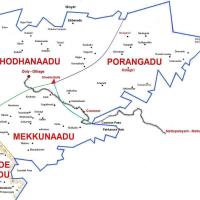
But there is also the belief that they are the indigenous people of the Nilgiris (or Nakku Betta to the Badagas). If this is the case, then as in In Australia at any function in Ketti (a hatti in the seemay of Mekkunaadu) the MC should commence proceedings with a statement in a form such as this:
“I would like to acknowledge the Badaga people who are the traditional custodians of Mekkunaadu and I would also like to pay respect to the elders past and present of the Badaga nation and extend that respect to other Aboriginal people present.”
I was educated in Ketti in the 1940s, and still have contact with St Georges School.
I was born in Sri Lanka and was educated at St Georges from 1940 to 1950. I then did further studies at MCC Tambaram . I then went to England where after National Service I qualified as a Chartered Accountant. I have now retired and live in Melbourne.
During my time in Ketti I had no contact with Badagas in school apart from school servants and the women who worked in the surrounding fields. We also attended at the Shantoor Temple to observe the Hubba and fire walking, which coincided with the Christian Palm Sunday (a week before Easter). I am now 80 years old.
//
One of the fascinating and interesting aspect of Badaga [both people & language] is the free use of delightful but deep meaning proverbs called “DHODDARU SHLOKA”. Also we can call it – “DHODDAVAKKA HEGIDHADHU [What the Elders said] or “MUTHAPPANA MAATHU [Ancestors Words].When you engage an elderly Badaga into any conversation, you are sure to hear a lot of these proverbs thrown in to make / emphasis a point.
Prof. Paul Hockings, probably the most authentic researcher on and of Badaga lists more than a thousand Badaga proverbs, 1730 to be precise. He feels that 1730 could be a complete figure containing all the proverbs there are. See his book,’Counsel from the Ancients: Study of Badaga Proverbs, Prayers, Omens and Curses’. He has given the meaning in English as well as making it easy to understand, in a beautiful manner.
Though I find his collection extremely interesting and educative, I do not agree with some of the conclusions he draws on certain proverbs. For example, on the proverb, ‘Odhidhama Niddhana, Oddidhama Erandina’ Prof.Hockings interpretation is quite different to what I feel is the correct meaning. I think ‘a person who spends time learning and ponders (over a problem) is better than the one who runs away (in a hurry) and thus trips over. [Odhidhama – one who has learnt (spent time learning), Niddhana – stops to ponder over[think], Oddidhama – one who runs, Erandina – trips over]. We can hear mothers telling their young children ‘Oda beda , Erandire’ – Donot run, you will trip over (a stone or any obstruction). That is ‘ do not be in a hurry and take a hasty decision’.
Another one is ‘Michidhavaga Morande Kolu Bangara’. In my opinion . the lady who does not listen to any one (Michidha Hemmathi) is bound to land up as a widow (when ‘Morande Kolu – a small stick of morende tree – replaces her jewellery (bangara) during the Ole Kattuva ritual of husband’s death / funeral ceremony). Prof.Hockings feels Mechidhavaga (see the difference between michidhava – one who does not listen- and mechidhava – one who is appreciated by all – even a morende kolu is enough as jewellery. Is it a case of wordplay (pun) by our ancestors??
Visit the website Badaga Proverbs for more interesting information
Posted in badaga
Deepak from Nanjanaadu
Sir, I used to mail you 4 to 5 years back. My father is in Army[Subedar Major].I wanted to ask you is there any translation of the book – “History of Hethey Amman“, either in English or if possible in Hindi.
Then sir, I am really happy to see your interest towards our community.Really it feels good to see such an interest and effort.Hope this effort will try to reveal the feelings that we teens have towards our community. Visiting the site after so many years it feels as if it is your obsession.Please don’t let this obsession get dormant.We youngsters actually need someone to tell our identity and tell us who we are.
Hello Deepak, I am very glad and feel thrilled to see your email. Unfortunately, there is no translation of the booklet on Hethey in English or Hindi.
I feel extremely happy that this website and its contents make youngsters like you to learn about us, ‘tell our identity and tell us who we are‘ as you have beautifully put it. As I keep repeating, ‘there is plenty to learn and know about ‘Badagas, the beautiful people of the Blue Mountains‘.
My motivation to keep going with this website is due to the encouraging words like yours. Thank you very much. – Wg Cdr JP
BADAGAR PANPAADU (Badaga Culture) Dr.Haldorai
‘Culture may be defined as behaviour peculiar to Homo-sapiens, together with material objects used as an integral part of this behaviour. Specifically culture consists of language, ideas, beliefs, customs, codes, institutions, tools, techniques, works of art, rituals, ceremonies and so on’ (Encyclopaedia Britannica).
Badaga culture evolved from the background of ancient Dravidian culture and in the isolation Nilgiri environment. This book tries to elucidate the Badaga culture with its three broader chapters and many subtitles.
The first chapter ‘LIFESTYLE’ consists of twenty five subtitles. They are: profession, barley, new tax money, commune, extended family, marriage, marriage rituals, ladies, delivery, ornaments, puberty, food habits, amaranthus, milk, tender bamboo shoot, hospitality, cleanliness, dress code, fire, house warming, structure of the house, bravery, pastoral pipe and insignia.
The second chapter ‘BELIEF’ consists of thirteen subtitles. They are: Dravidian, place of worship, water, water jar, totemism, clan deity, spirit, ancestral worship, salt giving festival, religion, ritual purity and auspicious day.
The third chapter ‘TRADITION’ consists of fourteen subtitles. They are: culture, tribal culture, tribe, symbol, place of residence, upper land, immigration, individual respect, egalitarianism, language, grandson, lineage, kinship, and family respect. Besides these there are four appendix chapters. They are: colour, knowledge of time-reckoning, proper names and kinship terms. With these chapters and subtitles the book tries to cover the entire culture spectrum of Badagas briefly.
Total Pages : 230 ; Price : Rs. 130/
Contact.No. 9442369506 R.Dharuman, Kekkatty