Badaga Origin

This article is reproduced due to readers request

^^^^^^^^^^^^^^^^^^^^^^^^^^^

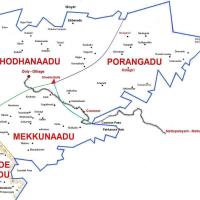
Many mistakenly claim that Badaga Origin is nothing but Badaga migration from Mysore  [now in Karnataka state] during Tipu’s time only because of  the name Badaga (meaning northerner). It is very debatable. Unfortunately many Badagas have believed it in the absence of any convincing and conclusive evidence to the contrary. But the latest revelations and links about the language, especially from the epics and writings during the Tamil Sangam period tell a totally different story (see below).

Portrait of Tipu Sultan once owned by Richard ...

I am firmly of the view that our history is much older- may be a thousand years or more older – and my initial ‘research’ confirms that. There is a lot written about the migration from Mysore theory by many anthropologists, researchers and others. For obvious reasons, most of them are/were ‘outsiders’ – like the early European missionaries and British. The one person who has done a lot to highlight about Badagas, in 1960s, Prof.Paul Hockings has chosen to go along with his predecessors in concluding that since Badaga means north[ner], they have migrated from southern  Mysore  during Tipu Sultan’s rule over Mysore to avoid being forcibly converted to Islam. Also sited in support of migration is the resemblance/similarity of Badaga (language) to Haleya [old] Kannada.

But, B.Balasubramaniam, a highly educated Badaga, in his book“ Paamé ” – The history and culture of the Badagas of the Nilgiris, feels that Badagas migrated from Southern Karnataka [then Mysore State] about 700 years back, much before Tipu’s time, around 1311 AD during the plundering raid of Malik Kafir.

  I am, also, firmly of the view that it is possible that Badagas have lived in the Nilgiris for thousand of years like the Thodas [Thodhamaru ] or Kothas [Kotharu] and migration theory is an attempt by historians and anthropologists to explain away a ‘historical puzzle’.  The mystery of migration needs to be solved once and for all.

What we DO NOT know about Badagas is more than what we know about them. Such is the mystery of Badaga Origin. Read the complete article here

Harakolu Music

The lives of Badagas and  Kothas are intricately connected from time immemorial. This may be due to the fact that both are considered as original tribes of the Nilgiris along with Todas.

Kotha music is, thus, an integral part of Badaga festivities in olden days. The nearby Kotha musicians were invited to almost all functions in any hatti – Badaga village.

Their ‘Harakolu’ music was the start of any dance, since it is so beautiful and rhythmic. When the dancers, generally male, wear ‘Dhodda Kuppacha – Big Garments’ and dance in circles [and going around in ‘circles’] with these garments ballooning out, it is a shear joy to watch.

The following video uploaded in youtube is by GRSARAVANAN7

Helpful “BADAGA” hand at Chennai

Are you at Chennai, looking for some help about LIC? Here is a Badaga lady who can assist you…
Sugirtha Paramasivan writes to say ‘I am working as a teacher in Jai Gopal Gorodia CBSE School. I am also an L.I.C.Agent in City Branch Office 6. I am a Badaga girl born in Denad Village and My husband is working in Tamil Nadu Government Commercial Tax Department whose native place is Bickol Village’
Contact:9840859720 lparamasivan@yahoo.com

Which Hatti is this?

The following pix was taken by me when I was on my way to Ebbanadu from Peddhuva.

Sudharsan Vasudevan [Anikorai] informs that this is “Thirichigidi Mandhu”

For PH2photo by : Wg Cdr Bellie Jayaprakash

Happy Birthday to Bella gowder of Jakkadha

Happy Birthday to Bella gowder of Jakkadha

On the eve of his 96th birthday, it is my pleasure and honour to wish one of the greatest sons of the soil, Jakkadha Bella Gowder, a very happy birthday.
May God give him many more years and may Bella Gowder bless us with his intricate and intimate knowledge of Badagas.
When I met his elder son Colonel Ramachandra at Hubbathalai about two months back, he was mentioning about the pleasant ‘camp fire’ evenings and discussions, he was having with his father, over a couple of drinks.
(photo by Maya Kumar in facebook)
Bella Gowder stays in his house at Aravankadu, on the way to Jakkadha with his younger son Bala [author of PAAME] and daughter in law Gayathri.
[The post I had written earlier- four years back]
There are a few elderly Badagas spread among our Hattis and Cities who are so well informed about us. May be due to their age or the personal interest and individual atrributes, they know about our origin, customs, culture or anything connected and concerning Badagas. It is a shear blessing to meet them.
Jakkada Bella Gowder is such a wonderful person. Talking to him is an honour and pleasure and needless to say, highly educative. It was indeed my good fortune when he dropped in at my place in Bangalore, though for a very short while. Discussing about [Jakkada] Hethe Amma or about Rao Bahadur Ari Gowder when he was a student of Madras Christian College, Madras in the 1930s, he becomes very exited and emotional. My only regret was that I could not spend more time with him.

He is 92 years younger and is in good health and does not like to have any artificial help like hearing aids etc. He moves on his own and politely declines when somebody tries to help him climb down the stair case or get into the car.

May God bless  him with many more active years!

Bella Gowder with the author of this weblog JP

################################

A letter from Prof.Paul Hockings

As I have mentioned elsewhere, Prof.Paul Hockings should be credited for doing a lot of research on Badagas [and Nilgiris]. He has published many books on both. Though priced on the higher side, his book ‘ A Badaga – English Dictionary’ written along with Raichoor is a must read for all Badagas.

badengdic.jpg

(See the page on Research for more)

So, it was a pleasant surprise to receive an email from him informing about his new books.

paul2.jpg
Dear Wing-Commander,
I have just finished writing a new book on the Badagas, “So Long a Saga“, which is a 400-page book on the social history of the Badagas from 1565 to 2012. ….[the book may take some time to be published and released- Wg Cdr JP]
I also attach a notice about my other recent book, “Encyclopaedia of the Nilgiri Hills“.
With best wishes,
Paul Hockings
PHnew

The NEGLECTED half

Pedhdhuva 012

The NEGLECTED half [part -1]


We may be proud of many of our Traditions – note the capital T – that we have followed for thousand of years. I repeat thousand of years though some so called foreign researchers along with many ‘yours truly types’ among us, would give only a few hundred years to Badaga history.

One such tradition, call it a custom if you want, that needs immediate attention is how we treat our WOMEN.

I am a staunch devotee of Hethe(y) Amma and very proud about the fact that Hethe(y) Habba is the ‘mother’ of all festivals for Badagas. But, let us face it. We call ourselves ‘Hethe(y) Makka’ – the children of Goddess Hethe(y).  And we very fiercely follow the strict customs associated with Hethe(y) Habba.

But alas, at the same time, our women are side lined and given only a secondary position in many of the rituals associated with this great and grand festival.

I have discussed about this aspect with many Badagas, including some from Beraganni and Pedhuva – “when we are so devotional to a deity that is personified in the purest female form called HETHE(Y), why are we NOT allowing our womenfolk who form half our population to participate in some of the rituals of Hethe(y) Habba?”

There are no clear answers. We cannot live in isolation.

Traditions need not be changed for the sake of change but surely, by involving the other half of our population in a much more ‘inclusive’ way instead of ‘rash restrictions’, will we not enhance our name and fame as a community that is forward looking?

If we do not change with times and be part of the larger society that encompasses the entire country, then, we will be condemned to face the serious and severe consequences.

May Hethe(y) bless us with the wisdom.

[To be continued …in ‘Part- 2’ we will see the injustice done to our women]

2012 in review of OUR SITE by web host WordPress

Thank you, your motivation made this site a ‘must see’ for all!

Anything and everything about BADAGA

Happy New Year!!

WordPress – 2012 in review of OUR SITE

AR m WP

Here’s an excerpt:

19,000 people fit into the new Barclays Center to see Jay-Z perform. This blog was viewed about 62,000 times in 2012. If it were a concert at the Barclays Center, it would take about 3 sold-out performances for that many people to see it.

Where did they come from?

That’s 129 countries in all!
Most visitors came from India. The United States & Kuwait were not far behind.

AR fm WP 2

Click here to see the complete report.

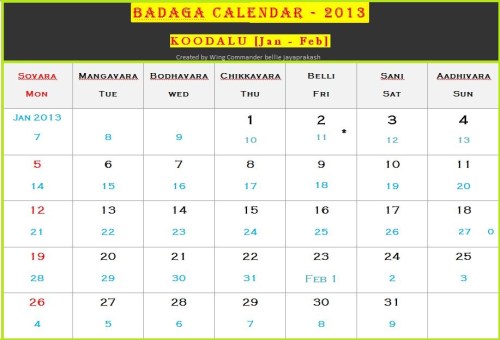
Main Festival – Hethe(y) Habba is on 31 – 12 – 2012

Rajeswari Devabettan comments on Hethe(y) Habba

Very nice messages and the details you have given are enormous & I loved reading it. Every Baduga should see this website. My best wishes! Great going!

Thanks a lot Rajeshwari – the motivation I get to keep going – ‘great going’ as you call it – is when I get such encouraging words like yours – Wg Cdr JP

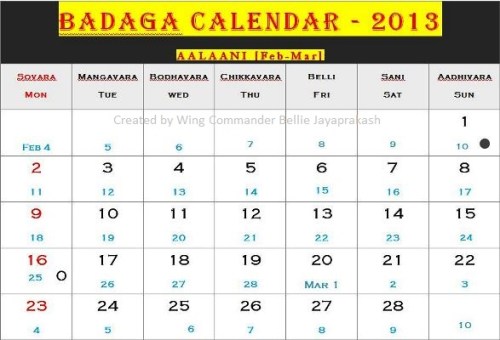
Hethe(y) Habba is always celebrated on the first monday after thirteen full moons

[Hadimooru Hunnavay thaandi da modal sovara].

That is why, it never comes on the same calender day every year.

Saavu Harakke – Karu Harachodhu [1944]

Saavu Harakke – Karu Harachodhu [1944]

Some time early, VIMAL.S [Manjoo?] had sent me a rare publication of ” Saavu Harakke -Karu Harachodu” by Ketti Achanakal M.K.Nanja Gowder  who had given credit to the ORIGINAL author and his father [Ketti Achanakal] late M.Kaala Gowder who published this on 25-9-1944 (Given below)

Late Mr.M.K.Nanja Gowder, was, in many ways the FIRST BADAGA, to have gathered and recorded a lot of information on and about Badagas and published a few of them. His manuscripts were given to many ‘ Foreign Researchers’ and I am not sure where they are now.

How wonderful it would be if we could access these rare manuscripts!

Thank you, Vimal.

Karu Arachodhu 1Karu Harachodhu 2Karu Harachodhu 3Karu Harachodhu 4

N.BELLIE [LIC] adds

“Dear Sir,
I am the younger son of M K Nanja Gowder Ex MP. Thank you for publishing the Saavu Harakke, originally written by Late M Kala Gowder (Miyya Kala Gowder), father of M K Nanja Gowder of Achanakal, Ketti Village.
As you have mentioned in the article, many manuscripts of my father were given to foreign researchers. Also our Badaga researchers and writers of our community collected a number of details about our community, from my father. Mr K P Raju Gowder of Kadasholai village, some teachers of our community, belonging to Thambatty village, Bikkole village, are among the notable scholars. I do not know all of them.

That documents were used to produce to the Central Govt. Officials, to add evidence to include our Community to Scheduled Tribes list”.

Thank you N Bellie (LIC) for the info – JP