Category Archives: badaga

Badaga Recipes

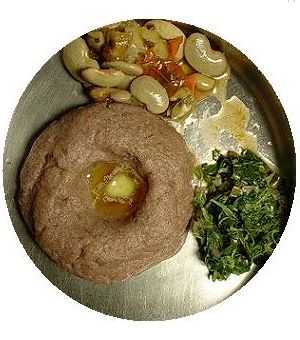
ErigittuErigittu with Thuppa, Avare Udhakka and Keere Soppu

 https://badaga.co/wp-content/uploads/2007/03/misc7307-001.jpg

Thuppadha hittu or Enne Hittu

Badagas usually grow vegetables in their small patch(es) of land called ‘HOLA’ (see photo) for their regular use apart from other commercial crops like potato, cabbage, carrot and cauliflower etc. These would also include many varities of beans, peas, greens, corn etc. Every variety of avere(bean) has a specific (sometimes unique) badaga name. No Badaga wedding meal is complete without ‘Avare & Gaasu udakka’ [beans & potato curry]. Incidentally, Badagas do not serve non-vegetarian (meat) dishes on the wedding day , main meal is called – ‘maduve hittu‘. Another great trait among these simple peasant people is called ‘nattu‘ – a sort of gift (again mainly the home grown vegetables & grains) given to relatives, friends and guests.

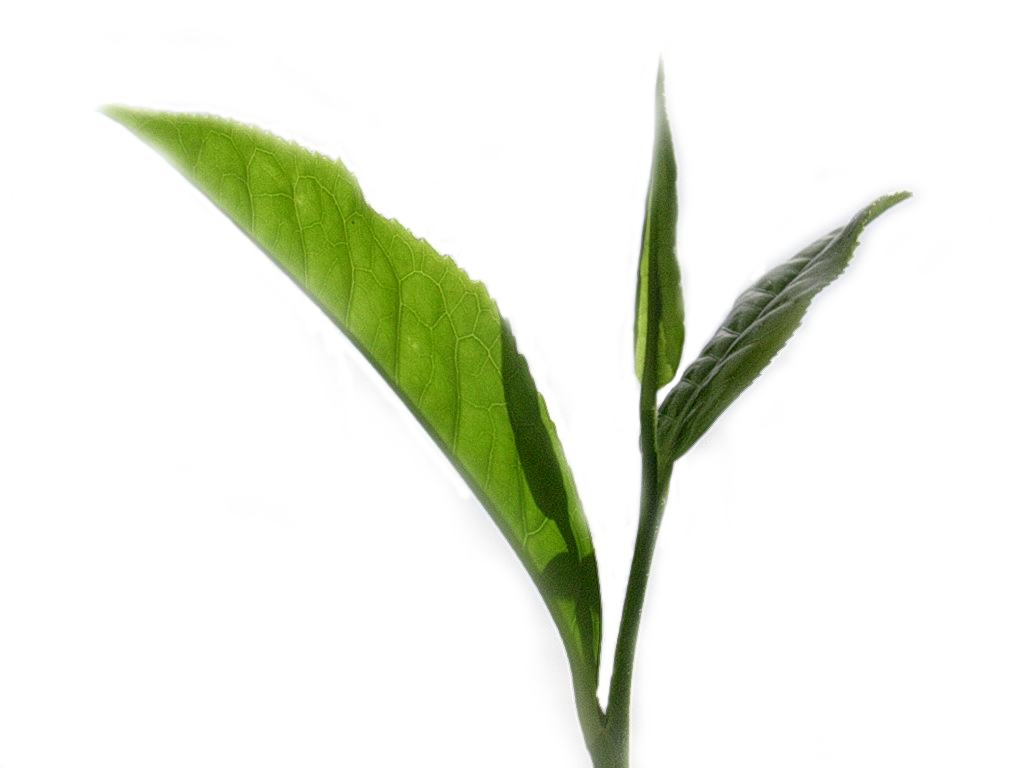
Tea >>Tea Leaves… the crop on which Badaga ‘economy’ depends so much..

The agricultural produce, food, dishes, eating habits and some interesting recipes of Badagas.
Apart from badaga.org, I am thankful to N.Bellie, R.Ramachandran (Kekkatty) and others for their imputs. A lot of info is from Prof.Paul Hockings’s books.
I have tried to discuss and describe, not only of authentic recipes on Badaga dishes but also on their agricultural produce, known in Badaga language as BAE – like for example Badagas used to grow wheat, barley, millet – GHODUME, GANJE, ERAGI, BATHA –etc but have almost completely stopped now.

The food, eating habits, preparations of some dishes as well as the ingredients used are covered. along with the methods used in cooking (like in a mud pot known as MADAKE in traditional fire place – OLE)

It must be mentioned that though many masala powders are available in the market, the Badagas use a specially prepared curry powder known as ‘ BADAGARU MAASU HUDI’ in their preparations.

I remember my childhood days when the dried GANJE / GHODUME (barley/wheat) used to be spread in the fore court of the houses called KERI (street) , between two groups of Hatti HEMMAKKA (ladies) squatted opposite to each other with GANJE DHADIS (sticks of about four feet long and an inch thick) systematically & alternatively beating to remove the chaff. The rhythmic ‘tak tak’ noise would be accompanied by some folk lore Badaga songs. This is known as GANJE SACHODHU.

How can anyone forget the GANJE that would be HURUTHU fied (fried) in a HURI MADDAKKE (mud pot with a hole on its side) through which a HURI KOL (a short stick with cloth tied at one end as a ball) would be inserted and the contents stirred constantly for uniform frying?

Huri Maddakke >

The fried ganje called GANJIKKE would be taken with BELLA (jaggery) and THENKE (coconut). The taste of this would increase if hurutha keerai is added. Used to be a very common snack during the “kodai” season when no one can venture out on account of severe wind and rain.

This ganjikke would be powdered in a ‘ BEESA GALLU ‘ or ‘BEESARAN KALLU’ ( grinding stone ‘flour mill’) that was a permanent feature in the EDHA or NADU MANE and stored for furture use. People who go on long journeys (in olden days travel was by foot only) took this powder along with them, a very handy and healthy meal. This powder would be mixed with hot water to make a gruel. Salt and jaggery could be added to taste.

[ Also see BADAGA RECIPES]

[Illustration by Bellie Jayaprakash]

Edha Mane (notice the Beesa Gallu (Grinding Stone-mill) at the right bottom corner. The corner is called GOTTU MOOLE)

(Buttermilk) MAJJIGE [ also known as – Pay’ray’] KADANJODHU or HAALU SORAKKODU( milk churning ) used to be a routine job and great fun for the children in trying their hands. The BENNE (butter) and THUPPA (ghee or clarified butter) are very healthy. When taken with ERAGI HITTU (wheat ball in the size of cricket/hockey ball), it is very tasty.

EEGAVE THIMBUDHUGA AASE BANDHARAVA ? (don’t you feel like eating now)?

POTHITTU (wheat dosai) has to be an all time favourite of Badagas. During SAKKALATHI HABBA (the last festival before HETHAI HABBA ) POTHITTU with THENKE NEERU (coconut water) is the main dish.

What about dishes like OTTU KUDI UDAKKA (bamboo shoot curry) which can put any BAADU UDAKKA (non veg curry) to shame?And KOONU (mushroom) preparations?

There are many side dishes like SOPPU, BARRATHA AVARE , GAASU SANDEGE Then the question of how to ERAGI HITTU HOKKUDU (make wheat ball?) or make HABBA (festival) specials like BADE (vadai) KAL KAL (sweets made out of maida) etc etc.

Talking about chutney – GAASU SANDEGE , when GAASU (potato) is cooked in KENDA (ember) – SUTTA GAASU – and mixed with UPPU & OLLIYA MAASU (salt & pepper) it really tastes great ……umm…really mouth watering.

Incidentally, a DODDARU SHULOKA (Badaga Proverb) goes like this ; GHANDA (GHANDU) ILLADHA MANE HOLLA, GAASU ILLADHA UDAKKA HOLLA” meaning : -” without a man(husband), house is bad ; without potato, curry is bad”

I was pleasantly surprised to know that Taj Garden Retreat hotel in Coonoor (in the Nilgiris) serves some exclusive Badaga specials like THUPPADITTU & OTTU KUDI curry.

“Since the British lived here for long, there was a mix of the English food with the local ingredients – mostly, the native Badaga food. Thuppathittu, is an example. That makes it different from the typical English food…..For vegetarians, … Ottakudi Gassu poriyal ( a typical Badaga food of potatoes, spices and bamboo shoots), …. Avarai Uthaka (traditional Badaga speciality), Khuni khichri (spice preparation) and Gassu Dhotti (boiled potato preparation)”

http://www.expresshospitality.com/20050808/viewpoint02.shtml

Rasam is called MAASU NEERU ( milagu thanni in Tamil that has found its way into dictionaries).BATHA HOKKUDHU was done by elephants in ancient period, and till a few decades ago, by 50 to 60 bulls and cows brought from the plains (mainly Avinashi near Coimbatore) to the villages and mostly done during night time. One of the methods/processes in storing/pruning our farm produce ERAGI (millet) is known as ” ERAGI METTODHU ” (Stamping).

This is done on the green ERAGI stems freshly harvested from the fields. A bunch of this is put indoors on the floor and squeezed by bare feet . This is done mainly in the night in the EDHA MANE (middle room) and stored in the DHARSAE PETTI / BALLA (storage basket) which is located on top of the HAGALAE (permanentally fixed long wooden plank from wall to wall that also served as a huge cot) in the EDA MANE . See the illustration above.

BALLA or BALLA PETTI is a big cylindrical basket for storage and fixed to the wall/floor by cow dung. There would be hole at the bottom to take out the grain. The hole is sealed with cow dung and removed whenever required. Smaller storage basket is called KUKKE. Depending on the usage they are known as BENNE KUKKE (butter basket), HUYIGAL KUKKE (multi utility basket), DODDA KUKKE (big basket) with a handle to carry mud to clean the temples before puja in the olden days and of course, the GANJIKE KUKKE with smaller baskets attached to a central bigger one used in SAVU (funeral) rites. MAKKIRI was a larger basket used to carry food items to fields (HOLA) and on long journeys.

BESAKATTI is a large flat basket, used for drying grains, hung above the fire place/ hearth ( OLE ) in the inner room (OGE MANE) of a Badaga Home during earlier days.The basket is suspended from the beam with wire rods /ropes (KANNI).

There are a lot of DODDARU SHULOKAs on BALLA (storage container for grains). A couple of them are listed here :

Ballada hattale siri, Kukkeya hattale uri” ,

Baavava balla ethone getta, badava baathu satha

visit Badaga Recipes for more

Continue reading

Nilgiri poetry day

Dharmalingam Venugopal

[Nilgiri Documentation Centre, (Camp) Ahmedabad]

A Nilgiri poetry day will be celebrated as part of the Ootacamund Day on September 13 at the Book Club of Nilgiri Library jointly with the Nilgiri Documentation Centre, Kotagiri. The day will mark the centenary of Nobel prize winning Mexican writer Octovia Paz who wrote a memorable poem on Ootacamund when he was the Ambassador of Mexico in India. The Blue Mountains have inspired poetries of several kinds for hundreds of years. The rich content and melodies of Toda, Kota and Badaga songs are living testimonies of this. The Nilgiri mountains have also inspired the  visitors to pen many memorable poetry. Lord Tennyson mentioned the sweet Nilgiri air in this poem , ‘Brook’. Lord Macaulay is said to have got his ideas for some of his epic poems while his sojourn in Ooty. Later Percy Macqueen, Collector of Nilgiris, collected many folk songs, and donated his manuscript to the Madras University Library. Tamil scholar Ki.Va.Ja. edited the collection, which was published by Saraswathi Mahal Library in 1958. Ki.Va.Ja gave the collection the title ‘Malaiaruvi’. Justifying the title, he compares folk songs to the untrammelled gushing of a waterfall. A folk song, he writes, is like a flower that blooms on an untended plant in a jungle, in contrast to the structured verses of poets, which can be compared to a carefully nurtured jasmine creeper. Macqueen also wrote published  a book Todaland, a collection of his  poems on Nilgiris. Hilton Brown was an ICS officer and Collector of Nilgiris in the 1940s, who wrote a history of Parry & Co, Parry’s of Madras, in 1954. A prolific writer between the 1930s and the 1950s, he wrote a dozen novels, including, Dictators LimitedSusannaLocust FoodThat State of Life and Asylum Island, two collections of short stories, Potter’s Clay and Maya, three collections of verse, including Both Sides of Suez and The Gold and the Grey, two critical biographies — of Rudyard Kipling and Robert Burns — and an anthology titled The Sahibs that he edited and a non-fiction memoir, The Civilian’s South India. Brown wrote several poems on Nilgiris. Beyond the Jungle, a Tale of South India which was published by the Edinburgh publishers William Blackwood  in 1968  was supposed to have been written by  a Sita Rathnamal  who was believed to be a Irula girl from Kil Kotagiri. It seems she was adopted and given  a English education and later she  became a nurse, marrying a Naval officer and wrote a competent autobiography in English which seems to have become a standard book for literature students all over India. She is said to have returned to her small village amidst the jungle and that there is no evidence whether she stepped out of the jungle after this return. Her identity is not still known.

For details of the Poetry Day, pl contact Mrs. Kamala (9442322218)

Badaga Poetry by Wg Cdr JP [Reproduced]

One of the enchanting aspects of Badaga Language is its disarming simplicity. But though the sentences are swathed in sweetness of simple words, it can contain deep expressions of emotions conveyed in the proper usage of rhymes [holla – alla] or pair words [huttu – nattu] apart from other attributes. When the sweetness of this language is combined to carry the human expressions in the form of a poetry, it is a great pleasure to indulge oneself in a world of sheer bliss.
When I came across the following poem, my first reaction was, ‘how beautifully the love of a mother has been brought out’. That set me thinking that there may be many other ‘unsung’ poets among ourselves. How nice if their poems in BADAGA could find a wider audience? I am not talking about some KAVITHAI in Tamil or a poetry in English. BUT ONLY BADAGA POEMS. By the way what is the word in Badaga for poem & poetry? I am sure it is not kavithai or kavi . Cannot be kadhe (song) too. Then……..??
This poem titled ‘My Mother’ by Mohan (hope he reads this and sends more of his creations) beautifully describes the filial bond and eternal love a mother has for her son even in very adverse, trying and difficult situations. She could not find any fault nor found anything demeaning, in the one whom she had brought into this world,nurtured, carried on her hips, cared for and brought up even when the rest of world rejected and rediculed him. I have attempted an English translation and hope I have captured the essence of the deep feelings expressed in the poem.The author has really ‘ played’ with the rhyming Badaga words and forcefully brought out not only the sadness and silent suffering of a son but also the uncompromised love of a mother.
Enna Awai by B.Mohan [of Kunna Bikkatti]
(From ‘Mandhadha Maathu’ – Published by Badaga Welfare Association, Madras, issue dated 1-4-93 (Hannu 3,- Hoo 10)

Kettu Muridhu Naa Kerio Kulibaneyu Huttu Nattu Enna Hollandhu Hegoneyu Hethu Thathi Saakidha Awai Enna Hollandhu Hegule Maathi Allandhu thallule Goonu bhuddu Naa Cooli Geevaneyu Huttu Kettu Naa Maasi Kulibaneyu Pattu Beetha Batte Ekkoneyu Kettandhu Hegule Awai Enna Mattandhu Thallule Kottage Huggi Naa Geria Baakoneyu Araya Kulidu Naa Danava Mesoneyu Horia Thookki Naa Hotte Kaibeneyu Kore Ondhu Hegule Awai Ondhu Ariandhu Nudivile

English Translation of the above poem by Bellie Jayaprakash
My Mother
Even when I was down with poverty and sat at the front court yard, Even when the near and dear ones despised and deserted, My mother who cared for and carried me as a baby, Did not blame me as bad and did not reject me,
Even when I toiled as a Cooli with a bent back, Even when I sat down with my looks dulled and dirty Even when I wore patched up old clothes My mother never gave up nor rejected me as gone !
Even when I swept the stables to clean the droppings, Even when I sat on the rock to tender the cows, Even when I lifted loads so as to suppress the hunger with the earning, My mother never found any fault ; never scolded me as ignorant.

Nilgiri Mountain Railway and Badaga connection

Do you know that there are two Badagas who were very closely involved in the construction and maintenance of the unique Nilgiri Mountain Railways from Mettupalayam to Ooty – Rao Bahadur Hubbathalai J.Bellie Gowder and his son Rao Bahadur Ari Gowder?

In the picture below,Rao Bahadur Bellie Gowder with British Engineers and workers at Bridge No.33 between Coonoor & Mettupalayam. Bellie Gowder was involved in laying the Nilgiri Mountain Raiway, now WORLD HERITAGE, a hundred years ago. He was conferred with the title RAO BAHADUR for carrying out the excellent but challenging contract work of building this unique railway system in inhospitable forest area that also involved in cutting tunnels through rocky hills as well as building many bridges with sheer guts. He employed human power to lift the racks & rails and remove the rocks and boulders. Many of his workers were BADAGAS who addressed Bellie Gowder as BELLIE MAISTRY.

Ari Gowder was also  honoured with the title Rao Bahadur and was given the railway contracts after his father, from 1935 till his death in1971.

hjbgat-bridge33.jpg

This short video is a tribute to them.

________________

———-

****

Tidbits

[Reproduced]

Badaga Inspiration

I love watching the Badaga dance in Coimabatore. Two years back when Amma last was here, and again during Amma’s 53rd birthday celebrations in Amritapuri, they also enchanted the crowd – inspiring westerners, students, and Ashramites to join in . The same happened again this year. Young and old, men and women. Their rhythmic movements, graceful flowing hands and bodies, the beating of drums and call and response voices calls to the dancer inside us. It’s so primal, so natural, and so beautiful. 

One wonders how long these people have been dancing like this – how far back in time? How wonderful that India has been able to preserve these
timeless traditions.

For a while, I was content just taking photos, or watching from the sidelines – focusing on their movements. But I found my inner self wanting to join in. I stood there – conflicted – trying to overcome my inhibitions – people would look at me – a westerner in white awkwardly throwing his body around. But then some westerners did join in, the Badaga happy to show them the movements even as they were ‘throwing a wrench’ into the coordinated movements of those already dancing.

Still, I stood by the sidelines. Then, at the end of the first night, as Darshan ended, and the Badaga still playing, Amma Herself stood up to leave the stage – and made a full circle – turning round with the beat, no inhibition, no concerns. Just dancing…..

The next day, I knew the Badaga would be there again. Would I join in?

Around 2am, they were singing and dancing again. Again, I stood by the sidelines, thinking about how Amma was so natural, innocent when She danced. I recalled how Amma says it’s just not enough to stand at the shore of the ocean and just get your feet wet. You have to dive in. I recalled how I overcame my fears when I used to go firewalking (walking on hot coals) – I would stand there trying to convince myself that it would be fine. It just takes a leap of faith…

In a moment of surrender, I joined the line. I found myself behind a Badaga man who was more than happy to call out the movements and changes as we made our way around the circle. I loved it. At times, it was awkward, but once I got the jist of it, it seemed so natural, so beautiful. When we were in synch -hands, legs, arms, – it was so nice – like a huge drum circle when they reach that magical moment when all the drummers are connected and the music just flows. So did our bodies-around and around, faster and faster.

I can’t wait till the next time..

Sri Pati, USA
Coimbatore, 23 January 2007


Enna Alli Mutta Beda…

A couple of days back I received the following email  from David McCreedy :

I’m looking for translations for four sentences in Badaga to add to my web site:

Currently the site lists over 500 languages in their own writing systems, everything from Afrikaans to Zulu, ancient Egyptian hieroglyphics to Braille.

I realize this request is rather odd…  Please let me give you some background:  My best friend from college has, since graduation, traveled extensively for her employer.  So much in fact that she JOKES she only needs to know four phrases in the local language to get by:

1)  Where is my room?
2)  Where is the beach?
3)  Where is the bar?
4)  Don’t touch me there!
I am hoping that you can provide me with translations preferably using the native/normal writing system for the language as well as the Latin alphabet.
I will appreciate any effort you can make. Thank you,

And here is my reply :

Your email to me. Quite interesting. Here are the Badaga – equivalents –
1)  Where is my room? – Enna Roomu ellie? என்ன ரூமு எல்லி?
2)  Where is the beach? – Beechu ellie hadadhey? பீச்சு எல்லி ஹடதெ?
3)  Where is the bar? – Baaru ellie hadadhey? பாரு எல்லி ஹடதெ?
4)  Don’t touch me there! – Enna allie mutta beda! என்ன அல்லி முட்ட பேட!

You can ‘see’ the Four Essential Travel Phrases at http://www.travelphrases.info/languages/badaga.htm

~~~~~~~~~~~~~

<strong>~~~~~~~~~~~~~~~~~~~~~~~~~~~~~~~~~~~~~~~~~~~~~~~~

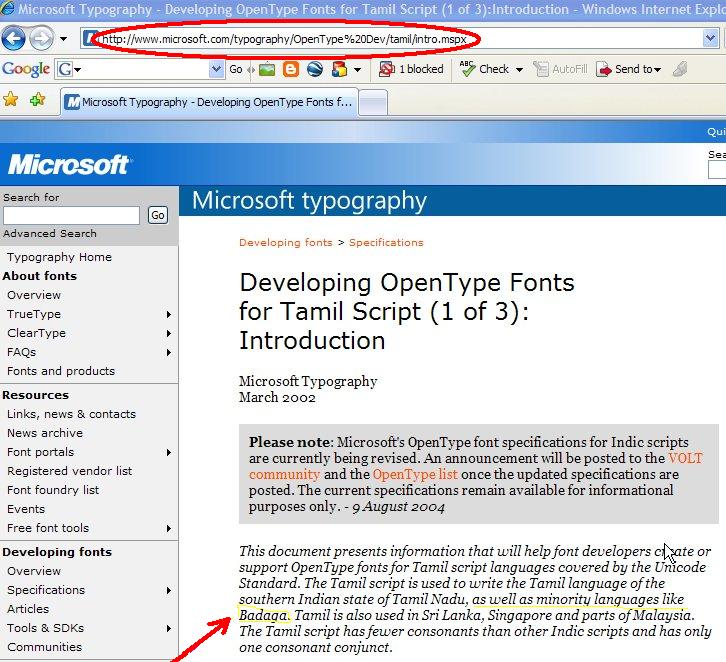
Microsoft on Badaga Language….

ms-onbadaga.jpg

@@@@@@@@@@@@@@@@@@@@@@@@@@

Limerick on Badaga

[found on the net]

screenshot.jpg

___________________________________________

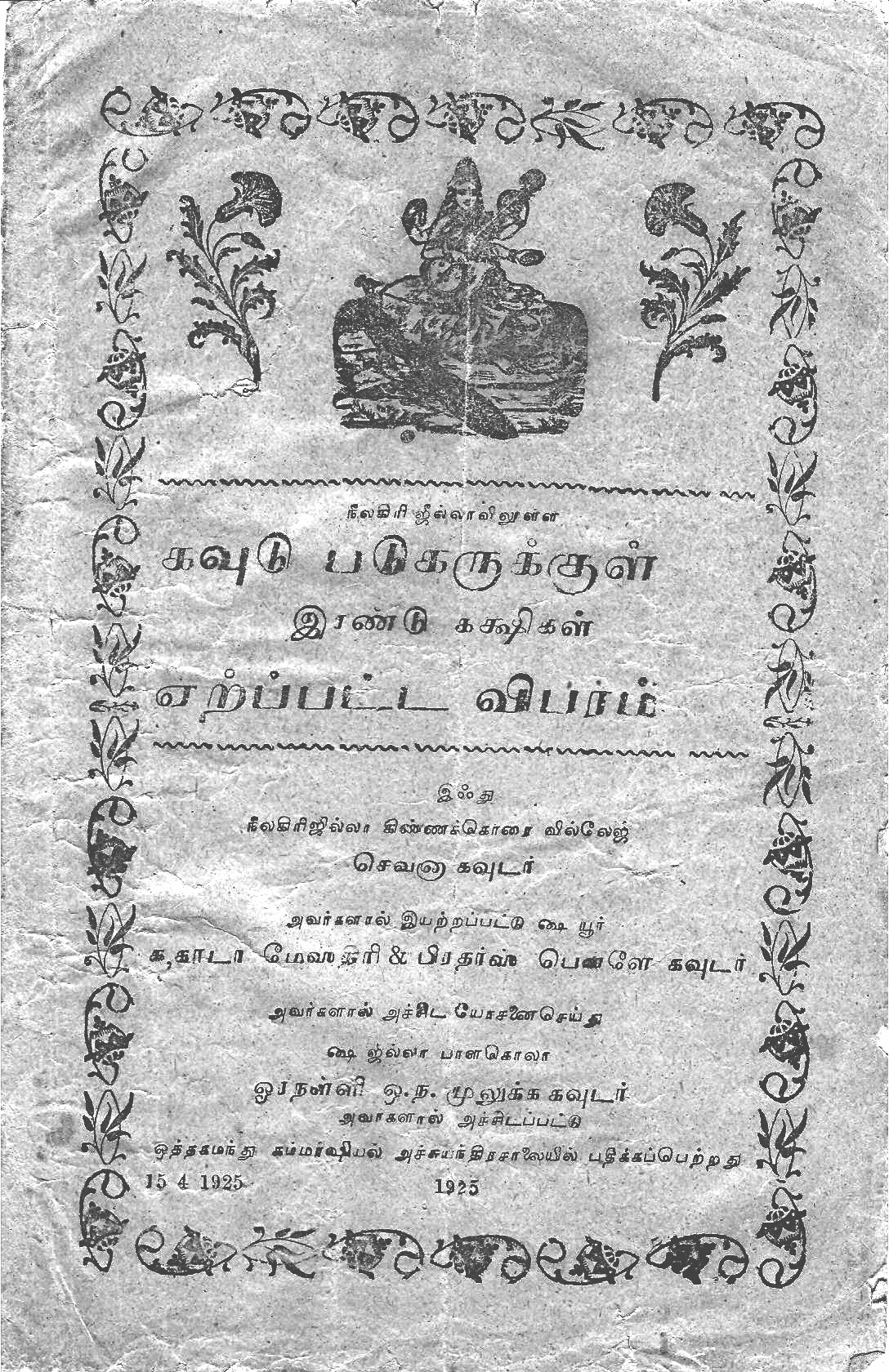
This must be the first book(let) published in 1925 about a very pressing and serious problem that split the Badagas vertically

[Original Cover page in Tamil ]

firstbadagapublication.jpg

firstbadagapublication5.JPG

[English translation interposed]

~~~~~~~~~~~~~~~~~~~~~~~~~~~~~~~~~~~~~~~~~~~~~~~~

I came across this interesting article while searching about Badaga music that goes with the unique dance form,

[H]ethai amma in Kovai [by Sakshi]

Seventy kilometers north of Coimbatore, in the Nilgiris hill town of Ooty, resides a community of people known as the Badaga. The Badaga trace their ancestry back to Ethai Amman, a pious woman from Mysore who fled the city when a Muslim king wanted her as his prize. Theirs is a somewhat cloistered community, stretching across some 500 villages in the Nilgiri Hills, which make the border of Kerala, Tamil Nadu and Karnataka.

The Badaga have their own customs, codes, traditions and language. Dharma, faith, compassion and service—these are the hallmarks of the Badaga. They will proudly tell you that one will not find a single beggar among their “brothers and sisters” and rarely are any of their children born handicapped. (They attribute both of these to their culture, which nurtures service-mindedness.)……

…..A central element of Badaga culture is music and dance. When inspired, the Badaga will spontaneously begin improvising melodies and lyrics. “It is our way of expressing our fondness for someone,” explains Smt. Sivagami, [a Badaga teacher].

Their often-ecstatic music comes in the form of call-and-response, and some say the Badaga even have a form of telepathy, which enables them to improvise cohesively. The words and melodies are ever new, but the dance steps remain the same, regardless of the occasion. The Badaga sing and dance at weddings, births, funerals and nearly all other occasions……..

The music was an onslaught of drums and cymbals. It was an earthy, powerful and glorious ruckus to which the Badaga’s synchronized slow-motion dance served as a stirring and poignant counterpoint……

Read the complete article here

<><><><><><><><><><><><>

GANGAMMA

[from the book FOLK-LORE IN THE OLD TESTAMENT]

by James George Frazer – 1918

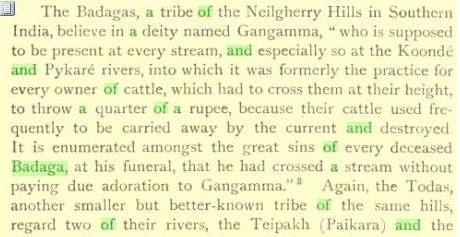
The Badagas, a tribe of the Neilgherry Hills in Southern India, belieive in a deity named Gangamma, “who is supposed to be present at every stream, and especially so at the Koonde and Pykare rivers, into which it was formerly the practice for every owner of cattle, which had to cross them at their height, to throw a quarter of a rupee, because their cattle used frequently to be carried away by the current and destroyed. It is enumerated amongst the great sins of every deceased Badaga, at his funeral, that he had crossed a stream without paying due adoration to Gangamma.

gangamma.jpg

Crossword in The Hindu about BADAGA

In ‘The Hindu’ newspaper of June 17,2008, crossword No.9252 carries the following clue for a six letter word for 5 Across:….. ” SHEEP’s CRY CAPTURES GADABOUT, A TRIBAL (6)”….. Yes. your guess is correct. Sheep’s cry is ‘BA’….. [Of course, as usual the answer to the crossword 9252 was given the next day June 18, 2008 in crossword no.9253]. Info Courtesy – my wife who is more fond of crosswords and sudoku than me – sob sob !! ….. See the crossword here !

No articles, images and other material in this website can be reproduced without the written permission of
Wing Commander Bellie Jayaprakash B.E.(GCT,Madras Univ).,M.B.A (FMS, Delhi Univ)
Contact : bjaypee@gmail.com
belliejayaprakash©2014

:::::::::::::::::::::::::::::::::::::::::::::::::::::::::::::::::::::::::::::::::::::

Dhoddaru Shloka – Badaga Proverbs

One of the fascinating and interesting aspects of Badaga [both people & language] is the free use of delightful but deep meaning proverbs called “DHODDARU SHLOKA”. When you engage an elderly Badaga into any conversation, you are sure to hear a lot of these proverbs thrown in to make / emphasise a point. Prof. Paul Hockings, probably the most authentic researcher on and of Badaga lists nearly two thousands Badaga proverbs, 1730 to be precise. He feels that 1730 could be a complete figure containing all the proverbs there are. See his book,’Counsel from the Ancients: Study of Badaga Proverbs, Prayers, Omens and Curses’. He has given the meaning in English as well as making it easy to understand, in a beautiful manner.

Though I find his collection extremely interesting and educative, I do not agree with some of the conclusions he draws on certain proverbs. For example, on the proverb, ‘Odhidhama Niddhana, Oddidhama Erandina’ Prof.Hockings interpretation is quite different to what I feel is the correct meaning. I think ‘a person who spends time learning and ponders (over a problem) is better than the one who runs away (in a hurry) and thus trips over. [Odhidhama – one who has learnt (spent time learning), Niddhana – stops to ponder over[think], Oddidhama – one who runs, Erandina – trips over]. We can hear mothers telling their young children ‘Oda beda , Erandire’ – Donot run, you will trip over (a stone or any obstruction). That is ‘ do not be in a hurry and take a hasty decision’.

Another one is ‘Michidhavaga Morande Kolu Bangara’. In my opinion . the lady who does not listen to any one (Michidha Hemmathi) is bound to land up as a widow (when ‘Morande Kolu – a small stick of morende tree – replaces her jewellery (bangara) during the Ole Kattuva ritual of husband’s death / funeral ceremony). Prof.Hockings feels Mechidhavaga (see the difference between michidhava – one who does not listen- and mechidhava – one who is appreciated by all – even a morende kolu is enough as jewellery. Is it a case of wordplay (pun) by our ancestors??

I have listed a few of the proverbs below and hope to add more in future.

[Sources : Interaction with Fellow Badagas, ‘Naakku Betta’ monthly (1979) –Edited by K H Madha Gowder, Achanakal, Ketti Post , ‘Naakku Seeme’ monthly – May 2006, Edited by K.M Nanjan, Kil Cowhatty Village, Muthorai Post,

Counsel from the Ancients: A Study of Badaga Proverbs, Prayers, Omens and Curses By Paul Hockings]

Continue reading

Echo of First World War in the Nilgiris

Dharmalingam Vengopal [Nilgiri Documentation Centre, Kotagiri]

dv2dv 1

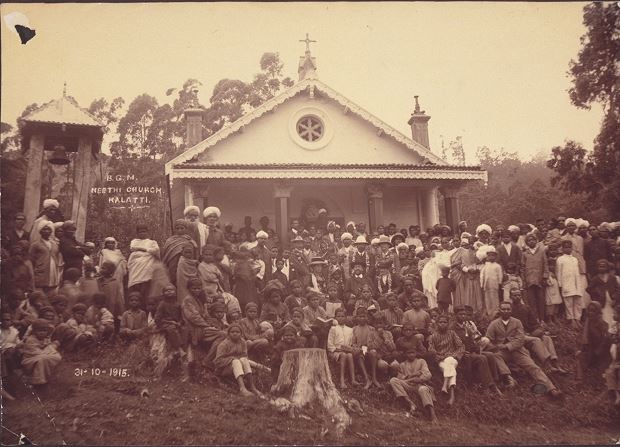
As the centenary of the First World War is being solemnly observed world over, the beautiful BEM Neethi church on the slopes of splendid Kalhutti valley in the Nilgiris also silently observes its centenary as a victim of the global war.

The Basel Evangelical Mission (BEM) was established in Basel in Switzerland in 1815 by German and Swiss missionaries who worked in Africa, China, South East Asia and south India. Their work began in 1834 in the Malabar area and spread to Karnataka and south Maharashtra.

Basel Mission came to the Nilgiris in 1845 at the invitation of retired judge G.J.Casamajor who donated his entire property at Ketti to the mission. The first missionary to arrive was Michael Buhler, a gifted linguist, who was the first to document Badaga folklore including the Badaga forefather sayings and ballads. He was the first to put, ‘Badaga language and culture on the scholarly map’. Buhler died young at the age of 37. Several  Badagas attended his burial at St. Stephen’s church at Ooty where Judge Casamajor was  also buried.

‘Thanks to the missionaries, many Badaga villages have had primary schools for longer than thousands of comparable small communities in Canada, the United States, South Africa or Australia’ says Prof.Paul Hockings, an authority on Nilgiri studies.

Exactly one hundred years after the mission was founded its missionaries were unceremoniously sent out of India and their properties confiscated as ‘enemy property’ after the outbreak of First World War in 1914.

dv3

The BEM Neethi Church stands a mute witness to the global war which had its echo as far as the peaceful Nilgiris.

Join In the Nation Building

One of Prime Minister Modi’s initiatives ‘MyGov’ is to make the citizens to be a ‘part’ of Nation Building’.

Let us Join In to make this country the best

MyGov –  ‘The citizen-centric platform empowers people to connect with the Government & contribute towards good governance’.

Click here

~~~~~~~~~~~~~^^^^^^^^^^^^^^^^~~~~~~~~~~~~~

Independence and Freedom!

Misc 025

Independence day

by Bellie Jayaprakash

August fifteenth.
Independence day.
Freedom from occupation of the land
by aliens. Celebrations.

But what about freedom
from exploitation of gender and hunger
from fights over caste and religion
from inequality based on creed and region
India, my great land of legends
when are you going to be really FREE?

#######################

Freedom Struggle in the Nilgiris

Dharmalingam Venugopal

Notwithstanding its remoteness and the influence of the British, the Nilgiris played its due role in the freedom movement. Mahatma Gandhi’s visit to the hills from Jan 31 to Feb 4, 1934 stoked the freedom call. Gandhians like Rev.C.F.Andrews and Marjorie Sykes further encouraged the movement among the locals. The house arrest of Sarat Chandra Bose, brother of Netaji Subash Chandra Bose in 1942 in Coonoor and his address in public meetings influenced many inhabitants of all classes.

Mrs.Anne Besant, George Arundale and B.P.Wadia were interred in Col.Olcott’s house in Ooty from June to September 1917 for their role in Indian Home Rule movement.

The freedom struggle not only touched the most numerous Badagas, it also equally influenced the small community of Todas on the hills, who composed  a remarkable  song to welcome Gandhi to the hills.

O wise man!
The like of you has been neither made nor born!
Who is was that acquired learning first? Mahatma.
Who it was that acquired wisdom first? Mahatma.
Who it was that behaved like a father to all? Mahatma.
Who it was that released all men from fetters? Mahatma.
Who it was that fought with the tiger? Mahatma.
Who  it was that did what he considered right? Mahatma.

Toda songs have both a lyrical component as well as a melodic component. The songs consists of several lines. The essential component of each line is a ‘konh’ which comes from the memory of the senior Todas describing various significant events on the hills.

Need for All Nilgiri Badagas Union (ANBU)

Dharmalingam Venugopal

[Nilgiri Documentation Centre, Kotagiri]

The Nilgiri district administration’s open mind to consider the positive winds of change among the feuding factions of the Badaga community is praise worthy. However, a lasting solution to the recurring problem and a competent body to take over the YBA Building should take into to account representations from across the Badaga community.

Badagas have always been socially conscious and have been forming various associations and advocacy groups to spread social, cultural, economic and ecological awareness among the community. A federation of all such groups will be the best representative body of the Badagas to manage common community assets like the YBA building and to make representation to  district, state and central administrations on the problems and welfare of the Badaga community.

All registered social, cultural and economic welfare associations including bajan and music groups and modern groups based on websites and social media as well  as documentation centres can form an umbrella organization which may be called All Nilgiris Badagas Union (ANBU ) or GAVA, the equivalent of the word  love in Badaga.

Only such a federation would reflect the glorious traditions of the Badagas together with the high achievements and aspirations of the community spread world over. Such a body will be capable of bringing all the two lakh odd Badagas under its active fold, mobilize enough funds and undertake necessary welfare and developmental activities.

The management can be of two tiers. The traditional leaders or the Parpathis and can be the patrons of the Union whose functioning can be managed by an Executive council  with due representations to the four Nadus and the various eligible associations.  A management consultant can be engaged to frame the criteria of eligibility, functions, laws and bylaws. The Union should be the sole voice to represent the Badaga view to the administration and  mediate in  local issues and disputes.

One third of the Executive Members should be necessarily women.

The YBA building can be managed professionally by a paid Manager and a Accountant, preferably non-Badagas,  to the satisfaction of all groups.

A library and a cultural gallery depicting the history and culture of the Badaga community should be the top priority of the new management.


Mahendra commented on Need for All Nilgiri Badagas Union (ANBU)

Sir, there is no doubt, our community needs a bonding body which can interact with every village. I hope all the seniors and experience elders like you can take up this task by approaching every village. As you have mentioned that Badagas have always been socially conscious and if every house becomes a member for the association then the bargaining power may increase. Badaga words for abbreviation only may give emotional touch for naming the association. beyond this with my limited knowledge, to get social identity, I humbly wish to suggest a celebration every year on a great personality who worked for the up lift meant of our community. District administration may be approached for the celebration and have a statue of such a personality at Coonoor or Ooty. Through my grand father I came to know about one of the great personalities Rao Bahadur Bellie Gowder, the great man who lit the light of education to our community. Like him other great personalities might be there in our community and those personalities can be remembered. Finally we must respect our community ladies for their hard work which helped our community’s development along with education.

____________________

Bellie N commented on Need for All Nilgiri Badagas Union (ANBU)

Dear Mr Venugopal, Your article seem very good and productive. If it is implemented our community will be united in alll aspects, and will get good knowledge about our culture and all. But unfortunately there was a Federation of all of our community Associations. The first hurdle started at that stage only. The ego and power fight between the Federation and YBA started and some unnecessary difficulties started there. At one stage all the leaders of Federation and YBA decided to stop the functioning of Federation. OK past is past.

I humbly suggest all our leaders to prefer YBA as our Apex Body for all the Badaga Organizations throught the Nation and Abroad. Any Association started at any place in India and abroad should be affiliated with YBA, and its name should be the same YBA followed by their respective area, like YBA, Coimbatore, YBA, Chennai and so on. As YBA is situated in our Native Nilgiris head Quarters, and all the Naakku Betta people are the members of YBA,, it is obviously the sole Association for our whole community. Of course all the other Associations, out of Nilgiris should be given representation in the Governing committee, and office. i hope it will be a welcome suggestion, I hope.

I welcome other opinion, to get a wide discussion in this matter.

Gayatri Mantra and Hethey Prayer

Gayatri Mantra, the most important prayer, inspires wisdom and is also a prayer to the “giver of light and life” – the sun (savitur), ‘Hothu’ in Badaga.
If you analyse the prayer to  Goddess Hethey [by listening to many Hethey songs], you will find striking similarities with Gayatri Mantra!
|:*:|:*:|:*:|:*:|:*:|

Gayatri Mantra

OM BHOOR BHUWAH SWAHA,
TAT SAVITUR VARENYAM |

BHARGO DEVASAYA DHEEMAHI,

DHIYO YO NAHA PRACHODAYAT ||

ॐ भूर्भुव: स्व: तत्सवितुर्वरेन्यं । भर्गो देवस्य धीमहि, धीयो यो न: प्रचोदयात् ।।

ஓம் பூர் புவ ஸவ |
தத் ஸவிதூர் வரேண்யம் |
பர்கோ தேவச்ய தீமஹி |
தியோ யோன பிரசோதயத் ||
[Oh God! Thou art the Giver of Life, Remover of pain and sorrow, The Bestower of happiness, Oh! Creator of the Universe, May we receive thy supreme sin-destroying light, May Thou guide our intellect in the right direction]
To listen to Gayatri Mantra go here
Most of the information has been taken from the net and may Goddess Gayatri bless all those authors who have put so much info on the net so that they are freely available to any one.
~~~~~~~~~~~~