Dharmalingam Venugopal is a man of many talents. His knowledge on the history of the Nilgiris is phenomenal. His campaigns on ‘Save the Nilgiris’ are well known and brought in rich dividends. He is also involved in saving the rich tribal culture of the blue mountains called the Nilgiris in South India. He is member of many organisations that are involved in the preservation of the mountains. Recently he participated in an UNO sponsored event in the USA.
As part of a well thought out strategy to preserve the cultural traditions of the hill tribes like Badagas, Thodas and Kothas, he had organised ‘The Music of the Mountains’ in 2006 and ‘Mountain Melodies’ in 2008 at Music Academy and British Council respectively at Chennai.
In a recent meeting at my place in Coonoor, Dharmalingam Venugopal shared many of his thoughts that were highly educative and greatly impressive. He was kind enough to share the videos taken on the above mentioned ‘musical events’ and has permitted them to be made public.
The following clip of Badaga Dance is just a small ‘trailer’ of the many more video clips that will follow :
Our Goddess Hethe stands for everything pure – pure as perfect white.
On this auspicious occasion of Hethe habba, wishing all the visitors and viewers a very happy Hethe Habba !
Ondhu, ombaththu aagali!
Bandha hechchali, badhukku Hechchali!
Kattidhadhu karayali, biththidhadhu baeyali!
Bhuddhi bevarava Kodali!
Uri Hogi, Siri barali!
Siri sippathi aagali!
Pava pariya nodi,
Olagadha hesaru eththi, Badhukki baa!
—-
May good multiply nine fold!
May wealth and affluence grow!
May milk and crop be plentiful!
May intelligence and wisdom be given!
May jealous (and) anger give way to happiness!
May you care for dear and near!
May you prosper in life with name and fame!
Hethe Habba has started in its full glory and grandeur.
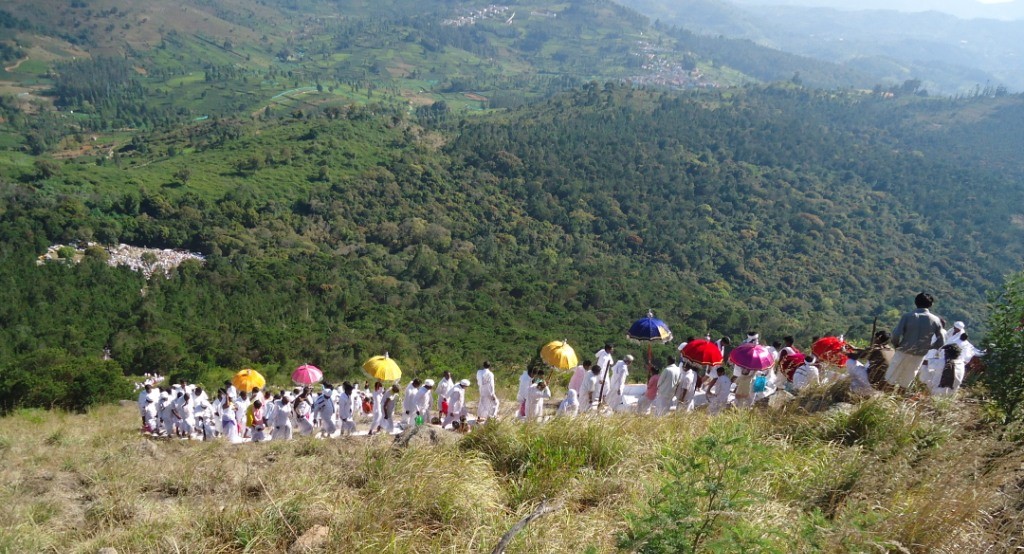
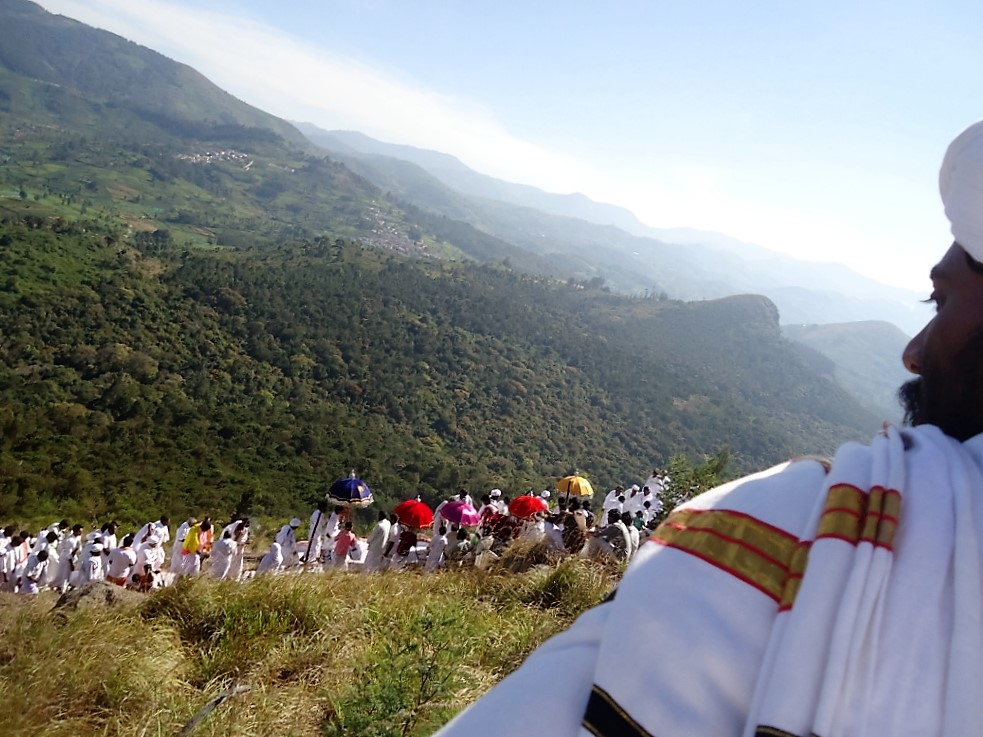
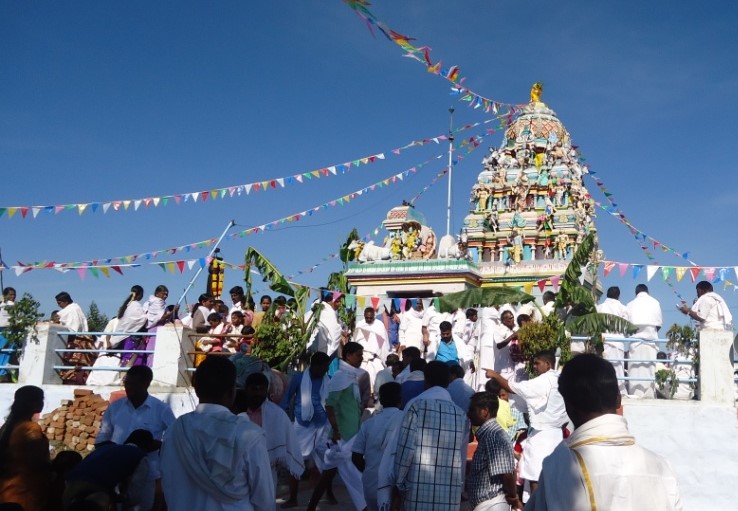
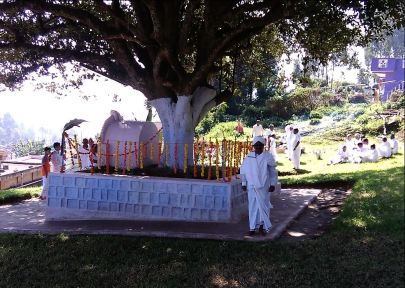
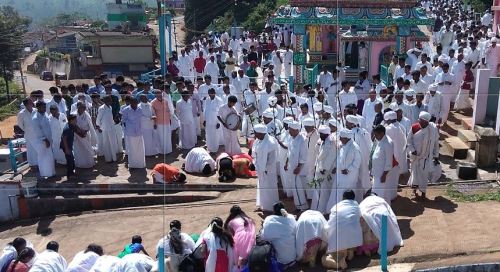
The following pictures [taken on 25-12-2015] are of the traditional send of to the men [only male members are permitted] ‘going to Hethe Manay’ from Hubbathalai.
Some of these men carry a ‘holy’ wooden staff known as ‘DHADI’. These Dhadis are passed on from generation to generation in that particular family and are limited to every village. No new ‘Dhadi’ is permitted to be carried to Hethe Mane [temple].
As always, it takes place on the Friday – Bellie- in Badaga, preceding the main festival that always falls on a Monday, Sovara in Badaga.
On this day, every house in the hatti, pays a religious donation- kaanikke, of five HANA [in the olden days, a hana means a four anna -25paise coin and hence a total of one rupee and four annas or Rs.1.25]; now a days it can be five one/five rupee coins] and that is given at the SUTHTHU KALLU [sacred stone at the base of an olive tree – bikka mora], see the photos below. Usually, along with this mandatory FIVE HANA, people donate more money.
This donation is carried by the men/boys who go to Beraganni and Pedduva and paid in a ceremonial function known as ‘HANA KATTODHU -paying the money’. The amount is proportionately shared between the two Hethe Temples and spent on the puja and annadhana [free food] to the lakhs of devotees who throng these temples during the week long celebrations of Hethe Habba.
Hette, the weeklong annual worship of the ancestress of the Badagas of Nilgiris, which begins today, coincides this year with several auspicious days – the Vaikunta Ekadesi, Milad-un-Nabi and Christmas- underlining the multi-cultural divinity of the Nilgiri mountains.
Abbe Dubois, the French pundit of Hinduism wrote in 1848 , ‘There is one of these holy mountains in the district of Coimbatore. It is called Nilagiri-malai…the Hindus have made it a punyasthala or place of virtue…as it is very difficult to reach the top of this mountain, a view of the summit alone is considered sufficient to remove the burden of sin from the conscience of any person who looks at it, provided that he looks at it with that intention’.
According to an account, the famous Kalighat temple of West Bengal had its origin in the Nilgiris. A devote named Brahmananda Giri who was alone meditating in the Nilgiri hills decided to commit suicide as Kali would not appear to him. Goddess Kali not only appeared to him but also took him along with another devote to the present Kalikshetra.
It was in Kotagiri that the sacred Hindu scriptures, the Vedas, were first rendered into English by Rev. R.T.H. Griffith between 1880 and 1899.
Dargahs of famous Islamic saints who lived in the Nilgiris are still worshiped in places like Pandalur and Ooty.
Guru Nanak is believed to have visited Nilgiris on his second ‘Udesi’ around 1507 on his return from Sri Lanka. He is said to have passed through Cochin, Palghat and Srirangapatnam.
Shri. Aurobindu Ghose visited Ooty in 1895 at the invitation of Maharaja Sayajirao Gaekwar of Baroda.
Sree Narayana Guru visited the Nilgiris in 1926 and suggested the location for the present Gurukula at Ooty.
The Ramakrishna Mutt in Ooty is believed to have a special vibration among all Mutts in the country. Young J.J. Godwin, the stenographer of Swami Vivekananda, lies buried in St. Thomas’ Church at Ooty.
Rabindranath Tagore visited Nilgiris in 1919 as part of his tour of south India and stayed in Ooty about ten days
Since the British days, the Nilgiris has been an important centre for missionaries from several countries. Rev. C.F. Andrews, a close associate of Mahatma Gandhi stayed in Kotagiri for several months in 1942.
[ Mahatma Gandhiji had visited the Nilgiris in 1934 and stayed at Mount Pleasant, Coonoor, as part of his South India tour. He himself has written about this in detail – Wg Cdr JP]
The Nilgiris has also been the home of Theosophists from their beginning from Madam Blavatsky to Dr. Anni Beasant.
[Nilgiri Documentation Centre,Kotagiri, The Nilgiris ; 9444365360]
on
International Mountain Day 2015
December 11 is International Mountain Day.
This year the theme is promoting mountain products.
Globalization offers opportunities for mountain producers to market their high quality mountain products, such as coffee, tea, tourism and handicrafts at the national, regional and international levels. Though mountain products cannot compete with the prices and volumes of lowland production, they can concentrate on high value, high quality products to boost local economies.
Photo by – JP
Very few mountains in the world compare with the Nilgiris in the range of products and services provided by these mountains.
The Nilgiri mountains of Tamil Nadu is unique in several ways. Scientists classify the Nilgiris as a ‘Living Fossil’. Ecologists say the biodiversity of the Nilgiris is ‘found nowhere else in the world’. Anthropologists describe the Nilgiris as an ‘aboriginal enclave’. Geographers have listed the Nilgiris among the 400 natural wonders of the world.
There are 348 mountains in the Nilgiris identified and named by the Badags since time immemorial. Of these, 256 are above 2000metres; 90 between 1000 and 2000 metres and 2 are below 1000 metres. 229 mountains are in Ooty taluk; 71 are in Kotagiri taluk, 38 are in Coonoor taluk and 10 are in Gudalur taluk.
Doddabetta (Big mountain) is the highest at 2637 meters followed by Kolari betta (2625 meters) and Kudikkadu betta (2590 meters). The Mukurti peak (2554 meters) and the Nilgiri peak (2474 meters) are popular mountains.
Three major rivers (Bhavani, Kundah and Moyar) originate in the Nilgiris.
Nilgiris is the home of nearly 300000 indigenous people with unique cultural heritage.
The economic benefits of Nilgiris is, again, outstanding.
– 2.5 million tourists visit the Nilgiris annually round the year.
– Nilgiri produces 700 MW of hydel power
– Nilgiri waters irrigate 2,47,247 acres of land in three districts below
– Several towns below use Nilgiri waters for drinking
– Nilgiri forests stock 1.5 billion tons of carbon
– All most all available land is cultivated without irrigation
– Nilgiri produces 590000 tonnes of tea which have been described as, ‘finest on earth’ by American Tea Association.
– Nilgiri has been producing ‘English’ vegetables for two hundred years with the current production of 69000 tonnes of carrots, 44000 tonnes of Cabbage and 36000 tonnes of potatoes.
Today is Bhagavad Gita Jayanti. Which means today is the day when Bhagavad Gita was spoken by Lord Shri Krishna to his very first disciple in the form of human i.e. Arjun. Tomorrow Bhagavad Gita will complete 5151 years.
What is the Bhagavad-Gita?
The Bhagavad-Gita is the eternal message of spiritual wisdom from ancient India. The word Gita means song and the word Bhagavad means God, often the Bhagavad-Gita is called the Song of God.
Why is the Bhagavad-Gita called a song if it is spoken?
Because its rhyming meter is so beautifully harmonic and melodious when spoken perfectly.
What is the name of this rhyming meter?
It is called Anustup and contains 32 syllables in each verse.
Who originally spoke the Bhagavad-Gita?
Lord Krishna originally spoke the Bhagavad-Gita.
Where was the Bhagavad-Gita originally spoken?
In India at the holy land of Kuruksetra.
Why is the land of Kuruksetra so holy?
Because of benedictions given to King Kuru by Brahma that anyone dying in Kuruksetra while performing penance or while fighting in battle will be promoted directly to the heavenly planets.
Where is the Bhagavad-Gita to be found?
In the monumental, historical epic Mahabharata written by Vedavyasa.
What is the historical epic Mahabharta?
The Mahabharata is the most voluminous book the world has ever known. The Mahabharata covers the history of the earth from the time of creation in relation to India. Composed in 100,000 rhyming quatrain couplets the Mahabharata is seven times the size of the Illiad written by Homer.
Who is Vedavyasa?
Vedavyasa is the divine saint and incarnation who authored the Srimad Bhagavatam, Vedanta Sutra, the 108 Puranas, composed and divided the Vedas into the Rik, Yajur, Artharva and Sama Vedas, and wrote the great historical treatise Mahabharata known as the fifth Veda. His full name is Krishna Dvaipayana Vyasa and he was the son of sage Parasara and mother Satyavati.
Why is the Mahabharata known as the fifth Veda?
Because it is revealed in the Vedic scripture Bhavisya Purana III.VII.II that the fifth Veda written by Vedavyasa is called the Mahabharata.
What are the special characteristics of the Mahabharata?
The Mahabharata has no restrictions of qualification as to who can hear it or read it. Everyone regardless of caste or social position may hear or read it at any time. Vedavyasa wrote it with the view not to exclude all the people in the worlds who are outside of the Vedic culture. He himself has explained that the Mahabharata contains the essence of all the purports of the Vedas. This we see is true and it is also written in a very intriguing and dramatically narrative form.
What about the Aryan invasion theory being the source of the Bhagavad-Gita?
The Aryan invasion theory has been proven in the 1990s not to have a shred of truth in it. Indologists the world over have realized that the Aryans are the Hindus themselves.
What is the size of the Bhagavad-Gita?
The Bhagavad-Gita is composed of 700 Sanskrit verses contained within 18 chapters, divided into three sections each consisting of six chapters. They are Karma Yoga the yoga of actions. Bhakti Yoga the yoga of devotion and Jnana Yoga the yoga of knowledge.
When was the Bhagavad-Gita spoken?
The Mahabharata confirms that Lord Krishna spoke the Bhagavad-Gita to Arjuna at the Battle of Kuruksetra in 3137 B.C.. According to specific astrological references in the Vedic scriptures, the year 3102 B.C. is the beginning of kali yuga which began 35 years after the battle 5000 years ago. If calculated accurately it goes to 5151years from today.
What is the opinion of western scholars from ancient times?
According to the writings of both the Greek and the Romans such as Pliny, Arrian and Solinus as well as Megastathanes who wrote a history of ancient India and who was present as an eyewitness when Alexander the Great arrived in India in 326 B.C. was that before him were 154 kings who ruled back to 6777 B.C. This also follows the Vedic understanding.
When was the Bhagavad-Gita first translated into English?
The first English edition of the Bhagavad-Gita was in 1785 by Charles Wilkins in London, England. This was only 174 years after the translation of the King James Bible in 1611.
Was the Bhagavad-Gita also translated into other languages?
Yes. The Bhagavad-Gita was translated into Latin in 1823 by Schlegel. It was translated into German in 1826 by Von Humbolt. It was translated into French in 1846 by Lassens and it was translated into Greek in 1848 by Galanos to mention but a few.
What was the original language of the Bhagavad-Gita?
The original language of the Bhagavad-Gita was classical Sanskrit from India.
Why is Srimad often written before the Bhagavad-Gita?
The word Srimad is a title of great respect. This is given because the Bhagavad-Gita reveals the essence of all spiritual knowledge.
Is history aware of the greatness of Srimad Bhagavad-Gita?
Historically many very extraordinary people such as Albert Einsten, Mahatma Gandhi, Dr. Albert Schweitzer, Herman Hesse, Ralph Waldo Emerson, Aldous Huxley, Rudolph Steiner and Nikola Tesla to name but a few have read Srimad Bhagavad-Gita and were inspired by its timeless wisdom.
What can be learned by the study of Srimad Bhagavad-Gita?
Accurate, fundamental knowledge about God, the ultimate truth, creation, birth and death, the results of actions, the eternal soul, liberation and the purpose as well as the goal of human existence.
[recd as a fwd email]
You can listen to Bhagad Gita in Anuradhs Paudwal’s beautiful voice here
Hubbathalai Bellie Gowda ARI GOWDA was born on this day in 1893 and was the first Badaga graduate.
Though his father Rao Bahadur HJ Bellie Gowda was a great Badaga Nakku Betta Leader, who brought in many reforms to not only Badaga Communiity but tried to bring in all the other tribal groups like Toda, Kotha and Kurumas together. Being credited with the laying of Nilgiri Mountain Railway from Mettupalam to Ooty, he was also instrumental in starting a free school and hostel for Badaga boys at Hubbathalai, as well as a strong Scouts Movement during the British time.
Ari Gowda, carried on the legacy of his father after his death in 1935 and brought in far reaching social reforms in the Nilgiri Hills. Being a MLC and MLA even during the British rule,he succeeded in making the Nilgiris free of the curse of drinking that ruined many families, with prohibition in 1943.
Ari Gowda was not only well known in the Nilgiris and then Madras state, he was declared as one of the 100 influential persons of Asia. The road in front of Mambalam Railway station in Chennai is named after him.
Though, he passed away in 1971, the undisputed fact is that there is no Badaga Leader like him since. Not yet.
On his birth anniversary, we bow our heads in repect and reverence!
Climate Change is realty. Chennai ( formerly Madras, the HQ of Madras Presidency) is in distress. We have all had connection with Chennai one way or the other. It is now time to rise up to Chennai in its hour of dire need. Working together is far better than working piecemeal.
The Nilgiris is the only district in the state to share the honour with Chennai of being a capital of the state. For nearly 70 years, from 1870 to 1933, the Nilgiris was the summer capital of Madras state.
The Save Nilgiris Campaign was started in the 1980s to save the Nilgiris. For thirty years it was Chennai and its citizens who supported the Save Nilgiris Campaign. It is now the time to repay the debt of gratitude.
The Nilgiri Documentation Centre has taken an initiative to coordinate all the support from the Nilgiris to the unfortunate brothers and sisters of Chennai.
A help in time is a help indeed. Time is essential. Chennai is starving and shivering. It is our mountain tradition to take to them food and warmth.
All donations in kind and cash are welcome. But it must be useful.
We will collect them at your door step.
Nilgiri can support in several ways- give cash, give teas, give varkies and other confectioneries, give vegetables, give sweets and chocolates, give used and new clothes and finally give love and affection.
For coordination contact 9444365360, 9942545085, 9442791531, 9789927510.
In his book, THE GOLDEN BOUGH – A STUDY IN MAGIC AND RELIGION (1922) Sir James George Fraser (1854 – 1941) mentioned the following :-
Among the Badagas of the Neilgherry Hills in Southern India, when a death has taken place, the sins of the deceased are laid upon a buffalo calf.For this purpose the people gather round the corpse and carry it outside of the village. There an elder of the tribe, standing at the head of the corpse, recites or chants [known as - "KARU HARUCHODU"] a long list of sins such as any Badaga may commit, and the people repeat the last word of each line after him.
The more I listen to the song 'Kappu Uttileyu', the more fascinated I become. All the 12 Badaga months starting with Koodalu [given in Capital Letters] are beautifully integrated within the song.
Bugiri Music Academy presents Videos/Songs to bring about mindset change to Badagas
Hethegu Dhukkaththa - by Porthy SJ Mani
A great song that describes the evil practice among a few Badagas who despise other Badagas, known as Nattaru, settling in a village which is not native to them but probably have married from that same hatti (Vilage). Great lyrics, haunting music and a video with mainly Thooratti Village people in the cast.
Sholur G Raman is one of the greatest Badaga singers. Gifted with a golden voice, he composes his own songs and adds a lot of punch to the lyrics. His dance number " Mele Kerioge" is the hottest song for atta in any Badaga Function. A great singer and a simplton, music is in blood and has done a a yeoman service to spread Badaga songs far and wide,
Badaga dance is all about grace and style. It is a wonderful sight when a group of ladies dance together. During the funeral, the ladies of the parental village [hatti] of the deceased woman, dance going around the cot [kattalu] to the music provided by the 'host' hatti musicians.
English Translation of the above poem by Bellie Jayaprakash
My Mother
Even when I was down with poverty and sat at the front court yard,
Even when the near and dear ones despised and deserted,
My mother who gave birth, cared for and brought me up,
Did not blame me and did not reject me- her son, as bad
Even when I toiled as a Cooli with a bent back,
Even when I sat down with my looks dulled and dirty,
Even when I wore patched up old clothes,
My mother never said that I was down ; never rejected me as poor!
Even when I entered the stables and cleaned the dung,
Even when I sat on the rock and tendered the cows,
Even when I lifted loads to earn so as to suppress the hunger,
My mother never found any fault ; never scolded me as ignorant.
Dhoddaru Shloka
Some Badaga Proverbs [Dhoddaru Shloka]
~~~~~~~~~~~~~~~
1.Akka Ghandana koda dhukka hegile, Makka maria buttu baa ennana (When
sadness is shared with elder sister’s husband, his advise is to
come to him) 2. Aandama ellade Haandi Beya, Ullama ellade Gulla
beya 3. Kiviga elladadu kombuga aeththaga 4. Guttige [Kuttige?]
bathavu arai aaga beda, kunna thammanu mella aaga beda 5. Kumbala
kaaya [Kumbakkeya] saaki handiga kottenge (Growing pumpkins only to feed wild boar) 6. Gumboonda Mola edda enge [like a hare jumping out of the bush -element of surprise] 6a.Eragi holaga mola hugga enge [ like a rabbit getting into a wheat field -destruction by deceit] 7. Sadiga madi elle 8. Saththu biththa kaaye 9.Saththaduga hinde etha holae eana? (After death, how does it matter where you go?) 10.Saththa Koyee, baththa mukkirava ? (Can a dead hen feed on grains?) 11. Gollaru mada kattida enge 12.
Ghandu gundu, hennu helavu 13. Ghandu kulidu ketta, Hennu thirigi [hisithu] ketta (The boy wasted his life by idling/lazying around
(sitting), the girl wasted her life by smiling (turning around) at strangers 14. Ghanda thoorile, kandamanu thoorina [when the
husband neglects, everybody follows] 15. Ghanda ebbane buddi elle,
buddi bappane ghanda elle (Wisdom did not come when husband was alive, when wisdom came husband was not there) 16. Gana ellade
sande aaga, sangadhi ellade daari sameya (Evening does not end without gossip, way does not end without some news) 17. Koyigu
kothigu maake (Like a hen and a cat [always fighting]) 18.Koy(iy)a Kaethaa maasu arappadhu (Do you ask the hen [being
killed for dinner] for grinding the chilli paste?) 19. Kona neeruga baggiravo, neeru konaga baggiravo [Will the bull bend to
drink water, or, water bends for the bull? -Implying
impossibility] 20. Kothi aatta, eliga prana sangada (The antics of a cat are matters of death to a rat) 21. Kothi kaala baase
denge (Like the cat licking its leg) 22. Savi kanda kothi attalu hathidenege 23. Koduva cooli nodu, kathuva olaya nodu [keep a watch at the wages being paid (and hence get work done) and keep a watch at the burning embers in the kitchen] 24.Kodalia kaavu, kolava kedu maadira 25. Kotta hennu nela arige 26.Kotta saalava kaeyade ketta, bithida holava nodade ketta (Suffering
by not asking the loan to be returned, nor looking after the planted[with seeds] fields) 27. Kai yoge kannaadiya beethindu neerunamoga nodidha enge (looking for the reflection of the face on thewater when there is a mirror in the hand) 28. Kai eelu aaga guddili masiya [the implement not bend as per the shape of bones in the hand] 29. Kaiga bandadu bega elle (What came to the hand did not reach the mouth) 30. Ketta arasa buda beda mikka
kannava eda beda 31. Kulidhu athamaga kulidhu avvu, niddhu athamaga niddhu avvu (Cry sitting with the one who cried sitting
with you, cry standing with the one who cried standing - pay in the same coin- –
proper and equal reciprocation 32. Kuradaga hagalu ena er uena (How does it matter whether it is day or night for a blind
man?) 33. Sandhe jaamana meiyu, saaku hoththu bandha nattan uhoga (The evening rain and the guest who had come with a hessian
cloth[bag] covering will not go easily) 34. Sappodu saare, Haagottudoora 35. Chiikkavanaalayu Sivana buddi (Even though he is veryyoung, has lot of wisdom like Lord Siva) 36. Ollitha ethi hollava
thallu, olagodho ellava gellu (Take only the good leaving behind the bad and win all in this world) 37. Hallana neeru hattaleyu
baavi neeru hechu 38. Thaaya palichileyu neera pallicha beda (Even
if you [have to] show scorn to mother, never do it to water [the
source of life]) 39. Kasa aaleyu rusi maadi thinnu (Even if it
is rubbish, eat it after making it tasty) 40. Natta maneye
hattaleyu, ghanda mane hesara ethu 41. Kicha muttile attira (If
you touch the fire, it will burn you) 42. Hottiya kitcha beethale
kettara 43. Aaru kaasuna sambuva aaleyu, aranmaneya gelacha
maadu 44. Adhista mooru p(b)aala, harakke aaru paala 45. Kitcha
thindama karia Hedana (One who eats fire, excretes charcoal) 46.
Nanga belli holladale thattana koda horatta ena 47. Ghandana
ollithundhu undia dhottadhu ekka beda 48. Maneya nududhu mandhaga
hogu 49. Maathu hetchi mane ketta, bithu hetchi hola ketta 50.
Aadindu holae maathu, agadundu holae mannu [Agadhale mannu, Nudidhale
maathu] 51. Hanja theedhara(theegira) maathu niddara 52.
Thandeya koddamana paadhava hidi 53. Thindhu santhosha aappadhuna,
nodi santhosha aagu 54. Avvaiya halladha nodile magava nodudhuga
mane enaga 55. Huttone anna thamma, hoppane dhayada kaara 56.
Sandhe aappile endhu hoga beda, baaga aappile endhu era (oraga)
beda 57. Kathu potti, hethu baradi 58. Ethu elladhamaga edha
elle, makka elladhamaga mane elle 59. Nangaga bandhale allu
thundhu, Ooruga bandale opedha kai 60. Hasanooru haala
kudipadhuna, Neelagiri neera kudhi 61. Moladha kanna neera, bettai
kara aradhaneya 62. Hadadhe endhu hatta maada beda, kette endhu
kaeda thora beda 63. kette endhu kaeda thora beda, baddendhu bava
thora beda 64. Sikkanuna badakku batta baiyilu 65. Niri
chikkira, hari chikka 66. Huttu daridharaga kottu dhandodhu
daara 67. Thale thatty nela nodi nade 68. Aandama illade aandi
bethadava, ullama illadhe gulla bedharava 69. Hitta andhu kondu,
battaya nidhu kondu 70. Balla beethu baddiga hoga beda 71.
Arasana makkaga hurikallu muthu 72. Aeye pyla moyae nodu 73.
Anai koodi halla, theni koodi batha 74. Thitta thevara otha
beda 75. Anna thammana agala maada beda 76. Thaaya maatha kethu
nodadhey nyaya hadadheya, thandhya maatha kethu nodadhey handhi
hadadheya 77. Madi buddu maaruga sedhara, hennu buddu nattaga
sedara (Madi buddale maaruga, ele buddale meduga) Added :- 78.
Badagava makka huttu , Badegega Athu AAgha Beda 79. Hothu Banda
Kathiya , Ooruna ebba Kathe othara 80. Badavaga Badukku Bandale,
Thinguva Beesiluna Kode Hidithana 81.Bendhamana Hunna, Nondhama
Ariyakku 82.Usara Kotta Kothi , Nosala Nakkira 83. Thalaiyamana
Maathu, Mundhuga Uppu – Hinduga Bella 84.Appana Maathu,
Aneya Bala 85. Bae Aadileyu Bae ga Kedu, Seegi Aadile yu Bae ga
Kedu [A word play-pun- on Bae which means both the mouth and crop
[vellamme] 86. Mundhileyu Mookku Hagga, Hindileyu Kaal
Kanni 87.Akka Ellade Natto, Avare Ellade Uttavo
On your Mobile
Now you can access our website www.badaga.co on your smart phone.
Remember to access many multi media posts like Badaga Songs and Dance.
The beauty about Badaga community is not only the unique customs specific to the community but the steadfast belief with which atleast some of them are followed by Badagas. One of them is the loud chanting of ‘Athikkodhu – EAY AH HOW – on certain but specific occasions. It is said that in earlier days [hundreds of years back], when the Badaga villages [hattis] were separated by thick jungle forests , 'athikkindu Hoppadhu ' - traversing the forest with loud athikkodhu chant - kept the wild animals away.
Three occasions, when this loud chanting takes place, come to mind immediately,
1)During “Hethay Habba’ – both when from every village the devotees go to Hethay temples at Beragani and Peddhuva [as well as when the Hethay deity from Hethai Gudi is taken to ‘Madi Halla -river’ for change into new dress once a year].Also, and whenever a hatti temple deity is taken on procession during habbas in hattis],
2) During weddings when the bride and groom are brought to the ‘Madhuvay Mane – wedding house' and the newly weds are taken to the temple and
3) On funerals when the widow is brought for ‘olay Kattodhu’ and the ‘akki eththuva ‘ procession starts from the ‘dhodda Mane’ to ‘saavu hanay ‘ where the corpse/body is kept before being taken for burial.
This loud ‘chanting /cry’ is made from the bottom of the stomach by a few leading the procession and repeated by the rest following them.
I have given the ‘live’ recordings of this unique chanting (recorded during a wedding [the band playing in the background] at Thambatty
That is a lot of hits for a website [weblog] on BADAGA that is focused on a small community of the Blue Mountains - the Nilgiris, in the southern part of India. Is it due to...
the urge to know the unknown about ourselves....
to sift the truth from fiction....the satisfaction that we have a very unique history.....the mystery about the mistaken migration.....the traditions that are still steadfastly followed.....the great language that has survived for centuries without a script...
The simple fact that this site's motto of 'Proud to be a Badaga ; Proud to be an Indian' has become an accepted norm...
You all, my dear friends, have made me bow my head in gratitude.
Proud to be an Indian and proud to be a Badaga, indeed.
Hope to say - 'thanks a million' soon...
Wg Cdr Bellie Jayaprakash, is the 'All-in-One' of this site. He started this site as a hobby but now, it has become an obsession. This website crossed the milestone of 100,000 visitors on 8-3-2010, 150,000 visitors on 20-4-2011, 200,000 visitors on 6-4-2012 , 250,000 on 22-1-2013, 300,000 hits on 6-1-2014, 350,000 on 6-1-15 and 400,000 on 13 -11-2015550000 hits on 1 Jan 2018. Feel humbled but proud
Once in a way, we get to hear a song which instantly registers both in mind and heart. The golden voice you hear in this saavu [funeral] song is, beyond any doubt, excellent and haunting.
Thomas Chandy (thomaschandy@gmail.com) writes:-
"This is my first visit to this site and was surprised to know how ignorant I have been about the Badaga community. All that I have read makes me hang my head in shame for I have been growing up in the Nilgiris, among the Badagas and I was so ignorant about their origin,culture and so on. This write up is very informative and useful and may the Badaga community grow and spread through the whole world and prosper".
"Thank you Thomas. I am humbled at your kind words. May I hope that the Badagas will live up to your hopes, and thank you once again on behalf of the Badaga community – Wg Cdr JP"
Learn Badaga
” Ollenge iddiya ? - How are you ?”
‘Suddi saddha ella olliththa ? (Roughly) Hope everything is ok ‘
1. Are you a Badaga ? - Nee ondu Badagana?
Yes, I am a Badaga - Ha, Na ondu Badaga
2. What is your name ? - Ninna hesaru aena ?
My name is .... Enna hesaru .....
3. Which is your village ? - Ninna Hatti edhu ?[3a. Amme / Thamma, nee ai hatti ? - Girl/ Boy, which is your village?]
My village is Bearhatti - Enna Hatti bandu Bearhatti
4. Whose son/daughter are you ? - Nee dara maathi / hennu ?
This is the the first time I am visiting this site.... It took 5 hours to go through this site, you have done a fantastic job. Its just like a bible for our next generation. Thanks for your commitment!
Badaga
From the heart
Do you feel very strongly about any issue concerning Badaga Community? Have the urge to pour your heart out ? Feel free to express yourself without any inhibition and send them tobjaypee@gmail.com
~~~~~~~~~~~~~~~~~~~~~~~
Save the TIGER
Tiger is HULI in Badaga Lanuage
Read any Indian Newspaper
Read any Indian Newspaper. [ In all Indian Languages]
CLICK HERE
------------------------
Bhuvaneshwari R writes :- This website is one of the best I have seen. Didn’t think I would find so much detail about our culture.
The history of origin of Badagas is quite fascinating. Photos are also really great.
Really good to see someone do an effort to spread awareness.Thank you…
~~~~~~~~~~~~~~
Learn Badaga
Welcome, one and all!, Baarivi, Ollengay Iddhara?
Ninna hesuru aena?- what is your name?,
Nee Ae hatti? - which is your village?,
Appana hesuru? - Father's name?],
Maduvey aai buttava?- [Are you] married?,
Ganda,Elliya gelcha gheedhana?- where is [your] husband working?,
Here's a question that was posed to the Dalai Lama:
"What thing about humanity surprises you the most?"
His answer is : "MAN - Because he sacrifices his health in order to make money. Then he sacrifices his money to recuperate his health. And then he is so anxious about the future that he doesn't enjoy the present,
And as a result he doesn't live in the present or the future. And he lives as if he's never going to die and then he dies having never really lived".
Once in a way, we get to hear a song which instantly registers both in mind and heart. The golden voice you hear in this saavu [funeral] song is, beyond any doubt, excellent and haunting.
Dedicated to my mother Mrs.Idyammal Bellie Gowder [1912-2011] who gave everything to me
That is a lot of hits for a website [weblog] on BABADAGA that is focused on a small community of the Blue Mountains - the Nilgiris, in the sosouthern part of India. Is it due to...
the urge to know the unknown about ourselves....
to sift the truth from fiction....the satisfaction that we have a very unique history.....the mystery about the mistaken migration.....the traditions that are still steadfastly followed.....the great language that has survived for centuries without a script...
The simple fact that this site's motto of 'Proud to be a Badaga ; Proud to be an InIndian' has become an accepted norm...
You all, my dear friends, have made me bow my head in gratitude.
Proud to be an Indian and proud to be a Badaga, indeed.
Hope to say - 'thanks a million' soon...
Wg Cdr Bellie Jayaprakash, is the 'All-in-One' of this site. He says that he started this site as a hobby but now it has become an obsession.This website crossed the milestone of 100,000 visitors on 8-3-2010, 150,000 visitors on 20-4-2011, 200,000 visitors on 6-4-2012 , 250,000 on 22-1-2013, 300,000 hits on 6-1-2014, 350,000 on 6-1-15 and 400,000 on 13 -11-2015550000 hits on 1 Jan 2018.600000 hits on Sep 2018 Feel humbled but proud