Dictionary…

Dictionary is the only Place where
The word Death comes before Life
 

End comes before Start 
Child comes before Parents 

Divorce comes before Marriage 
Evening comes before Morning 

Result comes before Test 
Destination comes before Struggle 

Dinner comes before Lunch 
Doctor comes before Fever

However, the THING I consider right in Dictionary is that  
Friends comes before Relative.

[recd as a fwd email]

Badagas who make us proud

There are a few exceptional Badagas whose entrepreneurship and talents  can  take them to places anywhere in this globe. They succeed in whatever field they choose to go ahead with sheer hardwork and dedication.

These Badagas are, an inspiration to all of us.

Lingan Krishnan  [I have never met him so far] is one such person. I was quite surprised but very happy to see his email to me in which he had mentioned that he is a practising lawyer In the Bombay High Court. Wow, a Badaga high court lawyer in Mumbai, was my first thought. Surprise did not end there when I learnt that he is also an ex-fauji. He has started a Trust that can  be of immense help to Badagas.

Thank you L. Krishna. You make us proud!

Email from  Lingan Krishnan [lingan.krishnan@gmail.com], a Lawyer in Mumbai High Court

Hello Sir,

I belong to Adigaratty Village and was  born on 10 May,1946. I do not recollect my father’s face since  he breathed his last  when I was 8 years old. My mother, a poor soul, brought us  up (one elder brother and two younger sisters) and she too passed away  this year ie on 26th April, 2012. Every year, Theer Festival used to be celebrated in our village in a grand way, which continues even today. My mother used to compel me to attend the same but never I was able to do so.

About 20 years back, one day while discussing about the festivals, Mom was bit up set for  my not visiting the Hatty at least  once  a year, and requested me to at least contribute the Theer Festival expenses fixed by our village Gowdars every year.That particular day I decided to keep her wishes alive and promised her that I would  contribute for the festival not only for one year but till my mother’s last breath.

As per my mother’s wishes, my little contribution towards the festival has been going on for the last twenty years and now. My Mom is no more now, hence I decided to continue my contribution till my death. While going through your web site I felt my mother was sitting with me and forcing me to do something for the common needy people.. Thanks for the unforgettable memories flashed back in my mind while going through the wonderful initiations and inspirations exposed vide your web site.

With regards to my education and experiences.   have done M.A and LLB. Had put in 15 years service in the Army, In the Regiment of Artillery.  Joined  as Manager Administration in Lupin Laboratory and left Lupin after 13 Years of service to take up  the responsibilities of a GM with Cybertech Systems and Software Ltd through which I could visit US for six times.  I retired from Cybertech in the year 2007 after rendering 12 years of service and then started practicing Law.

In Bombay, we started Bombay Badaga Association in the year 1990 and I was the President for 7years. Under  my command, we conducted quite a number of Tours and Picnics beside various programmes.  We released a Souvenir in the year 1995, and the interesting things to be  noted here is that, our Souvenir had the messages of celebrities of Politics, Cricket, Films, Police Big Vigs and even Gazal Singers.

This combination  was my personal test and I had taken a month holiday from my job  to meet all those famous people ultimately with the aim of releasing an excellent Souvenir. Subsequently, the Souvenir got appreciated by Badaga Associations of Chennai, Balgalore, Coimbatore, Erode an many more individual personalities of our Baduga community.

Some how due to various exigencies of services, my service to the community  could not  go further.  Now, after 15 years of interval, my mind again started revolving round the Social Welfare Activities and as such I got a Trust named    SENIOR CITIZEN WELFARE ASSOCIATION,THANE (WEST) registered,  under which, I have plans to help the aged people in various grounds.  Further details on this will follow.

Based on this NGO I want to do some favours to the Badagas  staying abroad. Any thing required from Bombay like, transportation
facilities, escorting relatives, children and even sight seeing
arrangements can also be arranged by my NGO at Bombay. Any investment part in Moumbai or educational activities including placement etc can be arranged if any one needs it.

The support extended from our N.G.O is listed below.
  We plan to assist seniors in the following areas:

 1.       Supporting and escorting the seniors during exigency
2.       Medical  assistance through NGO doctors
3.       Creating opportunities for the Seniors to engage themselves
4.       Classes for Yoga and Meditation
5.       Providing hygienic food at reasonable rates
6.       Financial assistance to the seniors
7.       Assisting in legal matters
8.       Anything related to real estate
9.       Arranging Mumbai Darshan/ Visit to Essel world

The extension of our NGO is to support the needy youth (will be executed at the later stage)

1.   Public speaking / Language classes
2.   Hostel facility for working class (ladies and gents separately)
3. conducting coaching clases for appearing in the IAS/IPS/Service selection boards.

I really need your suggestions and guidance in this regards.

Regards
L.Krishnan

Ravi Belliraj writes

Mr. L. Krishnan, such a great person I ever met in my life. He was my best friend cum brother in 1990s in Mumbai. Myself also an ex. Member of Bombay Badaga Association in 90’s.
Thanks and Namaskara Krishnanji.
Ondu Saavira Aagi Arasa Kodali.
PROUD TO BE A BADAGA.

Aside
Exclusive

Casteless Badagas

by Dr. R.K.Haldorai

Badagas were not under the influence of caste system in any part of their history. In caste system a person’s social status was determined by his occupation. Although caste depended upon a person’s occupation it became hereditary in due course. So, it is inevitable to a person to live with a unalterable particular social status throughout his life. The traditional association between caste and occupation is far from dissolution.

Badagas apparently changed their occupations to suit the environment. They never developed stigma with any particular occupation. It is to be noted that the very name Badaga itself is not derived from any occupation. In India, most of the caste names are derived from occupations. Badagas major occupations were food gathering, hunting, buffalo rearing, millet cultivation (that too swift cultivation for some time) and cash crop cultivation. Among these a particular occupation was predominant at a particular time. And also all the sub groups of Badaga community engaged the same occupation.

Badaga population was very small up to the beginning of the twentieth century and they spread over the entire Nilgiri plateau. In that case, for a long period there were very few families in a hatty (hamlet) and all the families were descended from a same forefather. So, there was a social compulsion to venture occupations in common. The origin of the caste system in India is shrouded, but it seems, it originated some two thousand years ago. Caste system is associated with religion and people were categorized by their occupations. Badagas’ religious beliefs were primitive in nature, so the religious side of their social organisation was lacking to originate caste system Continue reading

Slow Dance

This is a poem written by a teenager with cancer. She wants to see how many people get her poem. This poem was written by a terminally ill young girl in a New York Hospital.

Badaga connection

A lot of Badagas have died due to the curse of cancer – including breast cancer. Many of them could have been saved had it been treated in the initial stages. Take care of your dear and near ones – Wg Cdr JP


SLOW DANCE

Have you ever watched kids On a merry-go-round?
Or listened to the rain  Slapping on the ground?
Ever followed a butterfly’s erratic flight?
Or gazed at the sun into the fading night?

You better slow down. Don’t dance so fast.
Time is short. The music won’t last.

Do you run through each day  On the fly?
When you ask How are you?  Do you hear the reply?
When the day is done  Do you lie in your bed
With the next hundred chores, Running through your head?

You’d better slow down.  Don’t dance so fast.
Time is short.  The music won’t last.

Ever told your child,  We’ll do it tomorrow?
And in your haste,  Not see his sorrow?
Ever lost touch,  Let a good friendship die
Cause you never had time,  To call and say,’Hi’

You’d better slow down.Don’t dance so fast.
Time is short. The music won’t last..

When you run so fast to get somewhere
You miss half the fun of getting there.
When you worry and hurry through your day,
It is like an unopened gift. Thrown away.

Life is not a race. Do take it slower
Hear the music.  Before the song is over.

——————-

This poem is supposed to be from a special girl who will soon leave this world due to cancer. This young girl has 6 months left to live, and as her dying wish, she wanted to send a letter telling everyone to live their life to the fullest, since she never will. She’ll never make it to prom, graduate from high school,or get married and have a family of her own.

PS : From the net it is seen that this poem’s original author is David L Weatherford

CULTURAL HERITAGE

CULTURAL HERITAGE

by  Dr.R.K.Haldorai [exclusive article]

The innate philosophy of the life of ‘naaku betta’ (the people who live in the hilly region, Badagas) can best be understood from the tradition bound age old hatties (hamlets). The hatty (hamlet,village) is a group of persons as well as an aggregate of land holdings. The village life is highly characterized by various rites and rituals. The village life of Badagas had attracted the serious attention of the scholars even during the colonial administration of the British. Few indigenous scholars’ contribution in this regard is remarkable. The result of these studies have got significant role in reconstructing society’s lost glory and reviving cultural heritage.

The Badagas are an ethnic and linguistic minority tribal group with a distinct culture and heritage of their own. The socio-cultural life of Badaga village is largely influenced by customs and traditions with profound antiquated background. This can be explored and analysed through holistic approach of the regional condition based on certain universal thoughts and ideas as well as unified activities.

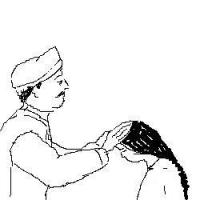
The history of a society is largely the history of the thoughts and deeds of masterminds. These men of mighty will, vision and wisdom impart new hopes, new life and new direction to a society. In fact the ancestor of Badagas imparted humanism and compassion to their society that was enmeshed in a complexity of rituals. For example, one can note how a salutation passes between two when they meet each other. The younger stands in front of the elder inclines his head slightly and says bandiya, ayya, mamma etc., (grandfather, uncle etc., you have come). The elder replies ‘badak, badak’ (blessing, blessing) and rests his right or both of his hands on the top of the younger. Though the word ‘badak’ usually means ‘live’ here it is used in the sense ‘flourish, prosper or live long’. Uttering these words the elder reveals his felicitation to younger without any prejudice. Whereas the younger shows his profound reverence to the elder. The elders took up with joy the task of shaping the future generation and discharged their duties in an exemplary manner. The elders of the village settled disputed arising among the village folk who were well acquainted with the norms. Justice was meted out at the very place where the dispute took place. It was inexpensive and immediate.

Continue reading

Badaga Food Habits

Badagas usually grow vegetables in their small patch(es) of land called ‘HOLA’ (see photo) for their regular use apart from other commercial crops like potato, cabbage, carrot and cauliflower etc. These would also include many varities of beans, peas, greens, corn etc. Every variety of avere(bean) has a specific (sometimes unique) badaga name. No Badaga wedding meal is complete without ‘Avare & Gaasu udakka’ [beans & potato curry]. Incidentally, Badagas do not serve non-vegetarian (meat) dishes on the wedding day , main meal is called – ‘maduve hittu‘. Another great trait among these simple peasant people is called ‘nattu‘ – a sort of gift (again mainly the home grown vegetables & grains) given to relatives, friends and guests.

Tea
Tea Leaves… the crop on which Badaga ‘economy’ depends so much..


The agricultural produce, food, dishes, eating habits and some interesting recipes of Badagas.

Apart from badaga.org, I am thankful to N.Bellie, R.Ramachandran (Kekkatty) and others for their imputs. A lot of info is from Prof.Paul Hockings’s books.

I have tried to discuss and describe, not only of authentic recipes on Badaga dishes but also on their agricultural produce, known in Badaga language as BAE – like for example Badagas used to grow wheat, barley, millet – GHODUME, GANJE, ERAGI, BATHA –etc but have almost completely stopped now.

The food, eating habits, preparations of some dishes as well as the ingredients used are covered. along with the methods used in cooking (like in a mud pot known as MADAKE in traditional fire place – OLE)


It must be mentioned that though many masala powders are available in the market, the Badagas use a specially prepared curry powder known as ‘ BADAGARU MAASU HUDI’ in their preparations.

I remember my childhood days when the dried GANJE / GHODUME (barley/wheat) used to be spread in the fore court of the houses called KERI (street) , between two groups of Hatti HEMMAKKA (ladies) squatted opposite to each other with GANJE DHADIS (sticks of about four feet long and an inch thick) systematically & alternatively beating to remove the chaff. The rhythmic ‘tak tak’ noise would be accompanied by some folk lore Badaga songs. This is known as GANJE SACHODHU.

How can anyone forget the GANJE that would be HURUTHU – fied (fried) in a HURI MADDAKKE (mud pot with a hole on its side) through which a HURI KOL (a short stick with cloth tied at one end as a ball) would be inserted and the contents stirred constantly for uniform frying?

Huri Maddakke


The fried ganje called GANJIKKE would be taken with BELLA (jaggery) and THENKE (coconut). The taste of this would increase if hurutha keerai is added. Used to be a very common snack during the “kodai” season when no one can venture out on account of severe wind and rain.

This ganjikke would be powdered in a ‘ BEESA GALLU ‘ or ‘BEESARAN KALLU’ ( grinding stone ‘flour mill’) that was a permanent feature in the EDHA or NADU MANE and stored for furture use. People who go on long journeys (in olden days travel was by foot only) took this powder along with them, a very handy and healthy meal. This powder would be mixed with hot water to make a gruel. Salt and jaggery could be added to taste.

 [Reproduced. Read more ]

Gone but not forgotten

You were everything for us for all those glorious 99 years and 10 months.

When we were preparing to celebrate the ‘century’, you chose to leave this earth just a couple of months earlier ….. to bless us all from the heaven far above.

Elle idhale’yu engava harachu

[Bless us all from where ever you are]

First Death Anniversary (13-7-2012)


Idyammal Bellie Gowder
Born September 05, 1912
Hubbathalai, The Nilgiris
Died July 13, 2011 (aged 99)
Parents Rao Bahadue HJ Bellie Gowder and Nanji Hethe
Sister of Rao Bahadur HB Ari Gowder
Spouse B.K.Bellie Gowder [Bearhatti]


MOM 5.jpg

[Autographed pencil sketch of Mom by JP in 1964 while she was reading Femina ]

“I know my mother looks much older than what she is but those wrinkles have the charm of their own. They indicate the signs of her great endurance; and the hard life she has to lead through to bring her children to lead a life that is respected and regarded by others” – JP 24-1-68

Dear Hands

[Grace Noll Crowell]

My mother’s hands were beautiful,
They are not always smooth and white
They were so busy making dull
And lusterless things clean and bright.

They reached so often to caress
A hurt child crying in the night
They moved as quick as fluttering birds
Among the cups and spoons at tea

They did a thousand lovely things
And did them all so graciously
There is no way to sum them up
The countless things she did for us.

[photo of  Idy Hethe’s hand by her grandson Abhi Ari -2010]

This slideshow requires JavaScript.

Burning Issues

Kumar’s [vina.vinasa@gmail.com]  comments in the page https://badaga.wordpress.com/burning-issues/

First regarding Karthick, I wil better say go ahead with your idea. Compatibility is a big issue with all the communities. If you are sure that you have good understanding with the girl, nothing should bother you. Marriage is the biggest burning issue in badagas. As youngsters are well educated and have more exposure, its common to fall in love with another community person. 10 to 20 is the growth period and 20 to 30 is the fertile period in a human life. But today there are lot of 30 plus badaga girls and boys yet to get married. Just think what will happen to all in another 5 to 10 years?.. Marriage is an important aspect in a person’s life, without marriage life never gets fulfilled, but at the same time it should not happen for namesake and run around for divorce. I am not against our culture, it has to be preserved, but not at the cost of our life. As someone quoted, did we forget badaga after learning english??

To our respected elders and the chairpersons of YBA, its time for you people to think hard and do some reforms in our society regarding marriages and functionality in our community. India is reeling under recession in financial terms and our community is reeling under marriage recession. Politics has intruded all the villages and has affected us badly, forget about who rules the country and think about how to solve the issues in our community. I dont know how many of you know about the arrest of 200 plus people from our community in Tirupur, I dont want to discuss in detail. Elders please think in a practical manner, LIVE AND LET OTHERS LIVE.

FOOD FOR THOUGHT:

Its good to see many from our community work in IT and R&D fields, but for the people in our villages, mother nature has given us abundance of opportunities in our own place. Cost of labor, fertilizer price, and el nino has affected agriculture and tea farming very badly. Let us be smart, try alternate crops like jatropha curcus or croton, these are cash crops used to extract biodiesel. i learnt that an acre can produce 3000 ltrs of biodiesel per year and cost of 1 liter is 34. It is grown extensively in Nagaland and Burma, so i think it should adapt our climate condition (any agri experts, pls share your thought). Dairy farming is another option for us. Than working in places like Tirupur and get lured by others for money, its better to try some alternative crops in our own place.

Badagas who make us proud

The World at Your Feet is a celebration of the richness and variety of  [U.K] Plymouth’s history and its role in relation to migration to other parts of the world.

“An interview with Vinitha Rajkumar the owner and founder of Rhythm Indian school of dance, Giving us information about her migration story and the part she plays in The World At Your Feet project here in Plymouth”.

Wg.Cdr JP adds :Vinitha Rajkumar, a Badaga, is married to Dr.Rajkumar Krishnan (Naihatty), daughter of (late) Mrs.Menaka (Hubbathalai) and Dr.K.M.Raju (Kerkandi,Kekkatti) and grand daughter of Mrs.Idyammal Bellie Gowder, sister of Dr.Vivek Raju (South Africa) and Vinod Raju (Coonoor) and also my niece.

http://www.youtube.com/watch?v=gLXPTCmyVwE

We are proud of you Vinitha!

[SLIDESHOW]


Rao Bahadur HB Ari Gowda – 41st death anniversary

Rao Bahadur HB Ari Gowder

Bowing our heads in silent reverence for all that he had done to our community…
so that we can hold our heads high !

hbag-with-turban-edited.jpg

[December 4, 1893 – June 28, 1971]

Rao Bahadur H.B.Ari Gowder, the first Badaga graduate, first Badaga M.L.C & M.L.A for a long time who had brought many reforms in/to Badaga Community including ‘prohibition’ (no alcohol – kudi) to Nilgiris in British days itself as alcoholism was playing havos with the tribals [as it is doing with the populace of the Nilgiris now].

Ari Gowder lead the Indian contingent (yes, “INDIAN CONTINGENT) to World Scouts Jumbore held in Europe in the 1930s.

Being a great philanthropist he had done a lot for the betterment of Badagas. He was the one who established Nilgiri Co-Op Marketing Society at Ooty, to save the small farmers-especially Badagas- from the exploits of middlemen & traders at Mandis in Mettupalayam. He was the President of NCMS for more than 30 years, till his death and NCMS was considered one of the best co-op societies in India during his days. His statue has been erected in the NCMS compound in appreciation of his great work.

The bridge constructed in 1939 at Kakkanalla, Masinagudi linking  Tamil Nadu state  with Karnataka state was named Ari Gowder Bridge.

Since he donated the land, the road in front of Mambalam Railway Station in Chennai (Madras) is named after him (known as Arya Gowder Street).

Ari Gowder was held in great esteem and considered as the ‘ Uncrowned King – Nakku Bettaga Raja‘  by Badagas.

The Hindu, 29th June,2012

Badagas pay homage to Ari Gowder

D. Radhakrishnan

He was instrumental in establishingNilgiris Cooperative Marketing Society

For many Badagas, all roads in this hill station led to the Nilgiris Cooperative Marketing Society (NCMS) off the Government Botanical Garden Road here on Thursday.

The beeline was made to garland a bust of H.B. Ari Gowder which adorns the threshold of the multi-purpose hall of the society.

The occasion was the death anniversary of Gowder. Adverted to as the uncrowned king of the Badagas, Gowder was born on 4th December 1893. He died on June 28 1971.

Speaking to The Hindu, senior members of the community recalled that he was a well-known philanthropist, who walked tall not only among the Badagas but also others. He was instrumental in the NCMS coming into being in the 1930s to keep at bay middlemen and unscrupulous traders in the plains.

For over three decades, he was its president and for long it was considered as one of the best of its kind. In recognition of his significant contribution, his bust was unveiled on May 25, 1987.

Gowder, who hailed from Hubbathalai village, near Aruvankadu, was a widely acknowledged leader of the community who had done a lot to lift the Badagas socially and economically.

While a bridge constructed in 1939 linking the Nilgiris with Karnataka is named after Gowder, a road near the Mambalam railway station in Chennai also bears his name.

As the first Badaga graduate, MLC and MLA, Gowder had introduced a number of reforms among the people, including abstention from alcohol. Among those who paid homage to the late leader were representatives of various Badaga associations, political leaders and employees of the NCMS.

from wikipedia

H. B. Ari Gowder

Continue reading