Category Archives: badaga

Barki

Ooty ‘varkey’ may be a local innovation
Dharmalingm Venugopal

[Nilgiri Documentation Centre,Kotagiri]

The Ooty ‘varkey’ due for Geographical Indication,  appears to have been an innovation of a local baker, quite likely from Kerala. There is no mention about ‘varkies’ in the British period.  The Blue Mountain Bakery advertises as late as 1916 about so many items of  breads, biscuits, cakes and pastries but no ‘varkies’. In any case, this  humble, semi-sweet, coarse pastry would hardly have appealed to the English palate.
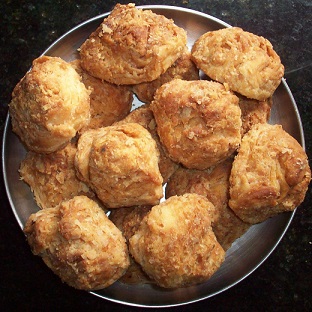
Barki

photo: jp

The ‘varkey’ may be an innovation which was necessitated during the World Wars when maida and other ingredients were in terribly short supply. World War II is more likely the period as that is when the local Badagas started replacing the departing English population in the towns.  Since then the Badagas have been hooked to ‘varkies’ which has given an almost ritual status.

As for the name  goes, it could simply refer to one Varkey who invented or innovated it as a Stanes’ alumni recalls, ‘The baker Varkey, from The Nilgiri Modern Bakery would come around 7 am… I always wondered if the snack, saada and Naii varkey was named after our baker! ‘

Varkey recipes today include varkey payasam and paratha varkey. However the ubiquitous varkey is eaten best deep dipped (ajjudhu, in Badaga) in tea or coffee.

[People who have tasted ‘barki’ – varkey is barki in Badaga, always get hooked to this Nilgiri special pastry. Whenever I go to Bengaluru, the only item my friends tell me to bring is this delicacy. Many prefer Kunna Barki – smaller variety of varkey. I recently read in the Hindu that ‘Ooty varkey is 100% vegetarian and no animal fat is added‘. But some disagree – Wg Cdr JP]

Sustaining Small Family Farming in the Nilgiri Mountains

Dharmalingam Venugopal

Nilgiri Documentation Centre, Kotagiri

International Mountain Day (IMD) is being celebrated on Dec 11 since 2002 to raise awareness about the importance of mountains, to highlight the opportunities and constraints in mountain development and to build partnerships that will bring positive change to world’s mountain areas.

This year the theme of IMD is ‘Farming in Mountains, farming for families’ to focus on valuable contribution of mountain family farming to livelihoods. Family farming in mountain regions is undergoing rapid transformation due to world population growth, economic globalization, urbanization and migration. At the same time recent trends present opportunities for local development in diverse activities.

The objective is to reposition family farming at the centre of agricultural, environmental and social policies in the national agendas by identifying gaps and opportunities to promote a shift towards a more equal and balanced development. How to increase awareness and understanding of the challenges faced by smallholders and help identify efficient ways to support family farmers?

Sustaining Small Tea Growers

To celebrate IMD 2014, Nilgiri Documentation Centre will  organise a One Day Workshop on ‘Sustaining Small Family Tea Growers in the Nilgiris’ on Dec 11, 2014. The workshop will seek to identify and  profile small family growers and seek answers for questions like  Are they viable? Are there any alternatives? Can they go back to vegetables, partly or wholly? How can they supplement their income? Can they add value to their product like promoting a niche market? What is the way forward? How to synergize the working of development institutions like Tea Board, Indcoserve? Can Small Family Growers and Bought Leaf Factories live together on mutual goodwill and benefit?

Nilgiri Conservation Award 2014

On the occasion, NDC will present the Nilgiris Conservation Award 2014 to the Hill Area Development Programme in recognition of its role in the development and conservation of Nilgiris in the last four decades.  As the HADP is poised to enter its 40th year, its future has turned into a question mark with the abolition of the Planning Commission.  Whatever may be the new Avatar of the HADP, its contribution to development and conservation in the Nilgiris needs to be acknowledged. It has touched all corners, all aspects and all sections of the Nilgiri society in the past four decades.

[Being a farming community & a large number being small tea growers, the Badagas have a big stake in the issues high lighted by D.Venugopal. They must attend the workshop to be held on 11-12-14 and make it a success. I can only recall the words of Thangadu Krishna Gowder [rendered in his golden voice in a song] ” elay hattalay belay elle dho “. The steep fall in the price of green leaf tea and the terrible menace of monkeys and other so called ‘protected wild life’ in the cultivation of farm produce, have made us desperate and dejected. Resulting in sometimes ‘desperate sale’ of our small holdings (tea estate – thotta). We have been taken for a ride by the green leaf  agents who cheat us in weight and price, unscrupulous tea factory owners who have no qualms in producing adulterated tea as well as the corrupt and cunning tea brokers. Not double damakka but triple damakka – Wg Cdr JP]

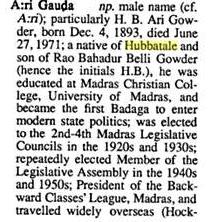
4th December is the 121th Birth Anniversary of Ari Gowda

Bowing our heads in silent reverence and respect for all that he had done for our community

Ari Gowderrbhbag.jpgAri Gowder2Ari Gauda[above – text] From the book ” A BADAGA – ENGLISH DICTIONARY ” by Prof.Paul Hockings and Christiane Pilot-Raichoor]

Rao Bahadur H.B.Ari Gowder, the first Badaga graduate & first Badaga M.L.C & M.L.A for a long time  including the British time. He brought many reforms in/to Badaga Community including ‘prohibition’ (no alcohol – kudi) to Nilgiris in British days itself.

Ari Gowder lead the Indian contigent (yes, “INDIAN CONTIGENT”) to World Scouts Jamboree held in Europe in the 1930s.

Ari Gowder was associated with the Nilgiri Mountain Railways, now an UN Heritage,  right from the time this great and beautiful track was established in early 1900s till his death in 1971. In fact his father Rao Bahadur H.J.Bellie Gowder was contracted by the British to lay the mountain railway from Mettupalayam to Ooty. Also, probably, Bellie Gowder and Ari Gowder are the only father -son duo who were conferred with Rao Bahadur title in India, though Ari Gowder hardly used the title being a great nationalist.

He was not associated with any political party  but was a true representative of the people, a powerful orator and  welfare minded  social reformer’ – says A.Kari Gowder [“Prongadu Seeme Welfare Association”] in his booklet published in  May 2006.

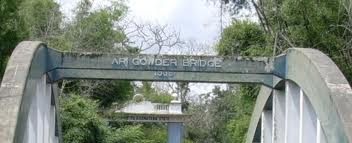
                                        AG1 bridge

He was the President of the Nilgiris District board in 1930s and 1940s and carried out a lot of welfare measures for the upliftment of the residents of the hill district, mainly tribals in those days. To remember his contribution to the society, the bridge connecting Tamil Nadu [then Madras] state and Karnataka [then Mysore] state, built in 1936, is named ARI GOWDER bridge (above pix).

Ari Gowder was listed as one of the famous leaders of South East Asia – Who’s who in India, Burma & Ceylon. Who’s Who Publishers. 1940. p. 681.

H. B. Ari Gowder’s name figures in the Famous Madras Christian College Alumni list along with people like Sarvepalli Radhakrishnan

Continue reading

Nilgiri Mountain Railway

  <a href="/channel/UCXOhrdRpgxCo9jOiORYm9Qw" class=" yt-uix-sessionlink     spf-link  g-hovercard" data-sessionlink="ei=O1V5VIz6ON38oAO08oDQDw" data-ytid="UCXOhrdRpgxCo9jOiORYm9Qw" data-name="">BoxKite Films</a>

What a beautiful documentary which offers not only a great visual treat but valuable information about the ‘Toy Train’ – Nilgiri Mountain Railway. Being a native of the Nilgiris and belonging to a family that is deeply involved in the construction of this unique railway system of the world, [my maternal grandfather Hubbathalai Bellie Gowder was involved in the construction and maintenance of this railway line from Mettupalayam to Ooty, till his death in 1935 and later by my uncle, the H.B.Ari Gowder [till  1971] and both of whom were great Badaga Naakku Betta leaders and recognised for their contribution and conferred with the title of RAO BAHADUR by the British], my mind and memories are filled with thrilling thoughts.

Not only that, traveling in this train from Aravankadu to Ooty everyday in 1964-65 while doing PUC in the Govt.Arts College, Ooty, the journey was nothing but a carefree but enjoyable experience of an adolescent in the company of other students and later in 1970-71 as a junior engineer, in the PWD along with other colleagues working in different fields – the travel would steer around with discussions of worldly affairs and politics, the days are still fresh in mind. I remember the  return journey to Ooty from Aravankadu would cost a ‘royal’ sum of Rs.3 for three months in 1964-65 for what was known as student pass.

A must see documentary for all. Hearty congratulations to Mohan Krishnan!

Mohan Krishnan’s film on NMR is commendable and well documented. That it is by a son of the soil makes it all praiseworthy. May other competent sons of the soil go about documenting visually other treasures of the Nilgiri hills. Best wishes

Dharmalingam Venugopal,

Nilgiri Documentation Centre,Kotagiri

**************

First ever portrait of a Badaga woman?

Displaying 1844 Badaga woman.JPG
First ever portrait of a Badaga woman
Dharmalingam Venugopal (Nilgiri Documentation Centre,Kotagiri)

Dr. James Cowles Prichard, an English Physician and Ethnologist wrote two books. ‘Researches into the Physical History of Man in 1813 and ‘The Natural History of Man: Comprising Inquiries into the Modifying Influence of Physical and Moral Agencies on the Different Tribes of the Human Family’ in 1843.
For the later he had commissioned the pictures of a Toda man and woman. Obviously, there was a mistake and the pictures sent from here were of a Badaga woman.
This print of a hand-colored aquatint engraving of an obvious Badaga woman was published in 1844. This could probably be the first ever picture of a Badaga woman.
An original of the engraving has been obtained by Nilgiri Documentation Centre thanks to the support of Mr. Colin Sullivan, the great grandson of John Sullivan, who visited the Nilgiris recently.

While thanking Venugopal for sending this information, couple of doubts creep into mind. Earlier days, Badaga Jewellery worn by women has distinct designs – the Ear rings – Kivi Chinna, Nose ring – Mookkuthi, and neck chocker – Saradu. In the painting above they are different.

 Badaga women also had very different type of tattoo on their foreheads. Not the Pottu – Bindu[dot].  So is the head cover – Pattu.

Update :- Venugopal feels that “it is 170 years ago and it is a painting and therefore interpretation of the artist. It is certainly not a Toda”. I agree.

– Wg Cdr.JP

Prof.Paul Hockings

I tend to agree with Wg Cdr JP that this might not actually have been a Badaga lady. The earring is not unusual for Badagas then, and is illustrated by Feodor Jagor from his expedition around 1873 (1914: Fig. 70). But the puttu is more of a problem. Jagor also illustrates (Fig. 60) several typical brow tattoos of Badaga ladies, which must have been pretty-well universal at that time, and rather rule out sticking a puttu on top of them. It is certainly not a Toda; but could it be an Irula? That seems most likely to me.

Badaga Script [Barey]

Badaga, now considered to be one of the ORIGINAL and old dravidian languages, is not a derivative of Kannada or Tamil, but  unique in its concept, construction, pronunciation and grammar. One of the regrets of many Badaga enthusiasts like me is that our language does not have a script of its own.

Recently I received an email from

Richard Parry <appleaccess@icloud.com>
Hello WC Jayaprakash,

I’m currently looking at the languages of India and the similarities between the various scripts.
I’m interested in adding Badaga into the mix, but currently have no way of entering the letters into the document.

Earlier Microsoft considered to include Badaga as a possible Indian Language in its OS developments.

Though some serious attempts have been made by RAJUS, Ananda, Kadasolai and Saravana [not related to each other but a sheer coincidence that Raju is in their names], still their scripts have not been fully accepted and adopted.

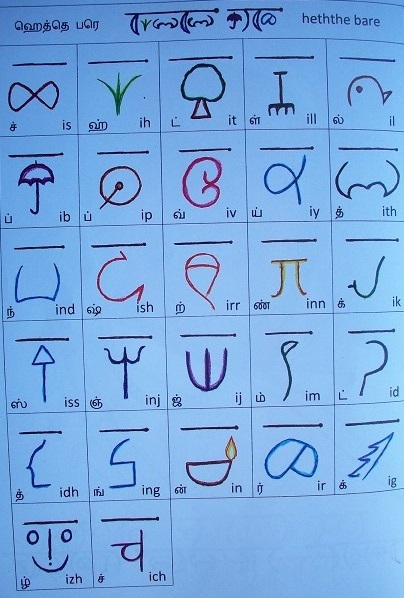
Saravana Raju, from Karimora hatti, is a gifted youngster with lots of original and ‘out of box’ ideas in developing a Badaga Script. He has just released his concept in the form of a booklet.

SaravanaWhen he called on me to present the book, his passion and dedication came out clearly. What is highly satisfying is the fact that some very young children of his hatti are able to read and write in his Badaga script

He has listed 12 letters as ‘AYYA Bare(y)’ and 27 letters as ‘ Heththe Bare(y)’ and combined them to call it ‘Mammakka Bare(y).

100_9113100_9114100_9115

Wishing Saravana Raju the very best and hope his contribution will find an unique place in Badaga !

‘Touch the Sky with Glory’

After graduating as a Mechanical Engineer, (Madras University – GCT, Coimbatore), I joined Indian Air Force (IAF) as a permanent commissioned officer in 1972  and took voluntary retirement after 20 years when I was a Wing Commander. My ‘bond’ [job agreement] was for a minimum of 20 years [guaranteed pension].

I gave my youth to IAF and in turn IAF gave me everything. Full of pleasures and some pains, but what an experience. Forever I am PROUD to have been associated with a great institution of the Defence Services that is involved in keeping the integrity and independence of our nation.

Probably, I am the first Badaga to have joined IAF as an officer (and there are many officers now – both serving and retired)

I am delighted to urge our youngsters (both men and women) to join

IAFwhose motto is

‘Touch the sky with Glory’

Defence Services offer you a great career!

Register between 6th December 2014 and 3rd Jan 2015.

Complete details in http://www.careerairforce.nic.in

Remember, as an Engineer, you can either join the FLYING branch (pilot) or Aeronautical Engineering Branch (Ground Engineer and can become a Flight Engineer in Transport/Helicopter streams later on)!!

‘Converting’ to Badaga??

The topic sounds a little strange? Yes, it does.

I get many emails/comments from non -Badaga boys and girls asking HOW TO CONVERT TO (BE) BADAGA. It generally goes like this, ” I am a non Badaga but in love with a Badaga girl/boy. Since, Badagas marrying non Badagas is rare and ‘difficult’, I want to convert to Badaga”

Badaga is not a religion, and hence the question of conversion to Badaga, does not arise. But then, this important question also begs a larger answer.

In this modern age and time, we have to accept that Badaga Society cannot remain isolated and will have to accept the reality that many marriages will take place between Badagas and non Badagas. That may happen sooner or later and the present trend points towards that.

Though we may hope and pray that these ‘mixed matches’ do not ‘happen’ to preserve our culture and traditions, we cannot change the changing times.

If we look beyond what we see, don’t we want an INDIA that is truly beyond  restrictions of religion and region but an united one? But then, how do we preserve the cultural and traditional ‘uniqueness’ of a community in this vast and diverse country? Aren’t they contradictory?

As far as Badaga ‘conversion’ is concerned, why don’t we accept if a non Badaga wants to follow the customs and culture of Badagas after marriage, with no reservations? I am aware this question is bound to invite strong reactions.

Better to be bold and face the facts than to be blind and left behind!

Badaga women

WomensDay

Badaga women

by Dr.R.K.Haldorai

Tremendous changes have taken place in the status and position of women in our society. Now woman is no longer looked upon as a ‘hari bakke’ (running grit i.e., child-bearing machine). She has acquired a new status and a higher social stature. Women are now better educated and few of them fortune enough to hold important jobs. At the same time, there is a grey area which is to be pondering over. On the one hand the socio-economic condition of our women has improved in the last few decades, thus resulting in lesser restrictions within the home and greater freedom of movement outside the home. On the other hand, still in some domain their status appears to have remained the same.

The women in our society seem more independent and self-assured. As wage-earners Badaga women occupy primary place and many of them earn more than their husbands. Nevertheless they continue to occupy an inferior status and the ‘hatti’(hamlet) is still very much male dominated. Economic independence and education do not seem to necessarily make women more powerful or enable them to get a place in decision making process. Even though the female population of our ‘hatti’ is a sizable one, the women seem to have very little decision making power.

To our dismay, even they do not participate in the public affairs like manda (village assembly) etc. Even though many of them are well educated, still they have to act as intellectually dependent upon men on common affairs and religiously they have no public role. A woman in the role of wife is subordinate to all desires, the whims and the angers of her husband.

It is said that in olden days, mother-in-law with sons and daughters-in-law is very powerful within the home and she forgets her past and starts ill treating her young daughter-in-laws. But the present generation mother-in-laws changed their attitude altogether. Now, it is true that some treat their daughters-in-law as their own daughters. Due to this, most of the present generation women are treating their mothers-in-law as their companion and interacting with them freely.

Compared to our ‘hethais’ (grandmothers) now women go out quite a lot. They go out to see the matters like buying groceries, selling farm products, visiting hospitalised patients. In the past woman would never sit in front of her father-in-law of her husband. In fact they were expected to stand behind a door and answer their questions. This attitude also changed considerably. However, if daughters-in-law are very dutiful they may not have any trouble with their in-laws.

Widows unlike married and menstruating women are pure but inauspicious in some other societies. But in Badaga society widows enjoy equal status like other women. Of course with borrowed ideas few prefer widows not to perform some rituals in rare occasions. In fact this is insignificant. In total, in our society there is no inauspicious attached to them.

Formerly women stayed away from the house in a shed (olegudi) each month during their menstrual periods. Women used to feel absolutely miserable on those three days. At night they have to sleep on mat and use only old blankets etc. That was the practice in those days and every one had to follow it. But now women do not adhere to these rules very strictly. Of course even now some do not enter ‘ogamane’ (kitchen) or puja room on these three days and sleep alone in a separate bed. Here we shall see that the rules of pollution and purity are not abandoned but are redefined.

Due to various socio-economic reasons late marriages are slowly being introduced in our society. Women now seem to get married only in early twenties or later than that. The convention that men and women from respectable families ought to get married according to the wishes of their parents still persists, strongly in our society. In olden days the bride groom’s family would be satisfied if she could cook, take care of a family and generally know everything that was necessary to be a good wife. Now, in addition, the education given to women comes as a plus point. Hence Badaga women believe that education given to their daughters fetches eligible men, as most young men these days prefer to marry only educated women.

Old women, in other societies, do lose their power within their homes and become unwanted. Older women in our society, on the contrary, have greater freedom and wield a large influence in the management of household affairs. They are respected more and as older married women they are symbols of auspiciousness.

In short the tradition oriented atmosphere of the ‘hatti’ is clearly reflected in the lives of its women. Indeed our women have tried and adapted the modern living conditions to suit their traditional way.
[ Wg Cdr JP adds – I have met Dr.R.K.Haldorai on a few occasions – he was one of the main architects of Nanjanadu Peace Committee – and found him to be highly knowledgeable and a simple & friendly person. Being a scholar and involved in researching about our society, he has written many books on Badaga – both people and language.  These books have been published by Nellikolu Trust -under the able care of R.Dharuman. He lives in Chennai (733, Mullai nagar, Tambaram West, Chennai -600045) and can be contacted on cell: 9444503414 ]

Badaga Poems

One of the enchanting aspects of Badaga Language is its disarming simplicity. But though the sentences are swathed in sweetness of simple words, it can contain deep expressions of emotions conveyed in the proper usage of rhymes [holla – alla] or pair words [huttu – nattu] apart from other attributes. When the sweetness of this language is combined to carry the human expressions in the form of a poetry, it is a great pleasure to indulge oneself in a world of sheer bliss.

When I came across the following poem, my first reaction was, ‘how beautifully the love of a mother has been brought out’. That set me thinking that there may be many other ‘unsung’ poets among ourselves. How nice if their poems in BADAGA could find a wider audience? I am not talking about some KAVITHAI in Tamil or a poetry in English. BUT ONLY BADAGA POEMS. By the way what is the word in Badaga for poem & poetry? I am sure it is not kavithai or kavi . Cannot be kadhe (song) too. Then……..??

This poem titled ‘My Mother’ by Mohan (hope he reads this and sends more of his creations) beautifully describes the filial bond and eternal love a mother has for her son even in very adverse, trying and difficult situations. She could not find any fault nor found anything demeaning, in the one whom she had brought into this world,nurtured, carried on her hips, cared for and brought up even when the rest of world rejected and rediculed him. I have attempted an English translation and hope I have captured the essence of the deep feelings expressed in the poem.The author has really ‘ played’ with the rhyming Badaga words and forcefully brought out not only the sadness and silent suffering of a son but also the uncompromised love of a mother.

Enna Awai
by B.Mohan [of Kunna Bikkatti]

(From ‘Mandhadha Maathu’ – Published by Badaga Welfare Association, Madras, issue dated 1-4-93 (Hannu 3,- Hoo 10)

Kettu Muridhu Naa Kerio Kulibaneyu
Huttu Nattu Enna Hollandhu Hegoneyu
Hethu Thathi Saakidha Awai Enna
Hollandhu Hegule Maathi Allandhu thallule
Goonu bhuddu Naa Cooli Geevaneyu
Huttu Kettu Naa Maasi Kulibaneyu
Pattu Beetha Batte Ikkoneyu
Kettandhu Hegule Awai Enna Mattandhu Thallule
Kottage Huggi Naa Geria Baakoneyu
Araya Kulidu Naa Danava Mesoneyu
Horia Thookki Naa Hotte Kaibeneyu
Kore Ondhu Hegule Awai Ondhu Ariandhu Nudivile

என்ன அவ்வை
[ பி .மொஹன் – குன்ன பிக்கட்டி]
(மந்தத மாத்து, படக வெல்ஃபெர் அசொசியெஷன், மெட்ராஸ்,1-4-93 ,(ஹண்ணு 3, ஹூ 10)
கெட்டு முரிது நா கேரியோ குளிபனெயு,
ஹுட்டு நட்டு என்ன ஹொல்லந்து ஹெகொனெயு,
ஹெத்து தத்தி சாக்கித அவ்வை என்ன,
ஹொல்லாந்து ஹெகுலே, மாத்தி அல்லாந்து தள்ளுலெ.
கூனு புத்து நா கூலி கீவனேயு,
ஹுட்டு கெட்டு நா மாசி குளிபனெயு,
பட்டு பீத்த பட்டே இக்கொனேயு,
கெட்டுண்டு ஹொகலி எந்து அவ்வை
என்ன மட்டாந்து தள்ளுலெ.
கொட்டகே ஹுக்கி நா கொரெய பாக்கோனெயு,
அரய குளிது நா தனவ மெசுவொனெயு,
ஹோரிய தூக்கி நா ஹொட்டே கைபெனெயு,
கொரெ எந்து ஹேகுலெ அவ்வை
ஒந்து அரியாந்து நுடிவிலெ

*+*+*+*

mom.jpg

My Mother

[English Translation of the above poem by Bellie Jayaprakash]

Even when I was down with poverty and sat at the front court yard,
Even when the near and dear ones despised and deserted,
My mother who gave birth, cared for and brought me up,
Did not blame me and did not reject me- her son, as bad

Even when I toiled as a Cooli with a bent back,
Even when I sat down with my looks dulled and dirty
Even when I wore patched up old clothes
My mother never said that I was down ; never rejected me as poor !

Even when I swept the stables to clean the cow dung,
Even when I sat on the rock to tender the cows,
Even when I lifted loads so as to suppress the hunger with the earning,
My mother never found any fault ; never scolded me as ignorant.

(Read more in http://www.badaga.co/badaga-poetry)

@#@#@#@#@#@#@#@#@#@#@#@#@#@#@#@#@#@#@#@#