Interesting titbits about Badaga

Badaga Inspiration

https://i0.wp.com/e.amritapuri.org/wp-content/uploads/2010/07/ashramdiary.jpg

[Badaga Inspiration]

I love watching the Badaga dance in Coimabatore. Two years back when Amma last was here, and again during Amma’s 53rd birthday celebrations in Amritapuri, they also enchanted the crowd – inspiring westerners, students, and Ashramites to join in . The same happened again this year. Young and old, men and women. Their rhythmic movements, graceful flowing hands and bodies, the beating of drums and call and response voices calls to the dancer inside us. It’s so primal, so natural, and so beautiful.

One wonders how long these people have been dancing like this – how far back in time? How wonderful that India has been able to preserve these timeless traditions.

For a while, I was content just taking photos, or watching from the sidelines – focusing on their movements. But I found my inner self wanting to join in. I stood there – conflicted – trying to overcome my inhibitions – people would look at me – a westerner in white awkwardly throwing his body around. But then some westerners did join in, the Badaga happy to show them the movements even as they were ‘throwing a wrench’ into the coordinated movements of those already dancing.

Still, I stood by the sidelines. Then, at the end of the first night, as Darshan ended, and the Badaga still playing, Amma Herself stood up to leave the stage – and made a full circle – turning round with the beat, no inhibition, no concerns. Just dancing…..

The next day, I knew the Badaga would be there again. Would I join in?

Around 2am, they were singing and dancing again. Again, I stood by the sidelines, thinking about how Amma was so natural, innocent when She danced. I recalled how Amma says it’s just not enough to stand at the shore of the ocean and just get your feet wet. You have to dive in. I recalled how I overcame my fears when I used to go firewalking (walking on hot coals) – I would stand there trying to convince myself that it would be fine. It just takes a leap of faith…

In a moment of surrender, I joined the line. I found myself behind a Badaga man who was more than happy to call out the movements and changes as we made our way around the circle. I loved it. At times, it was awkward, but once I got the jist of it, it seemed so natural, so beautiful. When we were in synch -hands, legs, arms, – it was so nice – like a huge drum circle when they reach that magical moment when all the drummers are connected and the music just flows. So did our bodies-around and around, faster and faster.

I can’t wait till the next time..

Sri Pati, USA Coimbatore, 23 January 2007

[ to read more titbits about Badagas, click here or here]

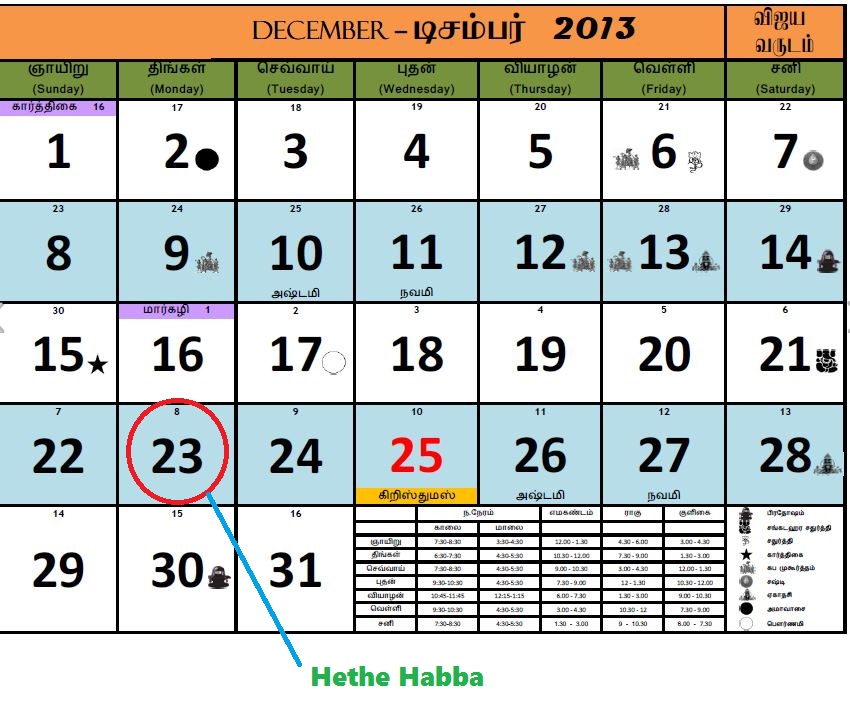
Hethe Habba

HH

The next

HETHE HABBA

is on the

23rd December, 2013 [Monday]

Dec 13

HETHAI HABBA’ is the biggest festival of Badagas!

Hethe Habba is always on the first MONDAY (SOVARA), the most sacred day for Badagas, after the full moon (paurnami – HUNNAWAY ) that falls in Badaga Hemmatti month, (Tamil – Margazhi month), that is the 9th day after eight days of ‘Kolu’. This year [2013] the Hethe Habba was celebrated on 8 Jan 2007 will be celebrated on 27 Dec 2010   will be celebrated on 31 Dec 2012 23 Dec 2013.

Hethe Amma, the purest one, in your blessings lie our well being !
Madekke mannoondha aaleyu, adhu thirigi mannoo aagha
[Even though a pot has been made out of clay, it cannot become clay again]
Thuppa benne endha aaleyu, adhu thirigi benne aagha
[Clarified butter (nei in Tamil), though made out of butter, cannot become butter again]
Jenu hoo endha aaleyu, adhu thirigi hoo aagha,
[Honey, that comes from flowers, cannot become flowers again]
Holladha vakka Hethe Mane ga hodha maele, thirigi holladhavakka aagharu
[After going to Hethai Temple, ‘bad’ people cannot remain bad]

Read more about Hethe Habba here

To read the ‘history of HETHE ’ Click here

Image

Photo Quiz

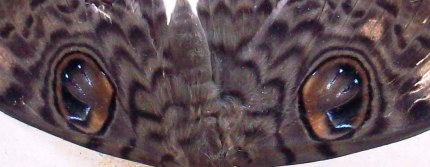
Can you identify this ‘animal’? Plenty available in the Nilgiris

Photo by JP
see here for the answer

..Finding the 18th Camel!

Do you know that the maximum number of court cases pending in the Nilgiris, yes, our great Nakku Betta, are filed by Badagas . No points for guessing that these cases are mostly among/against relatives involving property – ‘sothu’.
How great it will be if we can find the ’18th camel’ as mentioned in the following story and solve our problems!
A father left 17 camels as an asset for his three sons.
When the father passed away, his sons opened up the will. The Will of the father stated that the eldest son should get half of 17 camels while the middle son should be given 1/3rd (one-third).The youngest son should be given 1/9th (one-ninth) of the 17 camels.
As it is not possible to divide 17 into half or 17 by 3 or 17 by 9, three sons started to fight with each other.
So, the three sons decided to go to a wise man. The wise man listened patiently about the Will. The wise man, after giving this thought, brought one camel of his own and added the same to 17. That increased the total to 18 camels.
Now, he started reading the deceased father’s will. Half of 18 = 9. So he gave the eldest son 9 camels. 1/3rd of 18 = 6. So he gave the middle son 6 camels. 1/9th of 18 = 2. So he gave the youngest son 2 camels.
Now add this up: 9 plus 6 plus 2 is 17 and this leaves one camel, which the wise man took back.
MORAL: The attitude of negotiation and problem solving is to find the 18th camel i.e. the common ground. Once a person is able to find the common ground, the issue is resolved. It is difficult at times. However, to reach a solution, the first step is to believe that there is a solution. If we think that there is no solution, we won’t be able to reach any! If you liked this story… please share with friends, family and children… You might spark a thought, inspire and possibly change a life forever!!
[this story wasrecd as a fwd email]

Badaga Ballads

I am not too sure about the exact word in Badaga  for ‘ballad’ – Could it be  Paamay’ which also means ‘story?

[A ballad is a narrative poem, usually set to music; thus, it often is a story told in a song. Any story form may be told as a ballad, such as historical accounts or fairy tales in verse form. It usually has foreshortened, alternating four-stress lines (“ballad meter”) and simple repeating rhymes, often with a refrain. If it is based on a political or religious theme, a ballad may be a hymn (Wikipedia)].

There are quite a few ballads [‘traditional folk songs’] in Badaga narrating many stories that talk of the valour of heros [Kamarayya, Bala Sevana, Bela Madha], beauty of Badaga women [Giriji Madhi, Kolli Tippe], witchcraft of Kurumas , hospitality of Badagas [Unige Madha] etc.

I have heard these ballads narrated in a beautiful and melodious musical format by Kerban Bella Gowder and Kotagiri (Kurudu) Kada. Unfortunately both are dead now. Kada was blind but had an unique style of rendering these ballads and other Badaga songs. Of course, I can say without any hesitation that Bella Gowder’s songs were a sheer bliss to listen. His was the most accomplished voice. His SAVU SONGS can make the most hardened hearts melt and shed tears. He could create songs on the spot, known as – kadhe kattodhu

Listen to Kara Chenne – a great Ballad by Kerban Bella Gowder here :

The following information is found on the SPECIAL ISSUE of 1982 released by Kovai Badagar Sangam and I feel it deserves the attention of all of us who believe in our traditions, though some of the lines – the last few ones- are a little difficult to understand.

By Dr.K.K.Mathan M.Sc (Agri)., Ph.D
From the special issue published by Kovai BADAGAR SANGAM in 1982
Kovai Badagar Sangam Dr.KK Mathan

We have heard about from where Badagas migrated, where they settled initially, what sort of dress they wore, the type of food they had and what type of houses they dwelled from many researchers. Badaga ballads and true epics are quite famous from these researchs. These ballads and epics have blended with our blood. Even a five year old would sing ‘HANAYA MANNU, SOLUR HENNU’ when asked.

A surprising information is that our ballads have been printed in book format nearly two hundred {now, 225years} ago ! we are proud to learn about that. A German has translated ‘HANAYA MANNU’ song into German language. The English version of the same written by H.B.GRIGG in 1880 appeared in the ‘MANUAL OF THE NILGIRIS DISTRICT IN THE MADRAS PRESIDENCY’ on pages 281-225.

I reproduce and dedicate the same for the information of all ;

BALA  SEVANA

Once in the village of Hannia Mannu,

Near to the fortress of Koleya Kambe,

Lived there a youth named Bala Sevana,

Also, his brother, Bela-Madha.

Like were they to one another,

E’en as the spreading horns of a buffalo.

Nineteen men had Bela Madha,

Nineteen ploughed the land for Bala Sevana.

Once in the field of the gravel slope, they,

Met by the corner of the sacred seal stone;

First to Circar made they obeisance,

Then they made a salaam to the temple,

Folding their hands to the moon above them.

Deep in the earth they scooped a hollow,

Then they fetched an armful of hillus,

Played with a golden ball and with a Bat silver the game of Hillatta.

Lo ! the daughter of Yerugatta, The twice fallen Yerade – Bellie,

Took unto her eighteen maidens.

There stood she upon the green slope,

‘Neath the richly laden Khavilu;

There did she unbind her tresses,

Thick were they as the churn-stick, Mathu.

Meanwhile skillful Bala Sevana,

Caught the lillus of Bela Madha;

Madha caught not those of Sevana.

Then said Yeragatta’s daughter,

To twice fallen Yerada Bellie,

“Has not Bela in Temple”

In the grazing ground of Madha,

To the brim milked eighteen pailsful?

Then his loins with pure white kerchief Girt

he not and made the butter,

Made it with coir and churn of Pangni,

Allamaada was frame work?

Therefore Bela-Madha weary

Tho’ his have still their cunning

Widows sons are three times gifted.

But had skilful Bala Sevana

To the brim milked eighteen pailsful,

He forsooth had been too weary,

Poorly fed is Bala Sevana,

Drinking washings of the milk pails.

Art thou rich like Bela Madha?

Thus spake mocking Yerade Bellie.

Prone fell Bela ‘mid the rushes.

Bala Sevana too exhausted,

Fell among the Hubbe bushes.

See his face is dull and faded,

Which anon shone like the platter,

Fatal word of Yerade Bellie,

Word of dark and evil omens.

So the some time loving brothers,

Like were they to one another,

Even as the spreading horns of a buffalo

Part for aye from that same moments.

The ballad, which is very lengthy, goes on to relate the adventures of Bala Sevana, how he labored 12 years with his wife, became rich, performed heroic deeds and eventually was appointed the Chief Monegar of the Hills, receiving the seal of office from the cutcherry at Satiamangalam.

JP’s footnote :

HB Grigg’s’ Manual of the Nilgiris…’ can be accessed here

Here is another ballad  called ” UNIGE MADA ” on the hospitality and love shown by Kinnakorai Joghee to a Kurum(b)a called Mada from Folktales of India  By Brenda E. F. Beck

::::::::::::::::::::::::::::::::::

Badaga Villages [Hattis]

Hattis

Hi Sir ,
First and foremost my hearty congrats for your wonderful work.
I visited the site “https://badaga.co/badaga-villages-nakku-betta-hattis/”
I am from Bickatty village which is near to Akoni. Our village is mostly known by the name Akoni – Bickatty as there are lot of Hattis in this name.
Under Thodha Naadu Seeme our village is misspelt as Bikkatti. In most other places the spelling is as Bickatty. Could you please take my request(changing the spelling) into consideration.
Thanks a lot Sir.
With Regards
B.R.SATHEESH

[Though I would like to mention the hatti names as pronounced/called by Badagas, I feel I must incorporate Satheeth’s suggestion. Pl let me know of any omissions/corrections. – Wg Cdr JP]

[All photos are by Bellie Jayaprakash and copyrighted. Reproduction without permission is illegal]

ketti.JPG

Badagas, generally, refer to their village or hamlet as ‘ HATTI ‘ spread around ‘Nakku Betta’ (the Nigiris). Nakku Betta literally means four (Nakku) Mountains (betta) though there are many hills around which the villages are located. It appears that initially when the Badagas established their hamlets, they took two very important factors into consideration. Being very environment conscious, they chose a) direction – always or to a very great extent facing the east [ ‘Hothu (sun) uttua (rising) pakka (side)’] and b) water souce – near a stream (halla) or spring (huttu neeru).Every hatti had a ‘suthugallu’ (sacred triangular shaped stone) at the base of a ‘bikka mara’ (tree) around which important meetings (Kootu) took place. For the most sacred of all Badaga festivals ‘Hethai Habba’ – always held on a monday (sovara), the collection of money (Hana kattodu) took place at the suthugallu in an elaborate ceremony on the preceding friday (belli). Let me write about Hethai Habba in a separate article.

The houses of each village were laid out in rows, each row facing the east. The houses had common walls (Gode mane) possibly as a measure of security. Every house had exactly the same configuration of Bayilu (entrance), Nadu mane (central-living/dining room), Oge mane (inner room) where cooking also takes place (kitchen) with a large beskatti (basket) above the hearth where drying takes place, Pillay (bathroom) and Ereh (a separate room adjacent to the bayilu). Of course, there was an attic on top of beskatti( kitchen having a hearth) the entry to which is from the nadumane. Again, we will discuss about a typical badaga house separately.

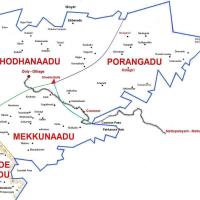
A cluster of villages, which need not be close to each other, is called a ‘Seemae’.

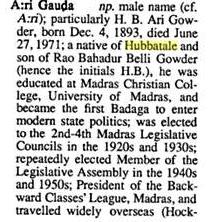
Though, so much is written and spoken about Badagas, it is a matter of great regret and concern that still the “EXACT” number of Badaga hattis is not known. The total number varies from 300 to 400. Though Rao Bahadur H.B. Ari Gowder is known to have sent his collegue HAIKA MATHI [literaly meaning horse man] Joghee Gowder of Bygemandu, in 1940s and 1950s to all the villages to know about the problems of Badagas, unfortunately there are no written records traceable.

Prof. Paul Hockings may be one of the earliest to mention the number and names of the hattis in his books.

In a laudable effort, Mr. K.H.Madha Gowder edited “NAKKU BETTA” magazine, had attempted to record all the hattis in one of its issues in late 1970s. I take this opportunity to list the villages as mentioned in ‘Nakku Betta’ hoping any omission/ incorrect mention will be brought to my notice so that the same can be included.

[Read the complete article HERE ]

Dr.Bhojan Anand – you make us proud !

There are many Badagas, spread around the globe, who have excelled in the field of academics and education. Some of the earliest ‘achievers’ are Prof. Sevannah (Bearhatty), a Mechanical Engineer who retired as the HOD from GCT, Coimbatore and Dr. Halayya (Muttinad) who was a professor in USA and VC of Dharwad University.

Here is another scientist whose career and profile should be an inspiration to all.

Dr Bhojan Anand, currently Senior Faculty in School of Computing, National University of Singapore, is probably the FIRST BADAGA SCIENTIST to receive “PhD in COMPUTER SCIENCE and ENGINEERING” from ASIA’s Number 1 and one of the World’s top 7 Universities in Engineering and Technology.

In 1994, after graduation with University First Rank in Computer Science (Bharathiyar University), he  started his career as Lecturer in Computer Technology at NPA Centenary Polytechnic, Kotagiri. Published his first book on “Basics of Computer Applications”, widely used by polytechnic students together with my colleagues.

In the year 2000, he  joined as Lecturer at School of Info-Communications technology, Singapore Polytechnic (he is one of the four members who were selected for this position in an All India level selection process arranged by the Polytechnics together with the Economic Development Board of Singapore).

In the year 2006, he joined as faculty at School of Computing, National University of Singapore completed his PhD degree in computer science and engineering with “Dean’s Graduate Research Achievement Award”  at School of Computing, National University of Singapore.He has received PhD in Computer Science from National University of Singapore. He was a mentor and visiting scholar at MIT (Massachusetts Institute of Technology) Gambit lab (2008), USA.

Bhojan Anand

He is from Siddha Kari Raju Gowder family, Konavakorai and son of Mr. K R Bhojan (KRB) and Mrs. Lakshmi Bhojan ( Betalada). Married to Florence (Kotagiri) and has two kids.

He has published on premier networking and multimedia conferences and has published five books on mobile computing and networks.  He is invited speaker in international conferences and forums. He has received best-invited presenter award in M2M conference, organized by SIAA, Singapore and  is honorary secretary of International Researchers Club, Singapore.

His full profile can be seen  in www.comp.nus.edu.sg/~bhojan

Dr.Bhojan Anand, you make us proud!
[Information recd from Dr.Bhojan Anand in a personal email to me – Wg Cdr JP]

Badaga Weddings

Badaga customs and traditions are known for their simplicity, adaptability and practicality. In this respect a Badaga wedding follows a set of simple rules that has been almost the same over the centuries. But for a minor change here and there, it has been almost the same in all the villages spread across the Nakku Betta or the Nilgiri Hills.
The greatest plus points of a Badaga marriage are that there is NO DOWRY, the wedding always takes place in the boy’s (bride groom’s) house [or the place of his choice in case of a Kalyana Mandapam /Hotel] and all the wedding expenses including the customary feast [Maduve Hittu] of only vegetarian dishes, are borne by the groom’s family.
Incidentally, divorce and remarriges are not uncommon and a widow is not condemned for ever like in most of the Hindu communities and in many cases the widow can marry again even if she has children from her earlier marriage.

This slideshow requires JavaScript.

See a typical Badaga wedding in pictures here

Badaga Language

Badaga Bashay

Recently, I was travelling by a taxi from Coonoor to the plains owned and operated by a Badaga youngster. Badaga music – mostly dance numbers was part of the journey. But what shocked me is a number ín which the lyrics go like this – ‘nee jalli kattu kaaley [ ஜல்லி கட்டு காளை]  edhaga, thulli [துள்ளி] guththu bandarey….’Badaga or Tamil song ? Song writes and music directors, will you preserve the uniqueness of our great language? I feel strongly that we must start saying – BADAGA KADHEY instead of BADAGA PAATTU.

Can you spot the grass hopper?

Can you spot the grass hopper?

Click on the image for enlargement Misc 022

photo by JP