Category Archives: badaga

‘Breaking’ Marriages.

It is very sad but true. Many marriages among Badagas are breaking and ending in divorce ‘buduchuvadhu’.

A sacred institution that is meant to be for life is not even lasting for a few months. I heard the shocking story, recently, that the girl returned home the same evening of the wedding not for ‘marumanay’ but for good. She was forced by her parents and those of the groom’s when she refused to get married in the ‘first place’ that lot was at stake. Really sad !What are the reasons?

One is surprised to see so many nice looking, educated and employed boys and girls among Badagas ready for marriage but hesitate to tie the knots since they not sure for how long the sacred marriage would last?

Is it the ‘old mind set’ of the boys and their parents that the ‘wife – hendaru or daughter in law – sosay’ is expected to be only a second class citizen bringing water, cleaning the house, cooking and bearing children even if educated?

Shockingly, it appears, the BPO driven ‘night shift’ non-performing boys, cannot carryout the fundamental principal of a marriage [that proclaims that a marriage is nothing but a public announcement of a private affair] and suffer from erectile dysfunctions and sexual deficiencies and thus cannot face their partners. Then they blame it all on the girl when they are grilled by his parents and relatives with the typical but crude Badaga sense of outrage, ‘ Ennu basaru aapillay’ya? – has she not become pregnant yet??

Are the educated and employed girls not ready to share and enjoy life but live in a false world that they are ‘more’ than equal in most respects and forget the adage that the fundamental requirement for a successful marriage is nothing but ‘adjustment’? Do they feel being single is better than being singled out for failures??

Seeking a non – Badaga partner seems to be a fashion and passion without differentiating between love and infatuation.

Where is the problem, really?

Are we, the elders, with blinkers firmly in place, not seeing the truth in a broader perspective? Are we contributing to the cause in a negative way and condemning our great community to a curse??

[Reproduced]

Now, Nive, writes to protest :
Do you think love is fake when it comes to a non Badaga partner….. even if not all, few know the difference btwn Love and Infatuation. Am I not right? So what you try to say is that love between badagas is true ,but between a Badaga and other is fake?

Hello Nive,I am surprised that you completely missed the point. Read my comments/opinion again. Love, by definition, is ‘blind’. Infatuation, on the other hand, is a temporary phenomena. I am aware of lot many successful LOVE marriages between Badagas and non Badagas. I am also aware, that there is nothing known as ‘love by design or default’. Thanks for the comments, anyway, it tells me that my words need to be put in proper way. The larger point, I am trying to make out is “why are so many Badaga marriages breaking ? Is ‘morey’ the single most reason that prevents young Badagas seeking or falling in ‘love’ with another Badagas? – Wg Cdr JP

Sofia Joghee comments :

“Marriages break in all communities. Its not just confined to Badagas. But the positive note is that, remarriage is not a problem in our community, because every one I believe is broad minded enough to understand that marriages could go wrong. What I have seen is in other communities, people have some horoscope match findings on top of the general points to think, to minimize the breakage. Yet, they happen, its just fate of some due to karmas. But looking into the percentages, we might be more, because of the smaller size in communities.

Most of the marriages within Badagas are forced by the restrictions in our community is very much true. My friends have told me that their parents have permitted them to choose their partners as long as they are Badagas. So, there is no restriction on that point. Choosing is different than falling in love you see. One who really love each other are one in soul, thus can forgive their partner for any blunder and can not be separated for long enough. That’s the strength of true love.

I strongly feel we need to change our mind set of being too restrictive to accepting other society girls as our sosay (daughter in law) and getting our daughters married to other society guys but still include them in our rituals and functions. The more we try to isolate, the community growth will anyway be small. Because, for the kind of distances the current generation is travelling, it is really difficult to restrict choices. In that case of restricting, may be we need t restrict our dressing styles to our food habits, can we really do that? We need to see evolution through adapting to changes.”

“The Speech Sounds of Badugu” – Anandhan Raju

Some time earlier, we had the pleasure of informing about the ‘Badaga or Badugu’ Script developed by Anandhan Raju. I am absolutely convinced that for any language to ‘survive’, it should have its own script [it could be a newly developed one like what Anand has done or an adapted one]. Seeing the disturbing trend of many Badagas freely indulging in conversing in Tamil or English among themselves, it comes as a wisp of fresh air to realise that Anandhan has put his ‘ heart and soul’ to maintain the purity of a wonderful and unique language like our mother tongue “BADAGA”.

Hence it gives me great pleasure to publish  Anandhan Raju‘s

‘The Speech sounds of Badugu ‘- an article on the phonology of Badugu

[This article expounds my views on the Badugu language and also underpins my argument that Badugu should have a separate writing system – Anandhan].
 Badugu is the language spoken by a member of a people of the Dravidian stock  called Baduga  inhabiting the Nilgiri Hills. Most of the languages of the Dravidian families have much resemblance to one another. All are descendants of a single ancestral language now lost.

There are no written records to tell us what the original Dravidian language was like and the original home of the Dravidians and the date of dispersal of the original Dravidian stock. But one thing is certain that the original Dravidian language was broken up into various dialects which underwent separate linguistic development.

Badugu resembles Kannada in certain correspondences, jointly in sound and meaning. Badugu shares such systems not only with Kannada but also with other Dravidian languages too.

The words such as oHzdf /oHDu/ (n. one) and n\kf /na:ku/

(n. four) illustrate and establish the kinship of the Dravidian languages.

Badugu                        Kannada                      Tamil

oHDu                                   oHDu                          onRu

na:ku                                   na:lku                          na:ngu

Examination of long lists of such comparisons shows that, despite differences of detail, original Dravidian sounds changed predictably and consistently in each of the languages.

Badugu is no doubt a cultured language with a wealth of spoken literature and not written, for it was a language hitherto without a writing system but is no longer one.

A study of the speech sounds of Badugu is made herein.

Vowels

The vocalic speech sounds are reckoned at 10 which are phonemic in status.

The classification of the vowels is as follows:

  •           Short Vowels………………………………          5
  •           Long Vowels………………………………           5
  •           *Retracted Short Vowel……………              1

*The point of articulation of this vowel is the same as that of the short vowel e /e/ except for retraction of the tongue. Though the vowel is an allophone, it may be written as eX /eX/. For example, the /e/ at the beginning of etztf /ettu/ (n. eight) is different from the /eX/ at the end of aeX /aeX/ (n. cave).

Update : 

The following is a public link that I would like to share with everyone who would care to read my manual entitled “Keying In The Badugu Alphabet”.

Read the complete article here  THE SPEECH SOUNDS OF BADUGU


Maasu Neeru: Garlic Curry

Here is a [Badaga] recipe by Sofia Joghee who lives in Singapore

Here is a traditional curry from our village that will help you get rid of your entire gastric problem, and relieve your bloated stomach caused due to gastric. Some of us have issues with regular gastric problems. Making this tasty sauce (curry) part of your weekly meal, will help you relieve the problem. But remember to drink lot of water to avoid the heat feeling in stomach, which occurs while curing the issue. In case you have a sudden heat after trying this dish for first time, you may want to drink some milk to cool down. This is a very healthy and safe way to avoid and cure gastric issues.

Quick Dish, healthy food, great cure!

Serving for 2 people

Here tbsp is table spoon. You may choose a medium size spoon that we use to eat our food to help measure. Also note that this curry is slightly watery, not thick gravy. However, it can be made thick gravy if you want to.

Ingredients:

  1. 10 garlic pieces
  2. 3 small onions
  3. 5-6 tbs grated coconut
  4. 1 tbsp cumin seeds (not mandatory)
  5. 2 small onion or 1 small size big onion (chopped)
  6. 1 small tomato (don’t chop)
  7. Red chilly powder (1 – 1.5 tbsp) as per the spice you may want
  8. coriander powder (half of red chilly qty)
  9. turmeric powder (a pinch – .25 tbsp)
  10. curry leaves (not mandatory, but nice for flavor)
  11. salt to taste
  12. 0.5 – 1 tbsp oil
  13. mustard seeds
  14. 1 tbs tamarind juice (if you don’t like sour, you may avoid this)
  15. Chopped coriander

Process:

  1. Add garlic, small onion (non-chopped), grated coconut, and cumin seeds in a mixer and grind well.
  2. Add some water to get a almost fine paste from the above mixture. Keep it aside
  3. Heat the pan, pour oil, splatter mustard seeds, and add curry leaves and chopped onions.
  4. Fry till the onions are golden brown.
  5. Pour the grated mixture into the pan. Add 1 glass of water.
  6. Put the chilly, coriander, turmeric powder, salt, and tamarind juice into the pan.
  7. Mix well, and put the full tomato (un-chopped) into the mixture in the pan.
  8. Cook in high till the mixture boils, then sim it and close with a lid.
  9. When the curry starts smelling good, appetizing, check the tomato for softness.
  10. If soft, mix it inside the mixture and taste the dish, to check if the garlic is cooked.
  11. Add chopped coriander for flavor.
  12. Off the gas, and keep it closed for 1-2 min.
  13. Serve hot with rice or noodles or chapatti or dosa…anything.

I hope you try this dish to help you relieve gastric problems and quick cooking.

Bon Appetite!

Reproduced with the author’s consent.

You can visit Sofia’s weblog  “Learning Every Time” here

D(h)enaadu Village

There are more than four hundred Badaga  hattis [Villages] spread around the beautiful Blue mountains known as ‘Nakku Bettas’ in the Nilgiri Hills. A visit to any one of the hattis is a pleasant and memorable experience.

.Dhollamma

Recently, I revisited Denaadu [Dhe’ Naadu] near Kaikatti of Kundah Seemay, for the funeral of our relative Bhoju’s mother and the wife of Late Dholla Gowder mamma.

What struck me first was the nice scenaries around the village and the abundance of water availability.

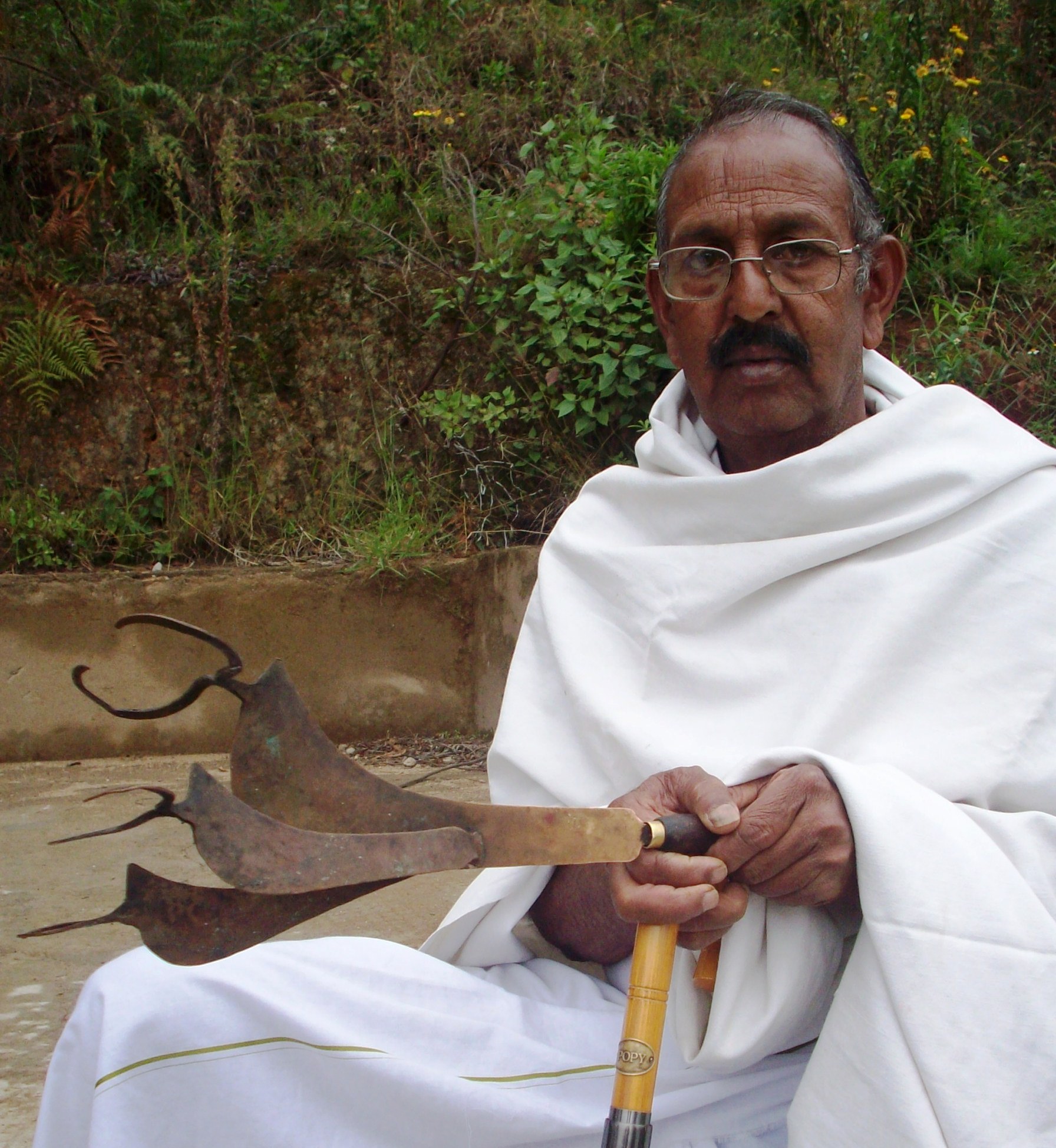
Many Badaga hattis have their own specially made ‘Kathi – knife’ for the Thalai Akki ethuva – Headman. The Dhenaadu knife has an unique design.

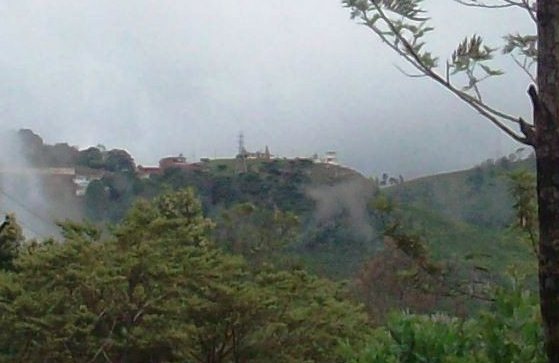
Kundah Manjoor and the famous Annamalai Temple are clearly visible from this hatti.

Some pictures of Dheenaadu


By the way, how many Badaga Hattis have you visited?

The Mouth Watering Badaga Dishes

The Mouth Watering Badaga Dishes

Badagas have given a lot of importance to their food habits. The most importance, obviously, was given to healthy dishes and how they were prepared. Taste, finds equal importance.
In any festival or celebrations one of the must prepare is the sweet dish known as “Thuppidittu – Thuppadha [Clarified butter – Nei in Tamil] Hittu [Food] – also called ‘Ennay Hittu – Oil [fried] Hittu’. For health and ease of preparation, what better than the wholesome meal of  Eragi Hittu. One of the longevity of life span of  elder Badaga Ayyas and Hethays [older people] is attributed to regular intake of this food for lunch. Taken with  ‘soppu’ – greens and ‘avaray’ – beans curry with a touch of ‘thuppa – clarified butter’…..ah..ah…as I write, my mouth is watering – ‘Jollu Jorira’.

Go here to see the recipes

The Badaga dance

One of the prominent Badagas who is involved in many developmental activities associated with Badagas is Mr.T.Rangaiah from Kothiben. He is well known and deeply involved with Tea Board. He is a quiet and unassuming person. In one of my recent meetings with him he mentioned about the Badaga dance.

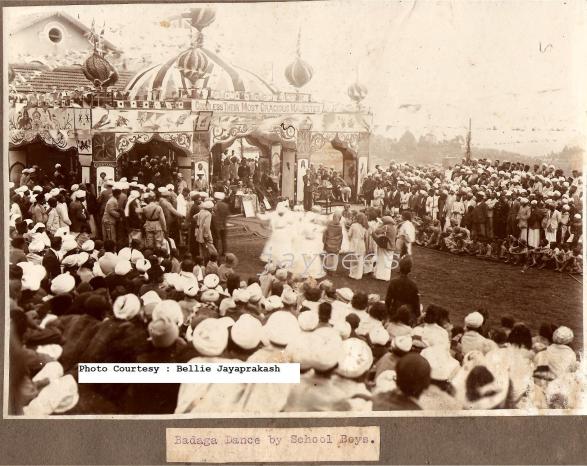
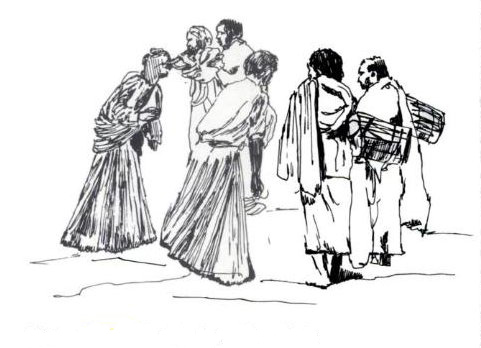
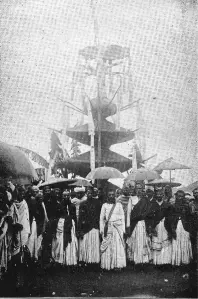
In olden days, Badaga dance was almost always performed by the artists wearing a typical dress called ‘Dodda Kuppacha’ – a two piece attire in white consisting of a top ‘waist coat’ like what the Rajasthani rural folks wear and a bottom skirt. Since the badaga dance is based on many steps in which the dancers go around [revolving] in circles, these skirts open up making a beautiful sight.

Badagas, in their DHODDA KUPPACHA (a flowing gown like attire) dancing to Kota music. Photo drawing from : ‘Counsel from the Ancients – A study of Badaga Proverbs, Prayers, Omens and Curses’ (Prof;Paul Hockings)

Whenever, any dignitary visited the Nilgiris in those days, it was always the Badagas who would present a dance – both for welcoming the guests and for entertainment – with the Kothas providing the music called ‘harakolu’.

But of late, the Kothas have adopted the Badaga dance. The Nilgiris district admin consisting of ‘babus’ who are reluctant to accept the fact the Badagas are one of the original inhabitants of the Nilgiris like the Todas and Kothas, have been presenting Kothas’ dance much more than the original Badaga Dance.

Mr.Rangaiah also mentioned about a ‘traditional door’ kept in the Tea Board/UPASI complex ‘museum’  in which the Badagas are NOT mentioned along with others as the tribes of the Nilgiris.

You guessed it, the door was presented  by none other than some Badagas from Kotagiri.

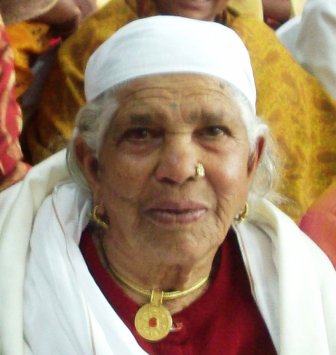
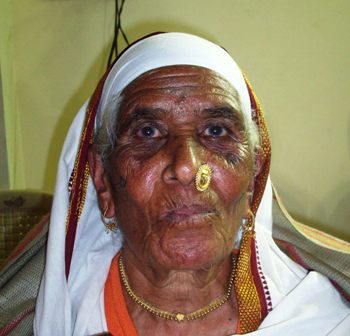
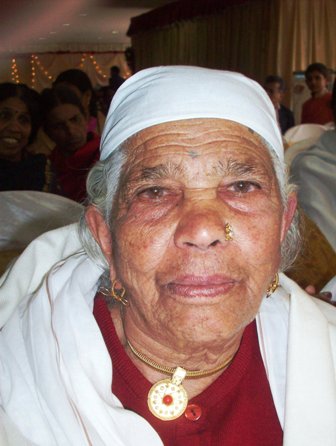
Nice to see these ladies with ‘Badaga Jewellery’

Recently I had the pleasure of attending Abhinesh – Revathi wedding at Ooty. What made me proud and pleased is that there are still some sweet ‘old’ ladies who wear traditional Badaga Jewellery in all its glory.

I am extremely grateful to Mrs.Maya Kumar (daughter of Balasubramaniam who had written the well received book on Badagas – PAAME and grand daughter of ‘the walking encyclopedia of everything connected with Badaga, the one and only Jakkadha Bella Gowder) who helped me in taking these pictures.

POWER TO CHANGE

  POWER TO CHANGE

[Dedicated to my mother]

Give me the power to dare,
to reach the heights with no fear,
Instead of meekly stand and stare.

Give me the courage to defend,
the innocent from injustice of any kind,
Instead of simply sit back and pretend.

Give the strength to protect,
the unique and wild to keep them intact,
Instead of finding excuses to destruct.

Give me the heart to offer,
whatever is left in the coffer,
Instead of walking past those who suffer.

Give me the chance to dream,
Give me the courage to dare,
Give me the conviction to do.

GIVE ME THE POWER TO CHANGE,
THE POWER TO CHANGE MYSELF,
TO CHANGE MYSELF FOR THE BETTER.

(Poem by JP)

Bravo Arjunan

Anand Ramachandran informs :

COME AND WITNESS A BADAGA MAKING HISTORY BY SUPERVISING THE WORLD’s GREAT FOOTBALL PLAYERS AT KOLKATA ON 02 SEP 2011.

On Sep 2011 an international football friendly match between ARGENTINA and VENEZUELA IS TO BE PLAYED AT SALT LAKE STADIUM KOLKATA. The football greats like MESSI,TAVEZ are part of the Argentina team. For this match 4 FIFA Referees are selected. AJJAGOWDER ARJUNAN (A PROUD BADAGA) is one of the Refrees. All badagas are invited to watch the match.(At least for the proud badaga).you can also watch the match on sports channels from 7pm.

Why Badagas wear silver – rings in pair?

A question from Suresh of Kalhatty who had obviously seen the page on Badaga Jewellery [Badaga Bangara]
has clean bowled me. His question is why do Badagas, always, wear silver rings in pairs. Does it have any special meaning?

I have heard elders telling ‘jodi (bellie) ungara ikku’ – wear (silver) rings in pair but never really found out the significance. Anyone who can through some light?