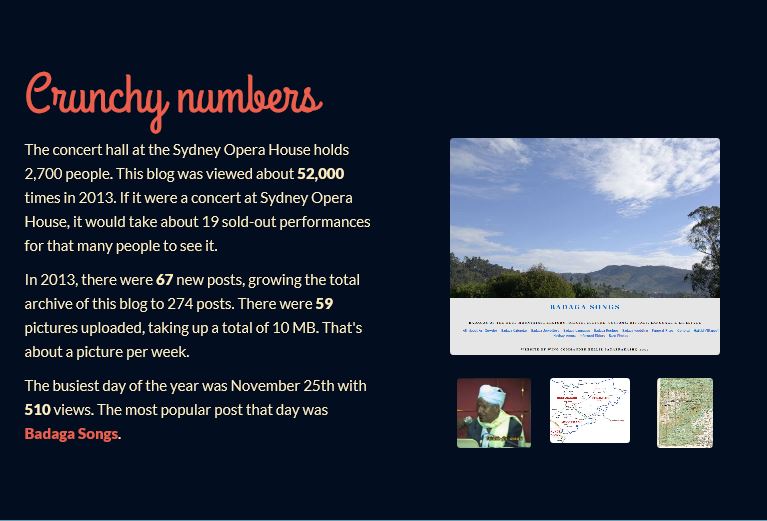
Extremely grateful to one and all for ‘HITTING’ us 300,000 times.
This landmark was reached on – 6th January, 2014 !!
Thanks again for the new year gift !!!
Uri Hogi, Siri Barali

Extremely grateful to one and all for ‘HITTING’ us 300,000 times.
This landmark was reached on – 6th January, 2014 !!
Thanks again for the new year gift !!!
Uri Hogi, Siri Barali
Click to read WORDPRESS annual report about our website

 Wishing all the visitors to this website, a very Happy New year!
Nearing the milestone of 300,000 hits.
Wing Commander Bellie Jayaprakash
Click to read WORDPRESS annual report about our website




Posted in badaga
‘Save the Nilgiris’ fame, Dharmalingam Venugopal, [Honorary Director, Nilgiri Documentation Centre, Kotagiri] is a man devoted to the development of the Nilgiris – the Blue Mountains known to the Badagas as ‘Nakku Beta’

He is ‘on a mission to put the beleaguered Nilgiris on the world map. Dharmalingam Venugopal is an angry man and is an anguished one too. A Badaga, he has grownup with stories woven around his beloved hills’ [ Read the full article published in The Hindu here].
He is organizing an ‘All India Workshop on Sustainable and Inclusive Mountains Development’ at Ooty from 29th to 31st December, 2013.
[Though he has been kind enough to invite me to this workshop, I am unlucky to miss this great opportunity being out of the mountains – Wg Cdr JP]
In the concept note , it is mentioned that
The object of this workshop is to evolve a framework for such a National Mountain Policy, which may pave the way, among other things, for:
Undertaking a mountain-state-wise inclusive inventory of the natural and cultural diversity and development challenges of Indian mountains;
Creating a mechanism for continuous and coordinated monitoring of mountain areas;
Providing for appropriate policies and programmes to prevent, mitigate and adapt to climate and land-use change;
Formulating mountain-specific sustainable development policies based on appropriate emulation of global and domestic ‘good practices’ while at the same time avoiding corresponding ‘bad practices’;
Ensuring adequate plan and budgetary provision for economic and social infrastructure in mountain areas;
Ensuring adequate funding/compensation for conservation activities in mountain areas based, where appropriate, on payment for ecosystem services or other such fiscal instruments; and
Launching a massive and effective awareness campaign for conservation and sustainable development in mountains.
‘The broad-based workshop will bring together a compact group of senior officials, professionals, social and natural scientists, environmentalists, writers, journalists, economists and corporate leaders’ like Dr.T.S.Tolia, [Former Chief Secretary, Uttarakhand] , Dr. N.Sundaradevan,[Former Addl. Chief Secretary, Tamil Nadu], Shri. Sudhirener Sharma [Climate Himalaya]’ Mrs. Rohini Nilekani,[Chairperson, Arghyam], Dr. SM. Ramasamy [Former Vice Chancellor, Gandhigram Rural Institute], Dr. O.P.S. Khola [Principal Scientist, Central Soil and Water Conservation and Training Institute, Ooty], Dr. Biswajit Banerjee [Director (Forestry) Planning Commission], Dr, P.A. Azeez [Director, Salim Ali Centre for Ornithology and Natural History], Shri. Ramachandra Guha [Environmental Historian], Dr. Sarala Khalling [Regional Director, Atree, Gangtok]’
For complete details of the Concept Note of this workshop Continue reading
Posted in badaga


Hethe Habba celebrated at Jakkadha on 23/12/2013
~~~~~~~~~~~~~~~~~~~~~
URI HOGI, SIRI BARALI !!!

~~~~~~~~~~~~~~~~~~~~~~~~~~~~~~~~~~~~~~~
***************************************************
|||||||||||||||||||||||||||||||||||||||||||||||||||||||
See below the latest response ‘From the Heart – from Sengamalam ]
Do you have something to say?… a thought, a feeling , a comment or for that matter anything straight from your heart.
The direction our community is heading towards?
The “MORAY” system that seems to be a hindrance for many marriages to be fixed?
The ‘fight’ over control of YBA?
The UNFAIR treatment still extended to the fairer sex in our community?
The controversy surrounding equality to NATTARU in out hattis?
[Only request is – to follow the secret of KISS – ‘Keep it SHORT sweety’]
From: Sengamalam [ j_senga@yahoo.co.in]
A feeling
Badaga , the innocent soul
Bagaga, the village joy
Badaga, the sweet raga
Badaga, the NA2
Badaga, the badaga dance
Badaga, the best of all……
~~~~~~~~~~~~~~~~~~~
A thought
BABU.M [ byangi_babu@yahoo.co.in]
1.MORAY should be liberal to some extend.
2.STRONG & GOOD DEDICATED Leader is to be found.
3.All are BADUGAS nobody should be seperated.
BADUGU KALACHARA THALAIVARU (like DALAI LAMA) is to be found.
Posted in badaga
R Haldorai, Principal Correspondent, New Indian Express,
[Kammandu Village, Ketti Post, Nilgiris ] writes :
At the outset, I thank the Badagas of the Blue Mountains for uploading Badaga history without changing the traditional nature of our unique community. I like the word “Ari Gowder-undisputed leader of Badagas”. We need such kind of leaders now. This reminds me about unwanted events happened in Young Badaga Association recently. We pray to Hethe Amman through the Badagas of the Blue Mountains to give good leaders like Ari Gowder.
It gives me great pleasure and encouragement to receive such comments from the Principal Correspondent of a National Daily. Thank you very much, Mr.Haldorai for the kind words. As I had explained elsewhere, if this website is able to convey the correct information about the Badagas of the Blue Mountains, then, we have truly achieved our aim. Thanks for all the kind words that give real motivation to do more – Wg Cdr JP
Posted in badaga
Birth anniversary 4th December

Ari Gowder2
For more details about Ari Gowda go here or see Wikipedia
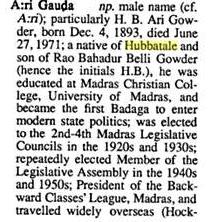
Ari Gauda
[ Ref : Hockings, Paul; Christiane Pilot-Raichoor (1992). A Badaga-English Dictionary. Walter de Gruyter. p. 47. ISBN 311012677X, ISBN 978-3-11-012677-8]
Posted in badaga
I was watching the programme on ‘Girl Child’ on NDTV. It was about the mind set of Indian men, rather the society. The mind set that is biased against the girl child. Against women.
(Talking about NDTV, I have the pleasure of knowing both Prannoy Roy and his graceful wife Radhika Roy right from the days when Prannoy used to be hosting ‘The World This Week’, a great weekly serial on DD. Have met them over dinner both at our place as well as his, along with other charming couples Prakash Karat and Brinda Karat [ CPM leaders] and Kishore Chandra Deo and Preeti [Union Minister for Tribal affairs]).
Though, Badagas, do not have a bias AGAINST girl child as such, the fact remains, that the Badaga men, still, do not consider Badaga women to be EQUALS.
This is greatly due to the fact that daughters are not given equal share of the property. In fact, no share at all. For centuries, this bias carried on making the daughters to be dependent on the ‘mercy’ of the brothers. And, the reason for the brothers not willing to share the property with the sisters, well, you guessed, is due to their wives.
Unfortunately, for these men to have a bias against women, is the result of the fact that many women do not consider others of their own sex, to be equals. Confusing ? Not really. Every mother in law considers the daughter in law to be a step lower.
Every woman hopes that the entire property will come ONLY to her husband and not given to his sisters.
There have been enough and more Katta Panjayats – Koottu [consisting of mostly men] in both village-hatti level as well as Seemay levels. But mostly these Koottus have not been successful in ending property disputes. Many have gone on to seek legal remedy – a lengthy process in our country.
Luckily, now that there is a law that gives equal share of the property to both sons and daughters, the importance of these kootus on property, is becoming irrelevant. This law is applicable even to daughters married after 1987(?).
Prannoy Roy concluded in the ‘Girl Child’ programme, “men are the problem and women – the SOLUTION’. True ? Or, is it the other way round?
It is time that we, who consider HETHE as the greatest Goddess, to ponder about this and change our mindset against girls and daughters!?
Posted in badaga
Tagged Kishore Chandra Deo, NDTV, Prakash Karat, Prannoy Roy, Radhika Roy
A couple of days back, I received the following email from a young mother [name withheld] who wrote to say :
Dear Sir,
It gave immense pleasure for me to visit your website. I was always amazed to know about the community and the culture.I am a Non Badaga and married last Dec to a Badaga from ………..
And Recently on the ….. of this month I gave birth to
a baby. My husband and my in laws want me to learn Badaga as I have to talk to the baby in Badaga for her to pick up the language.Please help me learn the language by sending me some day to day conversations .
Thanks in Advance. Best Regards.
My reply :-Thanks a lot for your email. I am delighted to learn that you find my website[s] interesting and informative.I have given a few ‘lessons’ about LEARN BADAGA in my websites/blogs. ….When you meet any elder, especially your in-laws and hubby’s grand parents, bow your head and say, ‘Kumbidichivi – meaning bless me. They are expected to touch your head and say, “Badhukku” – long live. You will find that any elder Badaga will be thrilled with this gesture as many do not follow this wonderful custom and your day will be made.As a new mother, for about 40 days after delivering a baby, you are a ‘baththya hemmathi’ with some diet and other restrictions.“Hosa koosuga, ondhu muthu kodu’ – give the new born baby a kiss.The following have been taken from my earlier posts
Let us learn Badaga
” Ollenge iddiya ? – How are you ?”
‘Suddi saddha ella olliththa ? – (Roughly) ‘ How is everything ? ‘
1. Are you a Badaga ? – Nee ondu Badagana?
2. Yes, I am a Badaga – Ha, Na ondu Badaga
3. What is your name ? – Ninna hesaru aena ?
4. My name is Bhoja – Enna hesaru Bhoja
5. Which is your village ? – Ninna Hatti edu ?
[5a. Amme / Thamma, nee ai hatti ? – Girl/ Boy, which is your village?]
6. My village is Bearhatti – Enna Hatti bandu Bearhatti
7. Whose son/daughter are you ? – Nee dara maathi / hennu ?
8. I am Mela thara (top street) Joghi Gowder’s son / daughter – Na Mela thara Joghi gowdaru maathi / hennu
~~~~~~~~~~~~~~~~~~~~~~~~~~~~~~~
Numbers in Badugu /Badaga
1. Ondu (One) 11. Hannondu (Eleven)
2. Eradu (Two) 12. Hanneradu (Twelve)
3. Mooru (Three) 13. Hadimooru (Thirteen)
4. Naakku (Four) 14. Hadanaakku (Fourteen)
5. Iidu (Five) 15. Hadanaidu (Fifteen)
6. Aaru (Six) 16. Hadanaaru (Sixteen)
7. eizhu (Seven) 17. Hadarizhu (Seventeen)
8. Eattu (Eight) 18. Hadarettu (Eighteen)
9. Ombathu ( Nine) 19. Hathombathu (Nineteen)
10. Hathu (Ten) 20. Eipathu (Twenty)
30. Moovathu (Thirty) 40. Nalavathu (Forty)
50. Iivathu (Fifty) 60. Aravathu (Sixty)
70. Elavathu (Seventy) 80. Embathu ( Eighty)
90. Thombathu (Ninrty) 100. Nooru (Hundred)
Days In Badugu/Badaga
1. Aadivaara (Sunday)
2. Sovaara (Monday)
3. Mangavaara ( Tuesday)
4. Bodavaara (Wednesday)
5. Chikkavaara (Thursday)
6. Bellie (Friday)
7. Sani (Saturday)
Months In Badugu/Badaga
It is said that Badaga month usually, starts on every 10th of the English month. Like for example the first Badaga month Koodalu starts on 10th January.
1. Koodalu (Jan)
2. Aalaani (Feb)
3. Nallaani (Mar)
4. Aani ( Apr)
5. Aadire (May)
6.Aadi (Peraadi) (Jun)
7.Aavaani (Jul)
8.Perattadi (Aug)
9. Dodda Deevige (Sep)
10. Kiru Deevige (Oct)
11. Thai (Nov)
12. Hemmaatti (Dec)
Pleasantly surprised to hear all the Badaga Months being mentioned in this song called ‘Kappu Huttileyu’ . See the widget on the right and click to listen to this great dance number
**************************************
| Hindu-Arabic numeral | Badaga and pronunciation | |
|---|---|---|
| 1 | ஒந்து (Ondu) | |
| 2 | எரடு (Eradu) | |
| 3 | மூறு (Mooru) | |
| 4 | நாக்கு (Naaakkuu) | |
| 5 | ஐது (aidhu) | |
| 6 | ஆறு (aaru)) | |
| 7 | எழ்ழு (ézhu) | |
| 8 | எட்டு (ettu) | |
| 9 | ஒம்பத்து (Ompathu) |
Maana – Pride, Mana – heart
~~~~~~~~~~~~~~~~~~~~~
Peculiar Words
There are some words in Badaga that are truly peculiar. for example :
1. GIJI GIJI ( as in Give & Jinx) – Confusion , mess up / disorderly
GIJI GIJI maada beda – Don’t create confusion
Room aekka ethe GIJI GIJI (ya) hadadhe ? – Why is this room in such a mess?
2. MURUKKU(LU) (Mu ru ku) – Foul mood / mild anger
Amme Ekka maathaduvadu elle ? – Why is sister not talking ?
Ava murukkindu endhave – She is in a foul mood
3. BADAYI (Ba daa ee ) – Show Off (proud)
Appara badayi maadiya – She shows off a lot
~~~~~~~~~~~~~~~~~~~~~~~~~~~~~~~~~~
Birds (Hakkilu)
Mari (chic) –{Koi Mari – chic(ken)}
Also for calf [ for eg) Nei mari – puppy dog]
COLOURS (BANNA)
Also see http://badaga-language.blogspot.in/
Posted in badaga
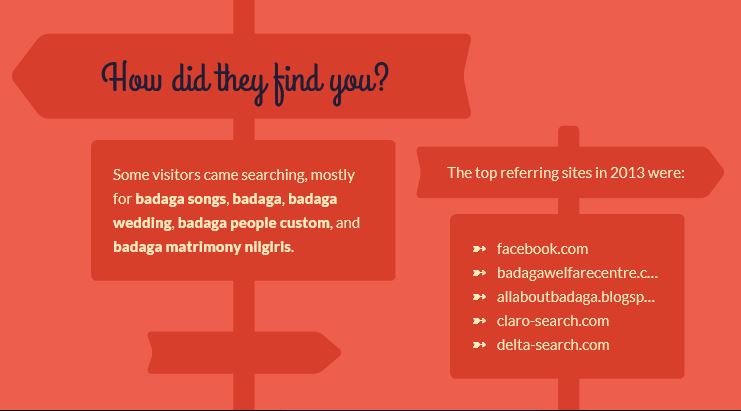
Our website http://www.badaga.co gets about 150 visits every day. The maximum visits, quite a few months ago,on a single day, was 375.
But imagine the pleasant shock of getting 510 hits! That happened on 25-11-2013 [see the stats below].
I am humbled and grateful to each and everyone of you for the encouragement and motivation.
How do I thank you?
Wing Commander Bellie Jayaprakash


Now you can access our website www.badaga.co on your smart phone.
Remember to access many multi media posts like Badaga Songs and Dance.
 Enjoy! Your feedback is most welcome!!

What we know about Badaga, both language and people, is less than what we DO NOT KNOW ABOUT THEM

my mother, Mrs.Idyammal Bellie Gowder,

my uncle Rao Bahadur HB Ari Gowder and

my grand parents Rao Bahadur HJ Bellie Gowder and Nanji Ammal
Barivi, Nodivi, Oridivi, Odhivi !
Now you can access our website www.badaga.co on your smart phone.
Remember to access many multi media posts like Badaga Songs and Dance.
Enjoy! Your feedback is most welcome!!
 | Mahesh Joghee Gowder on Proud of you DEVA HENNU ! |
 | Supriya Subramani on Tribal Status of the Bada… |
 | inventive71d7cc920c on Seemae [See’may] & M… |
| Riya on Seemae [See’may] & M… |
 | sekaran on History of Beragani Hethe |
 | Krish on Marriages between hattis from… |
 | Joghee Raman on Ari Gowda – 132nd Birth… |
 | Must Visit to know a… on © Copyright |
 | Gokul Gowder on Lt. Meera, First Badaga Lady N… |
 | Elisabeth Jensen on Nice to see these ladies with… |
 | Meghna on Learn Badaga |
 | Gokul on Seemae [See’may] & M… |
| Mahesh Joghee Gowder on Indrani Radhakrishnan at Cambr… |
 | freemortally2a5fac29… on Hethey Habba at Hubbathal… |
 Proud to be an Indian : Proud to be a Badaga
~~~~~~~~~~~~
This website is Designed, developed and maintained by Wing Commander Bellie Jayaprakash ~~~~~~~~ |
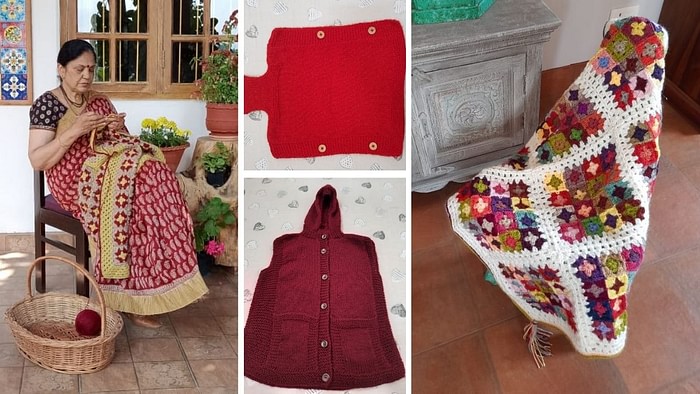
Tara's Creations
Namaskara – Greetings [Namasthe – Vanakkam],
Ollengay Iddhaya? – How are you?,
Ninna Hesaru A’ena? – What is your name?,
Maduvay aagi buttava? – Are you married?,
Nee a’ hattigha koodidhe? – You are married to [the boy/girl from] which village?,
Appara Santhosha – Thank you very much.
Aakkaday – That side,
Eekkaday – This side,
Horasu – Outside,
Baa – Come,
Bannay – [I] will come,
HOnay – Will go,
Hadadha’ya – Is it there?
KaaNay – Missing
>>
More than 1028,000 visitors
################################

::::::::::::::::::::::::::::::::::::::::::::::::::::::::::::::::::::::::
Aakkaday - That side, Eekkaday - This side, Horasu - Outside, Baa - Come, Bannay - [I] will come, HOnay - Will go, Hadadha'ya - Is it there? KaaNay - Missing
<><><><><><>><><>><><>
More than 1026,000+ visitors
################################
:::::::::::::::::::::::::::::::::::::::::::::::::::::::::::::::::::::::::::::::::::::
Now you can access our website www.badaga.co on your smart phone.
Remember to access many multi media posts like Badaga Songs and Dance.
Enjoy! Your feedback is most welcome!!
 In Badaga, MOON is ‘THINGUVA’, Full Moon is “HUNNAWAY” & New Moon is “MUTTU”
☂ ☂☂☂☂☂ ☂
|
|
Do you feel very strongly about any issue concerning Badaga Community? Have the urge to pour your heart out ? Feel free to express yourself without any inhibition and send them to bjaypee@gmail.com


Tiger is HULI in Badaga Lanuage

Here's a question that was posed to the Dalai Lama:
"What thing about humanity surprises you the most?"
His answer is : "MAN - Because he sacrifices his health in order to make money. Then he sacrifices his money to recuperate his health. And then he is so anxious about the future that he doesn't enjoy the present,
And as a result he doesn't live in the present or the future. And he lives as if he's never going to die and then he dies having never really lived".
Donate Your Eyes
 ==
==



![Seemae [See'may] & Morae [Mo'ray] (relationship)](https://i0.wp.com/badaga.wordpress.com/files/2008/11/nakku-betta1.jpg?resize=200%2C200)


 Air Gowder Street in Mambalam, Chennai
 Mookuthi
  Chinna