Badaga – Hatti, Ooru and Naadu[Seemay]

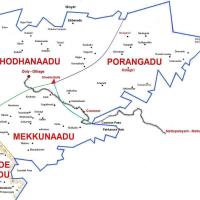
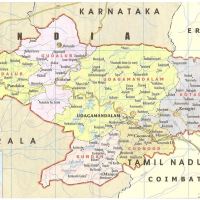
As elaborated in the page on Badaga Hattis [villages], still there seems to be no conclusive evidence about how the ancestors made the divisions [geographical and social] about their villages.Simply put, in ancient times, a few houses (among brothers and cousins) formed a HATTI and then a cluster of villages, though based not only on the geographical locations, formed a OORU. Obviously, all the people from the hattis forming the Ooru were/are considered as brothers and sisters – and hence no marriages among these hattis were considered. Then, many Oorus formed a SEEMAY or NAADU. And, FOUR Seemays or Naadus form NAKKU BETTA – representing the complete Badaga population in the Nilgiri hills. Though, only three Naadus /Seemays namely, Thodhanaadu, Mekkunaadu and Porangaadu have the Dhodda Betta peak as the apex and common point of  these three seemays, KUNDHEY SEEMAY, at the southern eastern end, is very much a separate  and important seemay. See the map.

Nakku Betta

The confusion comes when we realise that some Thodha,Kotha and Kuruma villages/Oorus were also included into the broader periphery of Naadu/Seemay. The probable reasons for this inclusion could be the close association of Badagas with these tribes considered as the original inhabitants of the Nilgiris along with Badagas.

Oorus forming Porangaadu Seemay ;


  1. Hubbathalai – [1.Dhodda Hubbathalai 2.Kunna Hubbathalai]
  2. Jakkadha – [1.Jakkadha 2.Kaarakorai 3.Bearatti 4.Mel Bikkatti 5.Kiya Bikkatti 6.Manjitha 7.Malligorai 8.Honnamudi 9.Odhanatti]
  3. Jakkanarai – [1.Jakkanarai Melkeri,2. J – Oorkeri, 3.J – Kiyakeri, 4. J – Thoria keri, 5.Thumboor ,6.Thinniyur, 7.Mudiakambai, 8.Bangalada, 9.Kallada, 10.Selavai, 11.Bettatti. 12.Naduhatti, 13.Arabettu, 14.Aravenu, 15.Aravenu kettikeri]

CONTINUE reading here…..

CONTINUE reading………..

Time to change with changing times?

Narmu  writes : “I am new to this site. I am very proud to be a Badaga girl. Our people are very loving, caring and are with humanity to a great extent except when it comes to inter caste marriage. They even accept when our boy marries a non-Badaga girl, but they really don’t accept when our girl marries with a non-Badaga boy. My view is that the parents ego plays a vital role. In today’s trends both the men and women are matured enough to choose their spouse. Any one who comes across this post, dont mistake me, its just my views”.


(Please note:  This website encourages all shades of opinions from viewers. You may agree or NOT agree with the views of some  but  harsh comments/ posts will not be approved/published. Editing or deletion of comments is at the discretion of the author/editor- Wg Cdr JP)

This topic, in my opinion, needs our urgent attention. There is plenty of truth in what Narmu says. Do we, especially the elders in the community, need to change our mind set? Is it not time to change with the ‘changing times’?? – Wg Cdr JP

Talented Badagas – abroad

I have written about many talented Badagas living far away from their native place in the Nilgiris. While most of them have crossed the ‘seven seas’ due to better opportunities or job requirements, there are quite a few ‘businessmen’ also.

Some of the spouses, mainly from the fairer gender, have  chosen to ‘DO SOMETHING  ABOUT THE TALENTS’ they have been bestowed with instead of merely remaining as ‘house wives’. Even in the face of stiff competition and alien atmosphere, they have carved a place for themselves.


One such lady is Mrs.Vinitha Rajkumar, daughter of Dr.KM Raju & [late] Meneka [Kerada] and wife of Dr.Rajkumar from Naihatti, living in UK. of course, I am proud to record the fact that she is my niece, too. She is running a Bharatanatyam dance school called “RHYTHM INDIA SCHOOL OF DANCE, PLYMOUTH, UK

Vinitha, is also, invited to many school/social gatherings to speak about INDIA !

Mrs.Vinitha Rajkumar, welcomes all to her website http://rhythmindia.wordpress.com

 Mrs Vinitha Rajkumar  with daughter Natasha

 Her website is http://rhythmindia.wordpress.com

Vinitha, you make us all very proud.

‘Matrimony’ page added

After receiving a couple of requests about ‘looking for a bride..’, the page -> ‘ Matrimony ‘  <- is re-added now.

This is being done as a FREE social service focused on Badagas ONLY.

No strings attached and NO guarantee about the authenticity of the details provided by the individuals.

JP’s other — ‘Badaga’ websites

One of the complaints I hear from our friends visiting  badaga.in is that it takes ages to fully display all the contents. This is because, there are many multimedia posts like songs, pictures, animations etc.To overcome this drawback I have developed another set of websites  that can load faster. Like for example, what you see in the ‘home’ page of this site can be seen with alot of animation in badaga.co

The most popular page ‘BADAGA SONGS ON THE WEB’ is made into a separate website “Badaga Songs on the web”where you can listen to ‘Badaga Music’ without leaving the page.

A partial list of new weblogs are

Badaga Wedding in pictures

Badagas- General

Badaga Songs on the WEB

Badaga Rare Photos

Badagas who made a difference

Badaga Jewellery

Badaga recipes…..

Badaga Funeral Rites

Badaga Songs

Hethay Amma History

Badaga Language

Badaga Villages

Have you visited www.badaga.name?

Have you visited www.badaga.name?

In this website,  www.badaga.co , you can ‘see and hear’ a lot more ‘media’ as javascript is enabled.

WELCOME TO THE WONDERFUL WORLD OF BADAGAS
 Baarivi, Nodivi, Oridivi & Odhivi!
[Come, See, Listen and Read!]
பாரிவி, நோடிவி, ஓதிவி & ஓரிடிவி
copyright©Bellie Jayaprakash 

Badaga Months in this nice dance number

Badagas had [have] their own calendar based , probably on lunar observations.  Being involved in farming [agriculture] totally, their activities were centered around this unique calendar. I have given more details here.

Click on the link below to hear all the Badaga months being mentioned in this foot tapping dance number. Great lyrics and great music !

Badaga Days1. Sovara – Monday 2. Mangavara – Tuesday 3. Bodhavara – Wednesday 4. Chikkavara – Thursday 5. Belli – Friday 6. Sani – Saturday 7. Aadhivara – Sunday

|
Badaga Months It is said that Badaga month starts on every 10th of the English month. Like for example Koodalu month starts on 10th January.

1. Koodalu (Jan) 2. Aalaani (Feb) 3. Nallaani (Mar) 

4. Aani ( Apr) 5. Aadire (May) 6.Aadi (Peraadi) (Jun) 

7.Aavaani (Jul) 8.Perattadi (Aug) 9. Dodda Deevige (Sep) 

10. Kiru Deevige (Oct) 11. Thai (Nov) 12. Hemmaatti (Dec)

Badaga Dance Song Kappu Huttileyu


You can also see details about Badaga Calendar here or here

Do you?

I have added a page titled ‘Do You?‘ where you can give your thought or  feeling  …… a free expression.   Please keep it short and do not be offensive. Click here and….Over to you.

Here is the FIRST ‘do you’ from Sofiajoghee from Singapore

Topic:  Praying Hettai Amma

I have no criticism on any religion or praying methods. Th only aim I think is to merge with our soul creator. So, I learnt a few techniques that would lead to the attainment of realization, healing and Samadhi if followed with discipline.

When I see we say we follow Hindu culture, however, our community is completely lacking in the growth in these areas except for the stories of Hettai Amma Eera Masi, who I was told vanished into the space when she found Iyya was found as a spirit after he was dead.

I am not sure how far my understanding of the story is true, because I have heard many versions of this stories from many people. So, I believe, she existed and was a great being. We have taken principles of her life to be followed in our life as well.

But end of the day, we need to reach a point which will lead us to eternity, and methods that can lead us to our creator. Do we have any such methods of prayers?

Even though Hettai Amma is a  mother godess (we believe so), we don’t allow women who try keeping the house clean over the hettai amman festival time to enter the temple. why are all these still in place.

If we understand the true value soul and the purpose of it, we shouldn’t have such practices, but strive towards one goal, because soul is always in its purest form. It is the intention of any person that needs to be pure when they pray, and not based on any division on color, sex, caste or creed.

Does our prayer practice have any such development helps? Kindly let me know if you have any pointers.

If not, don’t you too feel there is something we lack and its time for us to learn. Since we don’t have such learnings, many are changing converting their religion where their souls are motivated. nothing to blame, but every time soul is in search to reach Shiva.  So, how to teach such things to all?

JP adds -I agree with Sofiajoghee. I am a staunch believer of Hethai Amma and written extensively on Hethai Amma History and Hethai Habba in this website as separate pages. It is still a mystery to me why we do not ‘allow’ women to enter the Hethai Temples at Beragani and Pedhuva hattis all the time and on a regular basis. Yes, we all consider that Hethai Amma, as the name indicates, is our Goddess and deity in the FEMALE FORM like other Goddesses, Parvathi, Sarasvathi, Lakshmi, Kali or Durga. But when it comes to certain rituals and entry to Hethai Temples…it is a big NO NO. Are we following something blindly without any rhym or reason? Do we need to change our mindset? Should FAITH and religion be imprisoned to gender bias??

‘Breaking’ Marriages.

It is very sad but true. Many marriages among Badagas are breaking and ending in divorce ‘buduchuvadhu’.

A sacred institution that is meant to be for life is not even lasting for a few months. I heard the shocking story, recently, that the girl returned home the same evening of the wedding not for ‘marumanay’ but for good. She was forced by her parents and those of the groom’s when she refused to get married in the ‘first place’ that lot was at stake. Really sad !What are the reasons?

One is surprised to see so many nice looking, educated and employed boys and girls among Badagas ready for marriage but hesitate to tie the knots since they not sure for how long the sacred marriage would last?

Is it the ‘old mind set’ of the boys and their parents that the ‘wife – hendaru or daughter in law – sosay’ is expected to be only a second class citizen bringing water, cleaning the house, cooking and bearing children even if educated?

Shockingly, it appears, the BPO driven ‘night shift’ non-performing boys, cannot carryout the fundamental principal of a marriage [that proclaims that a marriage is nothing but a public announcement of a private affair] and suffer from erectile dysfunctions and sexual deficiencies and thus cannot face their partners. Then they blame it all on the girl when they are grilled by his parents and relatives with the typical but crude Badaga sense of outrage, ‘ Ennu basaru aapillay’ya? – has she not become pregnant yet??

Are the educated and employed girls not ready to share and enjoy life but live in a false world that they are ‘more’ than equal in most respects and forget the adage that the fundamental requirement for a successful marriage is nothing but ‘adjustment’? Do they feel being single is better than being singled out for failures??

Seeking a non – Badaga partner seems to be a fashion and passion without differentiating between love and infatuation.

Where is the problem, really?

Are we, the elders, with blinkers firmly in place, not seeing the truth in a broader perspective? Are we contributing to the cause in a negative way and condemning our great community to a curse??

[Reproduced]

Now, Nive, writes to protest :
Do you think love is fake when it comes to a non Badaga partner….. even if not all, few know the difference btwn Love and Infatuation. Am I not right? So what you try to say is that love between badagas is true ,but between a Badaga and other is fake?

Hello Nive,I am surprised that you completely missed the point. Read my comments/opinion again. Love, by definition, is ‘blind’. Infatuation, on the other hand, is a temporary phenomena. I am aware of lot many successful LOVE marriages between Badagas and non Badagas. I am also aware, that there is nothing known as ‘love by design or default’. Thanks for the comments, anyway, it tells me that my words need to be put in proper way. The larger point, I am trying to make out is “why are so many Badaga marriages breaking ? Is ‘morey’ the single most reason that prevents young Badagas seeking or falling in ‘love’ with another Badagas? – Wg Cdr JP

Sofia Joghee comments :

“Marriages break in all communities. Its not just confined to Badagas. But the positive note is that, remarriage is not a problem in our community, because every one I believe is broad minded enough to understand that marriages could go wrong. What I have seen is in other communities, people have some horoscope match findings on top of the general points to think, to minimize the breakage. Yet, they happen, its just fate of some due to karmas. But looking into the percentages, we might be more, because of the smaller size in communities.

Most of the marriages within Badagas are forced by the restrictions in our community is very much true. My friends have told me that their parents have permitted them to choose their partners as long as they are Badagas. So, there is no restriction on that point. Choosing is different than falling in love you see. One who really love each other are one in soul, thus can forgive their partner for any blunder and can not be separated for long enough. That’s the strength of true love.

I strongly feel we need to change our mind set of being too restrictive to accepting other society girls as our sosay (daughter in law) and getting our daughters married to other society guys but still include them in our rituals and functions. The more we try to isolate, the community growth will anyway be small. Because, for the kind of distances the current generation is travelling, it is really difficult to restrict choices. In that case of restricting, may be we need t restrict our dressing styles to our food habits, can we really do that? We need to see evolution through adapting to changes.”

“The Speech Sounds of Badugu” – Anandhan Raju

Some time earlier, we had the pleasure of informing about the ‘Badaga or Badugu’ Script developed by Anandhan Raju. I am absolutely convinced that for any language to ‘survive’, it should have its own script [it could be a newly developed one like what Anand has done or an adapted one]. Seeing the disturbing trend of many Badagas freely indulging in conversing in Tamil or English among themselves, it comes as a wisp of fresh air to realise that Anandhan has put his ‘ heart and soul’ to maintain the purity of a wonderful and unique language like our mother tongue “BADAGA”.

Hence it gives me great pleasure to publish  Anandhan Raju‘s

‘The Speech sounds of Badugu ‘- an article on the phonology of Badugu

[This article expounds my views on the Badugu language and also underpins my argument that Badugu should have a separate writing system – Anandhan].


 Badugu is the language spoken by a member of a people of the Dravidian stock  called Baduga  inhabiting the Nilgiri Hills. Most of the languages of the Dravidian families have much resemblance to one another. All are descendants of a single ancestral language now lost.

There are no written records to tell us what the original Dravidian language was like and the original home of the Dravidians and the date of dispersal of the original Dravidian stock. But one thing is certain that the original Dravidian language was broken up into various dialects which underwent separate linguistic development.

Badugu resembles Kannada in certain correspondences, jointly in sound and meaning. Badugu shares such systems not only with Kannada but also with other Dravidian languages too.

The words such as oHzdf /oHDu/ (n. one) and n\kf /na:ku/

(n. four) illustrate and establish the kinship of the Dravidian languages.

Badugu                        Kannada                      Tamil

oHDu                                   oHDu                          onRu

na:ku                                   na:lku                          na:ngu

Examination of long lists of such comparisons shows that, despite differences of detail, original Dravidian sounds changed predictably and consistently in each of the languages.

Badugu is no doubt a cultured language with a wealth of spoken literature and not written, for it was a language hitherto without a writing system but is no longer one.

A study of the speech sounds of Badugu is made herein.

Vowels

The vocalic speech sounds are reckoned at 10 which are phonemic in status.

The classification of the vowels is as follows:

  •           Short Vowels………………………………          5
  •           Long Vowels………………………………           5
  •           *Retracted Short Vowel……………              1

*The point of articulation of this vowel is the same as that of the short vowel e /e/ except for retraction of the tongue. Though the vowel is an allophone, it may be written as eX /eX/. For example, the /e/ at the beginning of etztf /ettu/ (n. eight) is different from the /eX/ at the end of aeX /aeX/ (n. cave).

Update : 

The following is a public link that I would like to share with everyone who would care to read my manual entitled “Keying In The Badugu Alphabet”.

Read the complete article here  THE SPEECH SOUNDS OF BADUGU