BADAGA KOLA [CLAN]

Pratheepan Raju posted this info in FB [http://www.facebook.com/groups/badagas/doc/430310926984904/]

This is a work of Late Thyagi. K.P.Raju Gowder of KADASOLAI Village who was Author of the local Nilgiri magazine called “ARAAICH [Araachi?]” in which he had published 13 issues.

The Badaga community, like several communities of India is formed of different Clans(KOLA) affiliated to different Totems.

The various clans and their totems are as follows:

1. Forefathers of Solur Group – NAGA (COBRA)

2. Forefathers of Thoodagur Group – ANEY (ELEPHANT)

3. Forefathers of Doddur Group – MARI (GODDESS MARI)

4. Forefathers of Sinnakunnur – Kethi – Kundha Group – KASTURI (MUSK DEER)

5. Forefathers of Hebbanadu – Halhattane – Thangadu Group – MANIKKA (CARBUNCLE STONE)

Forefathers of Meekeri – Ithalar – Balakola Group – MANIKKA (CARBUNCLE STONE)

Forefathers of Horanally – Porthy Group – MANIKKA (CARBUNCLE STONE)

Forefathers of Bembatti – Belida Group – MANIKKA (CARBUNCLE STONE)

Forefathers of Kasoley-Mandhanai Group – MANIKKA (CARBUNCLE STONE)

Forefathers of Jakkanarai Group – MANIKKA (CARBUNCLE STONE)

Forefathers of Kateri Ajjur Group – MANIKKA (CARBUNCLE STONE)

6. Forefathers of Adhikari Group – KOVERU (WHITE HORSE)

7. Forefathers of Kagguchchi- Jagadala Group – BELLIE (SILVER)

8. Forefathers of Pannemanai-Kenduva Group – SELANDI (SPIDER)

9. Forefathers of Porangadu Group – MADHUVA (HONEY BEE).

Each clan is exogamous, i.e., man belonging to one clan cannot marry the girls of the same clans as they are the descendants from the same ancestors. Men of one clan can marry girls of different clans affiliated to different totem.

Direct words from from his piece –

“It is claimed that the main merkunadu group,viz, the Hebanad-Halatanai-Thangadu group and the Jakkanarai group are descended from the same forefather. The Late A.N. Kadagowder, former Moniagar of Merkunad, Denad Village and the Late.M.Doddayya Gowder of Halattanai informed the author (Late.Thyagi.K.P.Raju Gowder) that the forefather of the Jakkanarai group of the Badagas was uterine brother of Huliajja, Guruajja and Haraajja, the forefathers of the main group of the merkunad people. The Jakkanarai forefather Batti Hettappa joined the Porangadu forefathers at Thalaimalai and accompanied them to Betalada where he married Yelingi Amma, the sister of 7 forefathers of Porangadu people. The above informants asserted that they belong to the MANIKA CLAN.”

SUCCESS STORY OF [Hubbathalai] SIVAN

I have always believed that success comes when one works with tireless zeal and single minded dedication to do something for the society. Recognition, of course, comes knocking down sooner than later.

One such unassuming Badaga who has achieved a lot of success and recognition is Hubbathalai Nandi Gowder SIVAN. He has traveled widely and is easily approachable for any sort of advise.

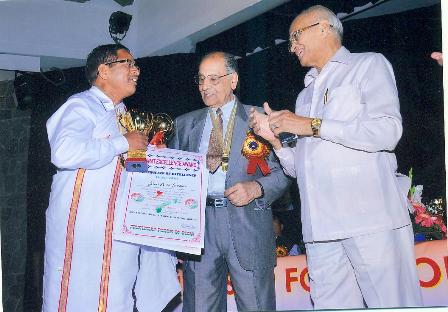
Recently, he was bestowed with the following awards at New Delhi.

Bharat Excellence Award with Gold Medal of FFI in 2012, presented by Dr.G.V.G.Krishnamoorthi, Former Election Commissioner,Govt of India for the growth of Indian Economy and Inspiring Pillar of India Award with Gold Medal of FFI in 2012, presented by Dr.Premnath, Former Deputy Director General, United Nations Food and Agricultural Organisation (UN-FAO) for successful achievements and contributions in the chosen fields.

Wonderful to see  Siva receiving the award attired in traditional Badaga dress.

Wishing Siva[n] many more success in all his endevours. We are proud of you, Siva.

Read more of Siva’s

SUCCESS STORY OF  THE NILGIRIS HORTICULTURE CLUSTER  PROJECT.

A Very Big Thank You

Mlle. Sumathi Halan [Canada] says:
Congratulations to you and your constant efforts to keep our website updated, interesting and great ! Hats Off, Wg Cdr JP for your efforts and selfless service to our community.

Thanks a lot Mlle.Sumathi, you have always been a source of help and happiness

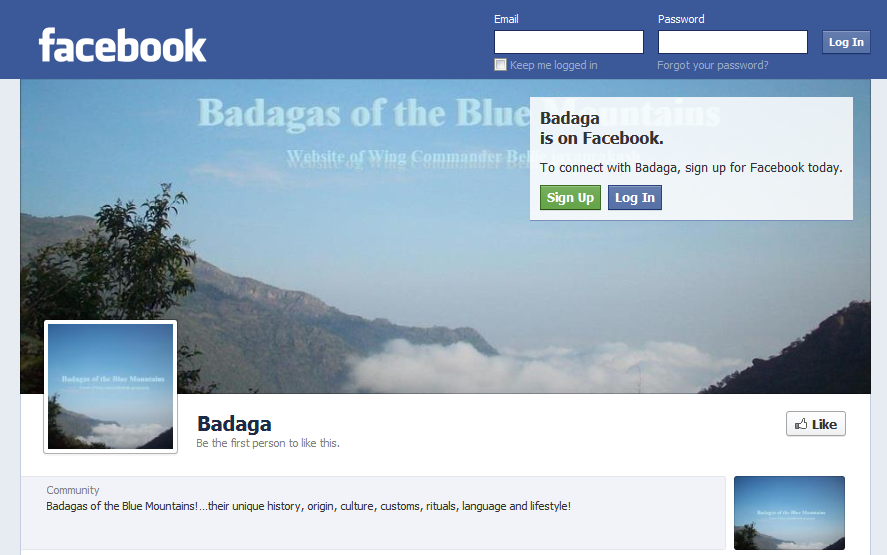
Badaga is now in FACEBOOK also. See https://www.facebook.com/badagas

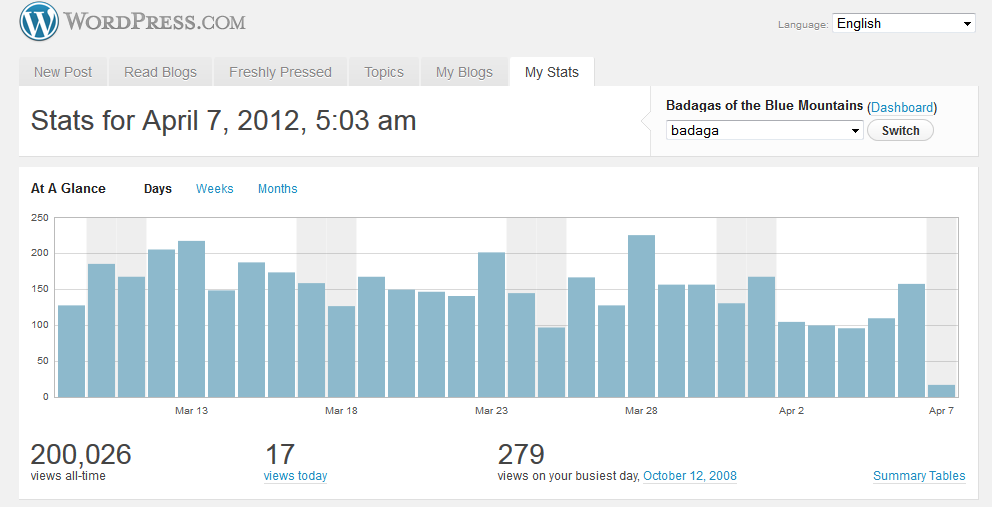
Two hundred thousand [200,000] – Not Out

AS WE GET CLOSER…..to the 200,000 visitors mark….

That is a lot of hits for a website [weblog] that is focused on a small community of the Blue Mountains – the Nilgiris, in the southern part of India. Is it due to…

the urge to know the unknown about ourselves….

to sift the truth from fiction….the satisfaction that we have a very unique history…..the mystery about the mistaken migration…..the traditions that are still steadfastly followed…..the great language that has survived for centuries without a script….

The simple fact that this site’s motto of ‘Proud to be a Badaga ; Proud to be an Indian‘ has become an accepted norm…

You all, my dear and loyal friends, have made me bow my head in gratitude.

Proud to be an Indian and a Badaga, indeed.

Hope to say ‘thanks a million‘ soon…

Started as a hobby but now an obsession.This website crossed the milestone of 100,000 visitors on 8th March,2010 and 150,000 visitors on 20th April,2011. Feel humbled but proud

Copyright © Bellie Jayaprakash 2006-2012

Dedicated to mom

Mrs.Idyammal Bellie Gowder

[1912-2011]

Badaga Baray [Script] – A request from Anandha

Dear Wg Cdr JP,
May I entreat the visitors of your websites to do what  they can for the cause of making Badugu, hitherto a spoken language, a written language?
I want every Baduga to stand by me in my endeavour to publicize the wealth of Badugu literature through the Badugu Alphabet.
Please find attached herewith the following files containing
1. The Badugu Alphabet and their International Phonetic Alphabet (IPA) Correspondences
2. Badugu Sayings with Phonetic Transcriptions using the IPA
Please do the needful. Thanking you, with kind regards,

R.Anandha(n)

Krishnamoorthy, B. S. commented on Badaga Script

Great Job… Kudos to both of you Sirs. BaduguAnandha works nicely… I can write words in our own script (couldn’t get the letter “sha”). Hope it will be nice for every badaga to do some writing practice using BADUGU BARE, So that we can teach to our children very soon…

https://i0.wp.com/a1.sphotos.ak.fbcdn.net/hphotos-ak-ash3/s720x720/551093_378308888867325_100000646522336_1199542_1649648523_n.jpg

From Malaysia

Anbu Keerthan Suppirmaniam

[ anbukeerthan6@gmail.com :: mobile : 0066 012 632 1579 ]

I’m from Malaysia and would like to share my personal experience in learning Badaga Language.

Badaga language is so amazing and very interesting. I got a lot information from websites such as numbers, greetings, months, animals name, months and i’m very proud that I can sing full length of badaga song.(Banuloka Thevakumara Neethano Song)

I just cant stop mentioning the words and singing Badaga language songs. Really amazing and interesting.

Now I want to improve on speaking and pronouncing and I need help and guidance to meet my own satisfaction.

Always proud to be an INDIAN.

Hello AKS, thanks a million for your views on Badaga. If you browse through my websites, may be you will find a lot on Badaga language. I hope, some Badaga friends in Malaysia will pickup your words and get in touch with you. Best wishes – Wg Cdr JP

Sowmya – the new singer from Manjoor

Manjoor  Raja [மஞ்சூர் ராசா] is a well wisher of our websites.

He has sent the following Youtube link where his daughter Sowmya’s debut Badaga song is featured. It is a song from singer Bellie raj’s new album “Hiriya Thambate“. The co singer is Thambatty Bala.

http://www.youtube.com/watch?v=S95YauR_OEU&feature=player_embedded”


We wish SOWMYA a wonderful future and hope her melodious voice will find a place along with those gifted with a golden voice.

Marrying a person with no MORAY

dharshani raj  (dharshani.ds@gmail.com) asks

‘I want to know if it is wrong in marrying a person with no moray’ 

This question, though appears to be simple, is an important one since many of us, including the self – appointed GOWDAS in every village or for that matter, many ‘old people like me’ are not clear and sure about this aspect.

There seems to be a ‘raging‘ discussion going on in  FB Badagas Group.

Let me answer dharshani’s question to the best of my knowledge.

What is Moray (relationship)?

In simple terms, Badagas, [being a very small community], have evolved, over the centuries, a system in which marriages are not ‘fixed’ – call it arranged if you want, between certain hattis (villages) since the ‘blood’ relationship  among them is considered to be very ‘close – anna thamma moray’.

How this could have happened is, like, in olden days, one brother deciding to move away from the hatti he was born in to establish a ‘new’ hatti for various reasons. For example, a brother from Hubbathalay could have moved to Eethoray. Hence, the male children of the elder bro X in Hubbathalay would/could not marry the female children of younger brother Y in Eethorai as they are considered brother and sister (being the children of two brothers).

Hence, Hubbathalay hatti has no moray for marriages with Eethoray.

This brings us to the grouping of various hattis into Ooru [communes] and Seemay.

So,where do we start to check about ‘Moray’?

Since, time immemorial, every Badaga belonged to a village, irrespective of his place of residence. For example, Kada [now, Srivasa Ramachandra] and Kangi [Lokeswari Renuka] are the son and daughter of Bhoja  and Laxmi , living in Ooty [this can be, Bangalore, London or Boston in USA]. Since Bhoja is the son of Rama Gowder of ‘Hannu Mora Hatti’ [ or Jakkadha, Dhavani or Ketchigatti for that matter], Kada and Kangi belong to HM Hatti for practical or rather, moray purposes. By the way, in olden days, all Badagas belonging to Gowda [group] were known as Bellie Gowder, Ari Gowder etc.

So all the youngsters of HM Hatti are brothers and sisters. Marrying among themselves is, thus prohibited.

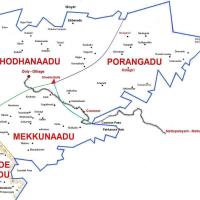
Now, our ancestors, being wise men of yonder, grouped certain hattis into communes called OORU. These hattis need not be very close to each other. The number of hattis forming a ooru need not be of a specific number. The next grouping done by our forefathers is forming a SEEMAY. Hence, a Seemay contains a few Oorus [which in turn has many villages]. And our Muthe Muhappa [the first of the ancestors] divided the Nilgiris into Nakku Betta [Four Mountains/massifs] to where all the Badagas belong to. See the division of Seemays and hattis in my websites here – Hattis, Ooru & Seemay or here

To put simply, a cluster of closely built houses formed a street -thara, [the thatched and later country tiled houses have common walls).

A few tharas formed a hatti with well defined and demarcated areas like ‘Dhodda Manay’ [big house- literally], ‘suthu kallu’ [mostly with a bikka mora (olive tree), gudi [temple],hanay [grass ground] etc.

A few hattis to Ooru. A few oorus to Seemay.

Four seemays namely 1)Thodha Naadu 2)Porangaadu 3)Mekku Naadu 4) Kunde [Naadu],  to NAAKKUBETTA. see Hattis, Ooru & Seemay.

And now to specifics

As far as MORAY for marriages are concerned,

a) A girl/boy cannot marry a boy/girl from the same hatti  to which they both belong to .

b) A girl/boy cannot marry a boy/girl from the same Ooru to which they both belong to.

c) BUT A GIRL/BOY CAN  MARRY A BOY/GIRL FROM THE SAME SEEMAY TO WHICH THEY BOTH BELONG TO.

There is a wrong impression that you cannot marry from the same seemay.

My own example

My father, Bellie gowder, one of the few educated Badagas was born in 1896 in Bearhatti ( the real surprise is that my grandfather Kada Gowder decided to educate my father in St.Michael’s in Coimbatore. In those days, I understand, he had to be taken upto Mettupalayam in a Kattay Bandi [bullock cart]. He got a job in Cordite Factory, Aravankadu near Hubbathalai. He married my mother Kaade (Idy ammal), daughter of Rao Bahadur Bellie Gowder and sister of Rao Bahadur Ari Gowder.

Bearhatti is one of the six hattis belonging to AARUOORU [six villages], Jakkadha [Jagathala] being the ‘head’ village. Hubbathalay is one of the hattis coming under HATHOMBATHU OORU [nineteen villages]. Both these villages belong to PORANGAADU.

After marriage, firstly for convenience as cordite factory is closer to Hubbathalai than Bearhatti and secondly being the youngest daughter of Rao Bahadur Bellie Gowder who was the Naakku Betta Gowda (chief) at that time and as she was only 15 at the time of marriage in 1927, my parents decided to settle down in Hubbathalai.

But my mother being a fiercely ‘PROUD” lady insisted that she would stay only in a new house built a little away from the main Hubbathay hatti. Thus, was born my ‘home’ called ‘DHODDI’ in 1948.

For all practical puposes, we are Nattaru (Guests- literally) of Hubbathalay.

Story does not end here. Though, I was born and brought up in Hubbathalay, I am married to Tara, grand daughter of Rao Bahadur Ari Gowder of Hubbathalay. That is, my mother and wife are from the same hatti.

Please note ; It is very common to see many marriages among boys and girls living in the same village. Living, I said and NOT BELONGING to the same village. But they are perfectly suited to each other and probably known to each other from childhood. May be their marriage is a LOVE marriage.

Exceptions

Incidentally, there are a few marriages solemnised  between the boys and girls belonging to the same Ooru. In one of the cases known to me, a boy from Eethoray is married to a girl from Hubbathalay – both belonging to Haththombathu Ooru. Though, it created some flutter in the beginning, it has been accepted now (due to the fact a rich and politically very influential person is involved??)

Do you know that Kodhumudi is one of the villages which is considered as two separate villages consisting of Mel Kodhumudi and Kiya Kodhumudi and marriages between them is normal?

When you refer to Kinnakorai, in fact it refers to six/seven hattis and marriages do take place among themselves as some hattis in them is consided to be completely made up of Nattarus??

More on Moray


So what happens when a boy belonging to Kavaratti of Thodha Naadu seemay wants to marry a girl from Yedapalli Village of Porangaadu Seemay ?

This appears to be a case of NO MORAY in the sense moray is neutral here and not prohibited. And, in my opinion, there should not be any problem.

Causes for confusion

Originally or rather in the earlier days, marriages took place only within the groups like Gowdas, Lingayats[Lingakattis],Haruvas, Odayas and Thorayas as they formed their own hattis. For example, Odhanatty near Jakkadha is a hatti of Thorayas and it does not come under Aaru Ooru [and hence Porangadu Seemay].

Without going into the details of the unfortunate vertical divide of Badagas, in the early 1900s, where one section was against the compulsory invitation of Kothas [to ‘harakkolu idippudhuga’ – playing music on payment in kind or cash, which ended in huge expenses and debts for the family of the deceased with devastating results. The funeral was not an oneday affair but went on for week and all the ‘guests’ who had come from far and wide, had to be looked after with food and drinks.  The expenses of funerals were not NOT borne by [all houses in] the hatti as is the practice now] for funerals and another insisting on inviting Kothas.

The section of Badagas who were against inviting Kothas was lead by Hubbathalai [Rao Bahadur Bellie Gowder, who introduced many reforms like 1) the funeral expenses would be borne by the whole village 2) education for all Badagas etc] and the other section by Thangaadu.

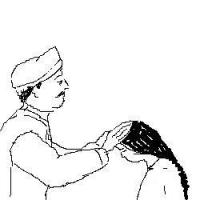
Another cause for this division was the claim of  Thangaadu [Haruva Katchi] led group that when they attend the funeral of Gowda, they would only touch the head [saavu muttodhu], irrespective of the age of the deceased saying that they were the priets. Generally, when a Badaga attends a funeral, as a mark of paying respect to the deceased, the feet or the head is touched depending on whether the dead is elder or younger.

 
I am skipping many more details since this would distract from the topic MORAY which is under discussion.

But these days, marriages among these groups [Gowdas, Haruvas, Lingakattis] have become common. Hubbathalai has marriage relation with Thangaadu or the Lingakatti Hatti of Sakkalatti [Sogathorai] with Eethorai or Bearhatti.
[to be continued]

Sathish Krishnan commented on Marrying a person with no MORAY
‘Thanks for the detailed explanation. I belong to Balacola and I’ve heard elders saying that there is no moray for any marriages within Maekunadu seemay, and Kundey seemay is the best suit for us. But your blog says there is only restriction for marriages within a village or within a ooru (group of villages), and no restriction for marriages within a seemay. It is contradicting and please clarify the same. I will be looking forward for further updates to this blog’

Hello Sathish, Thanks for the comments. First for the contradiction part. I am saying that “no marriages within a hatti and Ooru but yes within a Seemay as long as the Oorus are different. Like 6 Ooru can tie nupital knots with 19 ooru – both being from Porangaadu“. As far as your Hatti Bakkola (Balacoloa?), Mekkunaadu Seemay are concerned, I am NOT in a position to clarify but as far as Kundey Seemay – yes I agree. More in updates soon – Wg Cdr JP

[to be continued]

Aside
fromBBC News INDIA
India’s  homemakers  recruited as hotel chefs

As I finish my lunch at a restaurant in the city-centre, I reach for the dessert that the steward has recommended.A new breed of chefs is taking over hotel kitchens in India. Housewives and mothers are now being recruited to bring “home-cooked” food to five-star plates, as Vasanthi Hariprakash reports from Bangalore…….

Confidence

In the picture-pretty hill station of Coonoor in the southern state of Tamil Nadu, 51-year-old Indira is busy making the signature dishes of her community, the Badagas.
Indira, a single woman in her first job, says her family has kept the traditions of their centuries-old Badaga cuisine.
Whether it is avarai uttakka – local beans cooked with potato, tomato, onions, garlic and tempered with mustard seeds, or sandagai – roasted tomato sauteed with small onion, garlic and coconut ground to a fine paste – the “masala made carefully after dry-roasting 17 spices and not bought off the shops” is the key, Indira says.

She has the confidence of a professional chef who has fed a president’s entourage.


‘CURRENT’ issues…BEWARE !?


Can ELECTRICITY dangerously pass through Flash light of the Digital camera to your body??? Yes it is 100% true..!
 This is a true incidence reported of a boy aged 19, who was studying in 1st year of engineering, who died in Keshvani Hospital, Mumbai. He was admitted in the Hospital as a burned patient. Reason ??????This boy had gone to Amravati (a place located in State of Maharashtra ) on a study tour, on their return they were waiting at the railway station to catch the train. Many of them started taking pictures of their friends using “Mobile Phones” and / or “Digital Camera”. One of them complained that, he was unable to capture the full group of friends in one frame in the Digicam.

This boy moved away to a distance to get the whole group.

He failed to notice that at an angle above his head, 40,000 volts electrical line was passing through.


As soon as he clicked the digital camera? 40,000 volt current passed through the camera flash light to his camera and then from his camera to his fingers & to his body. All this happened within a fraction of a second. His body was half burned. 
They arranged for an ambulance & his burned body was brought to Keshavani Hospital, Mumbai.
For one & half days or so he was conscious & talking. Doctors did not have much hopes as there was a lot of complex issues in his body. He passed away later.

* Please avoid mobile phones on petrol outlets.
 
* Please avoid talking on mobile phones while driving.
 
* Change that “Chalta Hai Yaar Attitude”.
 
* Please avoid talking on mobile phones while kept in charging mode without disconnecting from wall socket.

* Please do not keep mobile phones on your bed while charging and / on wooden furniture. 
* Avoid using mobile phones / Digital cameras near high voltage electrical lines like in railway stations and avoid using flash.
[recd as a fwd email]