Badaga Proverb – Dhoddaru SHLOKA

DHoddaru SHLOKA

One of the fascinating and interesting aspect of Badaga [both people & language] is the free use of delightful but deep meaning proverbs called “DHODDARU SHLOKA”. Also we can call it – “DHODDAVAKKA HEGIDHADHU [What the Elders said] or “MUTHAPPANA MAATHU [Ancestors Words].When you engage an elderly Badaga into any conversation, you are sure to hear a lot of these proverbs thrown in to make / emphasis a point.

Prof. Paul Hockings, probably the most authentic researcher on and of Badaga lists more than a thousand Badaga proverbs, 1730 to be precise. He feels that 1730 could be a complete figure containing all the proverbs there are. See his book,’Counsel from the Ancients: Study of Badaga Proverbs, Prayers, Omens and Curses’. He has given the meaning in English as well as making it easy to understand, in a beautiful manner.

Though I find his collection extremely interesting and educative, I do not agree with some of the conclusions he draws on certain proverbs. For example, on the proverb, ‘Odhidhama Niddhana, Oddidhama Erandina’ Prof.Hockings interpretation is quite different to what I feel is the correct meaning. I think ‘a person who spends time learning and ponders (over a problem) is better than the one who runs away (in a hurry) and thus trips over. [Odhidhama – one who has learnt (spent time learning), Niddhana – stops to ponder over[think], Oddidhama – one who runs, Erandina – trips over]. We can hear mothers telling their young children ‘Oda beda , Erandire’ – Donot run, you will trip over (a stone or any obstruction). That is ‘ do not be in a hurry and take a hasty decision’.


Another one is ‘Michidhavaga Morande Kolu Bangara’. In my opinion . the lady who does not listen to any one (Michidha Hemmathi) is bound to land up as a widow (when ‘Morande Kolu – a small stick of morende tree – replaces her jewellery (bangara) during the Ole Kattuva ritual of husband’s death / funeral ceremony). Prof.Hockings feels Mechidhavaga (see the difference between michidhava – one who does not listen- and mechidhava – one who is appreciated by all – even a morende kolu is enough as jewellery. Is it a case of wordplay (pun) by our ancestors??

Visit the website Badaga Proverbs for more fascinating information

About these ads

Deepak from Nanjanaadu writes …

Deepak from Nanjanaadu

Sir, I used to mail you 4 to 5 years back. My father is in Army[Subedar Major].I wanted to ask you is there any translation of the book – “History of Hethey Amman“, either in English or if possible in Hindi.

Then sir, I am really happy to see your interest towards our community.Really it  feels good to see such an interest and effort.Hope this effort will try to reveal the feelings that we teens have towards our community. Visiting the site after so many years it feels as if it is your obsession.Please don’t let this obsession get dormant.We youngsters actually need someone to tell our identity and tell us who we are.

Hello Deepak, I am very glad and feel thrilled to see your email. Unfortunately, there is no translation of the booklet on Hethey in English or Hindi.

I feel extremely happy that this website and its contents make youngsters like you to learn about us, ‘tell our identity and tell us who we are‘ as you have beautifully put it. As I keep repeating, ‘there is plenty to learn and know about ‘Badagas, the beautiful people of the Blue Mountains‘.

My motivation to keep going with this website is due to the encouraging words like yours. Thank you very much. – Wg Cdr JP

Badaga Culture (in Tamil) by Dr.Haldorai

BADAGAR PANPAADU (Badaga Culture) Dr.HaldoraiBadagarPanpaadu

[The following gist about the book was sent by the author]

‘Culture may be defined as behaviour peculiar to Homo-sapiens, together with material objects used as an integral part of this behaviour. Specifically culture consists of language, ideas, beliefs, customs, codes, institutions, tools, techniques, works of art, rituals, ceremonies and so on’ (Encyclopaedia Britannica).

Badaga culture evolved from the background of ancient Dravidian culture and in the isolation Nilgiri environment. This book tries to elucidate the Badaga culture with its three broader chapters and many subtitles.

The first chapter ‘LIFESTYLE’ consists of twenty five subtitles. They are: profession, barley, new tax money, commune, extended family, marriage, marriage rituals, ladies, delivery, ornaments, puberty, food habits, amaranthus, milk, tender bamboo shoot, hospitality, cleanliness, dress code, fire, house warming, structure of the house, bravery, pastoral pipe and insignia.

The second chapter ‘BELIEF’ consists of thirteen subtitles. They are: Dravidian, place of worship, water, water jar, totemism, clan deity, spirit, ancestral worship, salt giving festival, religion, ritual purity and auspicious day.

The third chapter ‘TRADITION’ consists of fourteen subtitles. They are: culture, tribal culture, tribe, symbol, place of residence, upper land, immigration, individual respect, egalitarianism, language, grandson, lineage, kinship, and family respect. Besides these there are four appendix chapters. They are: colour, knowledge of time-reckoning, proper names and kinship terms. With these chapters and subtitles the book tries to cover the entire culture spectrum of Badagas briefly.

Total Pages : 230 ;  Price : Rs. 130/

Contact.No. 9442369506   R.Dharuman, Kekkatty

[This book "BADAGAR PANPAADU - [Tamil]” by Dr.Haldorai  was  released on 9th May 2013 at Ooty by Justice[retd] Chandru]

Badaga – leaderless and ruddderless??

http://badaga.files.wordpress.com/2013/05/f1e32-momwithjanakiakka20.jpg?w=462&h=234

A visitor to this site writes :

I wanted to ask you regarding the various scripts that are being developed for Badaga language. What is the relevance and which one is the right one ?  Who is the one who says this or that is right ? 

… so what is your thought on this. How are we going to learn it ? 
 
This has been bothering me the last few days. If you find some time, please clarify.

Well, Sumathi’s sentiments are expressed by many. Who really decides what is relevant or the right Badaga Script. Frankly speaking, I do not know.

The curse with our community is that while we boost of so many good people trying to do something for the society, there are equal numbers to disagree or disregard each and everything. There are so many self appointed ‘Gowdas/Leaders’ and associations who claim to represent all Badagas. The truth is, after Rao Bahadur Ari Gowda, there is not a single leader who can really ‘lead’  the complete community. Sad but true.

We keep hearing about the four  ‘Seemay’ Gowdas but it appears that their influence is confined to their own seemay or group. We hear about the Nakku Betta Gowda, but we do not really know his exact status and his views about the community.

Rao Bahadur Bellie Gowda and his son Ari Gowda were considered to be ‘the uncrowned kings of the Nilgiris – Nakku Betta Raja’ during their life time because of their service to the community and others.

There is supposed to be a federation of Badagas representing many associations spread around the country but these elected representatives are not acceptable to ‘some’ politically’ connected individuals who are not willing to ‘leave’ their ‘posts’. The less said about these individuals, the better.

Coming to the Badaga Script….while I welcome an easily understandable script, the million dollar question is, “what is easily understandable?’

The disturbing news is that a group based at Coimbatore is focused on promoting one particular script and discouraging others from developing better alternatives.

See below the post about Badaga in English Script and about Badaga Barae – Script here

More to follow soon….

Badaga In English Script – Qwerty key pad

Badaga In English Script – Qwerty key pad

It is fantastic that a lot of efforts are being made to develop a Badaga script by Kadasoley Yogesh, Anandha Raju, Saravana Kumar Raju and others. Each has a different script to offer.

Meanwhile, I feel, it may be possible to use English alphabet and special characters that are available in a standard ‘QWERTY key pad’ to ‘write Badagu’.

The special characters are used since we do not have equivalent English letters for some letters like La – ள, Na – ண ,  etc.

Special character like [colon] : is used to avoid writing ‘a’ twice in many words like ‘baalu – tail’.

See the examples below :-

a:du - ஆடு, Dance, sheep/Goat
[a:tta a:duva b:a - ஆட்ட ஆடுவ பா  - come, let us dance],

[kappu a:du dh:aradhu? -கப்பு ஆடு தாரது  whose black sheep is that?]

idhu adhu – இது அது – this and that

k:angi – காங்கி [Female] Name
[K:angi yu Gangi yu hola gelachcha ga hogi d:arey - காங்கி யு கங்கி யு ஹோல  கெல்ச்ச க ஹோகி தாரெ - Kaangi and Gangi have gone to work in the field]

g:ai – காய் -Wind
[baniyanu ikku, g:ai beesira - பனியனு இக்கு காய் பீசிர - wear (woolen) sweater, it is windy]

bal’l'ey – பள்ளே – flat footed woman
[ah bal'l'eya kan'n'u holla - அ பள்ளே ய கண்ணு ஹொல்ல - That flat footed woman's eyes are full of evil]

k^oi – கோய் -chicken
[k^oi udhakka - கோய் உதக்க - chicken curry]

kodu –   கொடு -give
[S^omi, ee koosuga budhiya kodu - சோமி , ஈ கூசுக புத்தி ய கொடு - God, give this boy some wisdom]

k^odu – கோடு – line
[k^oda th:anda beda - கோட தாண்ட பேட - don't cross the line]

ban’n'a – பண்ண – colour
[ban'n'a battey baekku - பண்ண  பட்டே பேக்கு - need colourful cloth]

hen’n'u – ஹெண்ணு – girl
[ah hen'n'u s^okka idhdhavey - அ ஹெண்ணு சோக்க இத்தவெ - that girl looks beautiful]

kan’n'u – கண்ணு – eye
k:an’u – காணு see
[kan'n'a tharadhu k:an'u  endhu haegu - கண்ண தரது காணு எந்து ஹேகு - ask (him/her) to open the eyes and see]

hal’l'a – ஹள்ள – river
[hal'l'adha neeru kammi - ஹள்ள த நீரு கம்மி - less water in the river]

halla – ஹல்ல – man with big teeth
[hallajja na namba koodadhu - ஹல்லஜ்ஜன நம்ப கூடாது - don't believe that 'toothy' man]

a:lu – ஆலு – anger
[appa a:l endhundu edhdhaney - அப்ப ஆல் எந்துண்டு இத்தனெ - Father is very angry]

h:al’u – ஹாளு – cursed
[h:aluvadha h:alu k:arana innu k:an'ey - ஹாளுவாத ஹாலு காரன இன்னு காணே - that cursed milkman is not seen still]

bella – பெல்ல – jagiri [black sugar]
Bel’l'a – பெள்ள – male name
[Bel'l'a na m:aththu bella m:akkey - பெள்ளன மாத்து பெல்ல மாக்கே - Bella's words are sweet like black sugar]

Bel’l'ie – பெள்ளி – silver, Male name
[Bel'l'ie j^odi bel'l'i ungara ikki dhaney - பெள்ளி ஜோடி பெள்ளி உங்கர இக்கிதனெ - Bellie is wearing a pair of silver rings]

[Bel'l'anu Bel'l'ie yu appara nattu k:araru - பெள்ளனு பெள்ளியு  அப்பர நட்டு காரரு - Bella and Bellie are very friendly]

What are your views? Please send them as comments.

Welcome to this site which is all about the

Badagas of the Blue mountains

www.badaga.wordpress.com

and

www.badaga.co

are the same.

Thanks for your visit and encouragement to keep this site as the TOP one for BADAGA

Badaga Origin

This article is reproduced due to readers request

^^^^^^^^^^^^^^^^^^^^^^^^^^^

Many mistakenly claim that Badaga Origin is nothing but Badaga migration from Mysore  [now in Karnataka state] during Tipu’s time only because of  the name Badaga (meaning northerner). It is very debatable. Unfortunately many Badagas have believed it in the absence of any convincing and conclusive evidence to the contrary. But the latest revelations and links about the language, especially from the epics and writings during the Tamil Sangam period tell a totally different story (see below).

Portrait of Tipu Sultan once owned by Richard ...

I am firmly of the view that our history is much older- may be a thousand years or more older – and my initial ‘research’ confirms that. There is a lot written about the migration from Mysore theory by many anthropologists, researchers and others. For obvious reasons, most of them are/were ‘outsiders’ – like the early European missionaries and British. The one person who has done a lot to highlight about Badagas, in 1960s, Prof.Paul Hockings has chosen to go along with his predecessors in concluding that since Badaga means north[ner], they have migrated from southern  Mysore  during Tipu Sultan’s rule over Mysore to avoid being forcibly converted to Islam. Also sited in support of migration is the resemblance/similarity of Badaga (language) to Haleya [old] Kannada.

But, B.Balasubramaniam, a highly educated Badaga, in his book“ Paamé ” – The history and culture of the Badagas of the Nilgiris, feels that Badagas migrated from Southern Karnataka [then Mysore State] about 700 years back, much before Tipu’s time, around 1311 AD during the plundering raid of Malik Kafir.

  I am, also, firmly of the view that it is possible that Badagas have lived in the Nilgiris for thousand of years like the Thodas [Thodhamaru ] or Kothas [Kotharu] and migration theory is an attempt by historians and anthropologists to explain away a ‘historical puzzle’.  The mystery of migration needs to be solved once and for all.

What we DO NOT know about Badagas is more than what we know about them. Such is the mystery of Badaga Origin. Read the complete article here

A letter from Prof.Paul Hockings

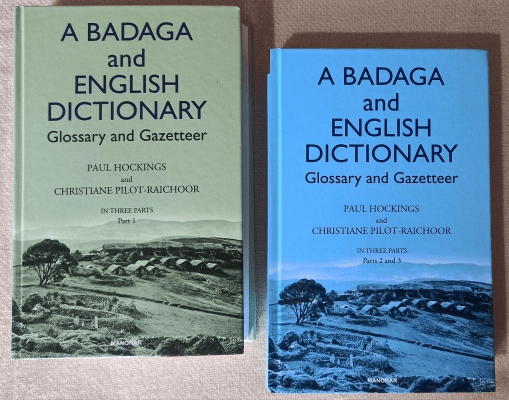
As I have mentioned elsewhere, Prof.Paul Hockings should be credited for doing a lot of research on Badagas [and Nilgiris]. He has published many books on both. Though priced on the higher side, his book ‘ A Badaga – English Dictionary’ written along with Raichoor is a must read for all Badagas.

badengdic.jpg

(See the page on Research for more)

So, it was a pleasant surprise to receive an email from him informing about his new books.

paul2.jpg
Dear Wing-Commander,
I have just finished writing a new book on the Badagas, “So Long a Saga“, which is a 400-page book on the social history of the Badagas from 1565 to 2012. ….[the book may take some time to be published and released- Wg Cdr JP]
I also attach a notice about my other recent book, “Encyclopaedia of the Nilgiri Hills“.
With best wishes,
Paul Hockings
PHnew

The NEGLECTED half

Pedhdhuva 012

The NEGLECTED half [part -1]


We may be proud of many of our Traditions – note the capital T – that we have followed for thousand of years. I repeat thousand of years though some so called foreign researchers along with many ‘yours truly types’ among us, would give only a few hundred years to Badaga history.

One such tradition, call it a custom if you want, that needs immediate attention is how we treat our WOMEN.

I am a staunch devotee of Hethe(y) Amma and very proud about the fact that Hethe(y) Habba is the ‘mother’ of all festivals for Badagas. But, let us face it. We call ourselves ‘Hethe(y) Makka’ – the children of Goddess Hethe(y).  And we very fiercely follow the strict customs associated with Hethe(y) Habba.

But alas, at the same time, our women are side lined and given only a secondary position in many of the rituals associated with this great and grand festival.

I have discussed about this aspect with many Badagas, including some from Beraganni and Pedhuva – “when we are so devotional to a deity that is personified in the purest female form called HETHE(Y), why are we NOT allowing our womenfolk who form half our population to participate in some of the rituals of Hethe(y) Habba?”

There are no clear answers. We cannot live in isolation.

Traditions need not be changed for the sake of change but surely, by involving the other half of our population in a much more ‘inclusive’ way instead of ‘rash restrictions’, will we not enhance our name and fame as a community that is forward looking?

If we do not change with times and be part of the larger society that encompasses the entire country, then, we will be condemned to face the serious and severe consequences.

May Hethe(y) bless us with the wisdom.

[To be continued ...in 'Part- 2' we will see the injustice done to our women]

Set your mood to these songs…

Set your mood to these songs…

Badagas have made singing and dancing an integral part of their lives.

A happy occasion like a habba [festival] or marriage….there you go….to the foot tapping ATTA – Dance songs like ‘Meley Keriyoge – On the top street‘….even a non dancer will get the inspiration to let the hair loose and join the crowd….
A sad situation….like the demise of a departed dear one…..the sad ‘saavu – death’ songs of Kerban Bella Gowder or Thangadu Krishna Gowder like ‘Ganjikke Kukkeya...’ will make tears roll down the cheeks as they remind you of some one who is no more…
The ever green…Hethe Songs…..
Melodies with a message like ‘Manesella Nondhara – ‘
Or, the melodious modern Badaga songs where the instrumental music has been given more importance…
Or, listen to the powerful ‘Badaga Funeral Prayer – Karu Harachodhu [Blessing the calf]…the famous group rendering of ‘AATHIKKODHU

Listen to some of these ‘best of the best songs and sounds’ chosen by me by clicking on the links or ON SOUNDCLOUD given below…
Must see the website on Badaga Songs

Image

Kootu [Meeting] at Hubbathalai

Kootu [Meeting] at Hubbathalai

Click on the pix to see Rare Photos of Badagas

Badaga – is a separate language by itself

Badaga – is a separate language by itself

I have been steadfastly claiming that Badaga is an unique language by itself and not a derivative of any other Dravidian Language – I WILL WRITE MORE ON THE FOLLOWING SOON – Wg Cdr JP

Badaga language not a dialect of Kannada, claims French linguistic scholar

Shanta Thiagarajan, [Times of India] Dec 4, 2012,

UDHAGAMANDALAM: “The Badaga language, widely believed to be a dialect of Kannada, was the language of communication of ancient South Dravidians and shares similarities with the local Alu Kurumba tongue,” said Christiane Pilot-Raichoor, a linguistic French scholar from LACITO, a scientific research centre in Paris. She was in town recently to do some research work.

“Today, it is recognized as a separate language,” said Pilot-Raichoor, who has been working on the linguistic heritage of the Badaga language for the past two decades. According to her, there are too many important differences in the phonology and the grammar, differences in gender system, case system, verb classes, to claim a genetic relationship between Kannada and Badaga languages.

“Once our minds are freed from the idea that Badaga is a dialect of Kannada, it may become possible to consider more objectively the Alu Kurumba-Badaga linguistic relationship,” she said. Alu Kurumba shares most of the characteristic Nilgiri features including verb peculiarities of Badaga language. “Whatever resemblance it has to Kannada points to early medieval and older forms of the language. The core grammar in the Badaga language converges with other Nilgiris languages which can be traced to early south Dravidian features,” she explained. Continue reading

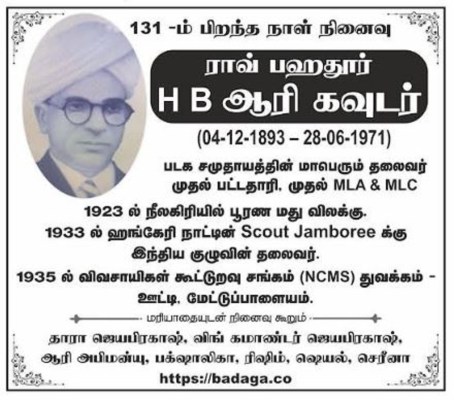
Rao Bahadur Ari Gowder

To day, 4-12-2012, is the 120th birthday anniversary of one of the greatest sons of Badaga Community,

Rao Bahadur HB Ari Gowder.

For all that he has done for the community, let us remember him with respect and gratitude !

My sincere salutations to the great and reputed man of Badaga community.
 
“To be born as a gentleman is an accident..
To live as one is an achievement…”
 
He has lived and achieved. Every badaga should feel proud of him.
He will be living eternally in the hearts of  all of us.
 
Regards,
kethorai rajma


Badaga leader’s birth anniversary celebrated

The Hindu – Udhagamandalam, December 5, 2012

Badagas celebrated the 119th birth anniversary of H.B. Ari Gowder at the Nilgiris Cooperative Marketing Society (NCMS), off the Government Botanical Garden Road, here, on Tuesday.

Long considered as the uncrowned king of the Badagas, Mr. Gowder was born on December 4, 1893 and died on June 28, 1971. He hailed from Hubbathalai village near Aruvankadu

The head of the Thodhanadu Seemai Badaga Welfare Association T.M. Kulla Gowder recalled that Mr. Ari Gowder was a well known philanthropist, who was respected by not only the Badagas but also others. He was instrumental in the NCMS coming into being in the 1930s to protect farmers from middlemen and unscrupulous traders in the plains.

For over three decades he was its president and for long it was considered as one of the best of its kind.

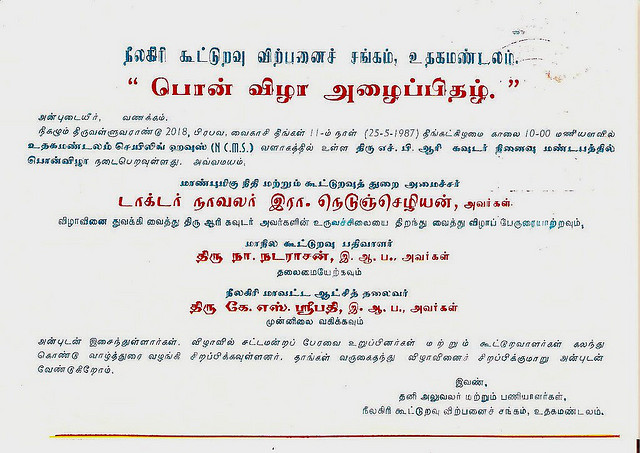
By way of acknowledging his significant contribution his bust was unveiled on May 25, 1987, in the multi-purpose hall of the NCMS.

The ‘Warisu’ card …..

It is unfortunate but true. There are still a lot of ‘greedy’ Badagas who feel that ‘all  property’ should go ONLY to a son / sons and and not to the daughter/daughters. These people, many of them- ‘educated idiots’ of both genders, would justify their claim and contention by saying only a son CAN be warisu or heir. Needless to say, they are living in an ancient  world [when, in a  Badaga Family], girls were NOT treated as EQUALS  and like in any other Indian Community, they were sort of discriminated.

This flawed thinking is very much against the rule of the land. The Indian constitution and present rules and regulations ensure that GIRLS GET EQUAL SHARE of the properties of their parents and ancestors [as BOYS]. Any discrimination in this respect is a criminal offence punishable under law.

But still many ‘self appointed’ and hapless  Badaga kap leaders and Gowdas, live under a false notion that all property is for males only. This cancerous notion which is destroying the  harmonious Badaga family system needs to be cut and CUT NOW. Unfortunately, the people mainly responsible for this ‘cancer’, you guessed it, are females – wives,mothers and grand mothers with ulterior motives.

It is high time we start treating this cancer of Warisu with all the contempt it deserves and cut it off before it destroys the very fabric that is  uniting the community.

More, with many examples, will follow….

Pa – Ha [ப-ஹ] change in Badaga

Pa -> – Ha [ப - ஹ] change in Badaga

Exclusive from Dr.R.K.Haldorai

The initial ha- ஹ - sound of the Badaga words confused its speakers many a time. Of course, there is a phonological point to be noted.

The present Badaga has a tendency to drop the initial ha- ஹ  -sound altogether. Due to this, the words once pronounced with h – sound are without that now. Hence those words which had initial ha- sound are now vowel initial sounds. ha sound is totally foreign to Dravidian languages. Therefore its use is equivalent to dropping the initial consonants altogether (Father Henry Heras 1936).
Example

  • hallu - allu -ஹல்லு - அல்லு  tooth
    haalu - aalu – ஹாலு – ஆலு milk
    hiTTu - iTTu – ஹிட்டு இட்டு - food
    hiiru - iiru - ஹிரு இரு-  to split
    hullu - ullu – ஹல்லு உல்லு grass
    huuyi - uuyi – ஹுய் ஊய் - tamarind
  • heTTe - eTTe – ஹெட்டே எட்டே - hen
    heegu - eegu - ஹேகு ஏகு -to tell
  • hoge - oge – ஹொகே ஒகெ - smoke
  • Hogu - Ogu – ஹோகு ஓகு - to go

As a special feature among Dravidian Languages Kannada language attested p – > h- change; a change which occurred quite early (Kulli 1976:304). This change is found in Badaga language too. This aspect has been adduced as an argument for settling Badaga language’s relationship with Kannada and even for deeming it a dialect of Kannada.
Since pa -> ha - change is common to Kannada and Badaga, scholars tried to fix the date of separation of Badaga language. On the basis that Badaga diverged from Kannada only after the old Kannada initial pa – , changed to middle and modern Kannada initial h – (Emeneau 1965 :18,19). They ignored the fact that in spite of attested p -> h – change , Badaga still has many words in use with initial p – ,many in basic in nature.

( E.g. paTTu -பட்டு  towel , payilu -பயிலு sprout, paTTe - பட்டேbark, paame - பாமே  story, payere - பேரே buttermilk, paaTTa koDe - பாட்டே கொடே umbrella of palmyra leaves)
The Kannada Encyclopaedia (KE) analyses this Badaga feature in brief and points out that all initial p – words are not changed into initial h – words in Badaga. Many initial p – words are in daily use in Badaga.

In Kannada p – > h – change began after 10th century. Hence Badaga might have diverged from Kannada prior to 10th century A.D.

The Kannada Encyclopaedia [KE] therefore assigns Badaga the status of an autonomous language (Nayak 1983 :412). Differing from Emeneau and others KE holds that Badaga might have diverged from Kannada even earlier than 10th century.

Kannada dictionary (Butcher 1983) recorded many initial p – and h – words, including some which are mere variants of the same words. Among these, Badaga language retained initial p – instead of initial h -.

Example

Kannada> puccu - huccu [puchchu huchchu] – புச்சு ஹுச்சு  (foolishness) : Badaga. puccu [puchchu]
Ka. paLi, haLi - பளி ஹளி (blame,rebuke ) : Ba. paLi
Ka. pusi, husi புசி ஹுசி (falsehood,lie ) : Ba. poy, puyyi -பொய்
Ka. pooTe, hooTe போட்டே ஹோட்டே (hollow of a tree) : Ba. pooTe  போட்டே(hollow)
Ka. pisuku, hisuku பிசுக்கு ஹிசுக்கு (to squeeze ) :Ba. பிசுக்கு -pisuku

In some cases Badaga substitutes s – for the h – found in Kannada words.

E.g. Ka. heDe (the expanded hood of a snake ) : Ba. seDe
Ka. huLi (sour ) : Ba. suLLe
Ka. hiju (to rend ) : Ba. suli
Ka. hore (neighbourhood, vicinity ) : Ba. saare

In few words PDr.(Proto Dravidian) p – changes into b – in Badaga.

E.g. Ka. pakkaLe (a kind of vessel) : Ba. baggare
Ka. paNi (stick, bat) : Ba. baNe
Ta. pambaram (top) : Ba. bombare
Ta. pakkam (shelter) : Ba. bakka

In a few places the initial p – and h – forms of the same word are use in Badaga but with
different meaning.

E.g. pace (green) : hacce (half-boiled, unripe, tender etc.,)
piri (to separate ) : hiri (to demolish)
piccu (to scatter) : hiccu ( to squirt )
poru (to endure ) : hour (to bear, carry or the head)
poTTu (simpleton ) : hoTTu (chaff, husk)

p – > h – is a share innovation found in Kannada and Badaga languages but with the following special features in Badaga.
1. Many initial p – words are in use in Badaga language and they are basic in nature
2. Unlike Kannada, all initial p- words are not changed into initial h – words in Badaga.
3. In a few places s – replaces h – in Badaga.
4. In a few places p – and h – form the same words are in different meanings in Badaga.

It is not correct, therefore to hold p – > h – change as a major criterion in settling the relationship of the Badaga language with Kannada.

Sutta Gassu Sandage…Badaga Recipes…

Gourmets’ worry over vanishing traditional foods, tastes

Article by Arun P Mathew, Times Of India | Nov 3, 2012

COIMBATORE: Ever heard of Sutta Gassu Sandage? It is one of the vanishing food items of badaga community of the Nilgiris. Taking part in a national seminar on ‘Heritage Foods of India’ at AJK College of Arts and Science here, senior chef H N Vijivan of Taj Vivanta Hotel in Coimbatore said the delicious badaga food item is made out of potato. Potatoes with skin are cooked over live charcoal, cleaned and salt and spices applied on it to make sutta gassu sandage.

According to him, there are over 20 exceptional varieties of food items of badagas and they need to be introduced to the gourmets across the world. Mouth-watering delicacies include ganjikke (boiled wheat pearls in an earthenware pot mixed with jaggery and coconut), eragi hittu (finger-millet balls made out of raggi flour, hot water and salt), badagaru koi uthakka (badaga chicken curry) and belle boungue sandage (roasted garlic chutney). Read the complete article here

Seen below on the left is ‘Thuppadittu – Ennayhittu’ and on the right is Eragi Hittu with Avaray Udakka and soppu’

Have you visited the page on Badaga Recipes ?

Badaga Songs…some of my favourites..

In a mood to listen to some fab Badaga Songs ['My Choice'] as you browse the posts…click on the pix and choose the song in the new window that opens up…

Badaga Songs

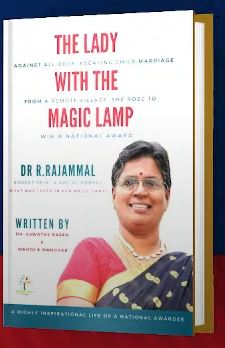
RAJMA, the great ‘GURU’

I have never had the fortune of meeting her so far. Only, the media reports about her receiving an award from the President of India, made me proud being a native of the Nilgiris & a Badaga. And take notice.

If you sit back and think of ONE teacher of our school  whose teachings & advise has made us what we are today, we feel so happy and grateful to have studied under her/him. This ‘guru’s’ teachings touch our lives in many ways.

When I wrote about her in my websites, the response from her students and others was huge and I realised ‘HOW ONE PERSON CAN MAKE A DIFFERENCE IN SO MANY LIVES’.

That great person is Mrs.Rajamma from Kethorai Village, Rajma Mam to her students.

Recently when I received the following  email from her, appreciating the work on these websites, I felt humbled. I can feel how powerful her words and teachings would have been.

I take the liberty of publishing her letter to put on record my deep gratitude and I am sure she will remain a powerful influence in many more lives.

Dear JP,
 
Greetings. Hope my mail finds you in good health and cheers. Nice to read a lot of issues about our community in your web site.
 

“A lot of things go unquestioned..
Several questions go unanswered…
Many words go unsaid..
A number of words go unheard..
Some dreams are buried alive…”
 
WE CALL IT LIFE.
 
WHAT LIFE HAS  IN STORE FOR US TOMORROW , NO ONE KNOWS.

In this mysterious life , a very few people like you leave an ever lasting mark for their life time. You are doing a wonderful job. Keep it up.
 
Take care. My best wishes for you will remain always.
 
With regards,
 Rajma

http://www.thehindu.com/multimedia/dynamic/00162/15dcmypr_woman_powe_162738e.jpg?%20w=100

[photo courtesy - The Hindu]

JP adds :

It is said that, “If you educate a boy, you educate an individual but if you educate a girl, you educate an entire family.

Indeed, GIRL POWER IS GREAT POWER

BADAGA WORDS AND WRITINGS

BADAGA WORDS AND WRITINGS

Exclusive article by Dr. R.K.Haldorai

Family of languages is known as cognate languages, which means languages descended from common ancestor (origin). Because of the family relation, most of the words are formed in similar construction in cognate languages. Similarity is seen in grammar too.

The renowned Dravidian Etymological Dictionary, compiled by T.Burrow and M.B.Emeneau (available in internet too) gives the similar (cognate) words of Dravidian languages in one group. If we go through that we can notice the similarities of words within the family of languages. On etymological basis it grouped Dravidian words into 4572 entries. In that dictionary, to our dismay only thirteen Badaga words are included. Some twenty years back, I brought this to the notice of one of the editors, M.B.Emeneau. It is apparent that Badaga words are available for most of these entries. It is our ardent duty to collect words for these entries and make available with them. By this way one can find out the common origin of Badaga words. So, linguistically it is correct to uphold the common origin. The innovations and borrowings are to be dealt separately. Innovations are special features and in Badaga’s case the distinct language status is marked with its many such things. Usually language borrows vocabularies, mostly nouns; grammatical borrowing is near nil; verbs are borrowed very rarely.

The influence of neighboring languages on Badaga is to be seen with this background. And it is not right to conclude that a word or feature belongs to a dominant language when it is common in minor and dominant languages.

Basically language is spoken. Written language is nothing but the reflection of speech. Out of seven thousand languages spoken throughout the world only few hundred have scripts. On other hand, we cannot say that all the speakers of a language know its letters, which has written character. Among Dravidian languages only four are having their own scripts and Tulu and Kodagu adopted Kannada scripts. Anyhow script was vogue in Dravidian languages in their proto stage. That letter is called braami or tamizhi, from which letters of Indian languages, including Tamil and Kannada are derived. When we say Badaga is descended from Proto – Dravidian or Proto – South Dravidian, it is obvious that once it had letters. But because of long isolation in the Nilgiri plateau that had forgotten. Anyhow the words like bare (to write, letter, written document), baregaara (writer),  bareyagaara  (writer of our fate, god) , haNayal bare, nettiya bare (fate, written on ones fore – head), baretoDe (literacy), oodu (read), kallu (to study), ooleyakaara (messenger who brings documents written on palmyra leaf),etc., imply that writing was known to Badagas. Above all Badaga word muniya signifies as noble teacher and this is attested in one of the Badaga ballads. So, it is understood that teaching activities were also there and the word kallusu (make one to study, teach) makes known it.

( I must put on record my deep appreciation and gratitude to Dr.Haldorai for sending articles for publication in our websites. He is one of the original NATIVE researchers of our language and culture. Dr.Haldorai is being very proficient in Tamil also, some times I find some bias in his articles in favour of Tamil when he discusses certain issues. The difference between the articles of Dr.Haldorai and other ‘outsiders’ like Prof.Paul Hockings or M.B.Emeneau is that there is a definite authority and acceptance in what Haldorai says because he is a Badaga and obviously knows what he says. – Wg Cdr JP)

What a shame ?!

Badaga is an unique language…which still retains its old world charm. Unfortunately, the absence of a script has resulted in abuse of the language, what with ‘some learned and self proclaimed researchers’ claiming it to be a derivative of Tamil and others of Kannada.

It does not stop here, some ‘highly qualified/educated’ non – Badaga persons go as far as writing articles and books on Badaga language without understanding the basics or the fundamentals of this beautiful language. While we appreciate the interest and initiative shown by non Badagas to learn and write about Badaga, we feel angry when they give totally wrong information. Worse still, they have the audacity to ‘invite readers’ to ‘learn Badaga’. Shocking to say the least.

I came across a book in Tamil [courtesy - Saranavaraj] called “Arivom Badagar Mozhi’ அறிவோம் படகர் மொழி [ பழங்குடியினம் ] by Era.Jayalakshmi – published by Vijaya Pathippagam, Coimbatore.
It appears that Jayalakshmi’s only ‘qualification’ to write about Badaga is that she ‘found out’ in ” Badaga people’s spoken language, the greatness of old Tamil”  [ தமிழ் 'படுக' மக்கள் பேச்சு வழக்கில் தமிழின்  தொன்மையை கண்டறிந்தார் ] when she was serving  in the Ooty Municipality.
She starts off on a wrong note. In her preface, she claims that all Dravidian Languages are derivatives of Ancient Tamil. “Kannada, Telugu and Malayalam are languages that came out of the ‘blood’ of Tamil – கன்னடமும் களித்தெலுங்கும் கவியின் மலையாளமும் உன் உதிரத்தே உதித்தெழுந்து ஒன்று பல ஆயிடினும்..” she quotes Caldwel.

She goes on to say that like many Dravidian Languages ” BADAHAA - படஹா ” is only a spoken language. Note’ she does not even know that Badaga and Badagu - படக &  படுகு are never referred to as Badahaa. In her preface BADAHAA – “படஹா” is mentioned atleast eight times with quotation marks.

Here are some bloomers – deliberate or otherwise :-

In the book, what is your name [உன் பெயர் என்ன?] is given as: -
1.Enna eraru ena  இன்ன எசரு என? -  what is your name - உன் பெயர் என்ன? (This is the very first sentence in the book).
[It should have been :- Ninna hesaru yena - நின்ன ஹெசரு ஏன?]
2.uralvai esaru ena உறல்வை எசரு என? – what is mother’s name – அம்மாவின் பெயர் என்ன?
[should have been - Awwaiya hesaru yena - அவ்வைய ஹெசரு ஏன?]
3.Enaga paadi ariye – எனக பாடி அறியே -  I donot know how to sing – எனக்கு பாட தெரியாது
[should have been - Na kadai hegi ariye - ந கதை ஹேகி அறியே]

There are too many mistakes, all most in every page, to elaborate . In one word this book is PATHETIC.

The author, it appears, has never heard of proof reading or the Badaga words in the book are either meaningless or distorted. The icing on the cake is that she dedicates her book to those ‘researchers of languages -மொழி ஆராய்ச்சி  அறிஞர்கள் ‘.

It is high time, R.Lakshmi withdraws this book, consults a Badaga and do a proper proof reading and then dare to publish.

What do you do, laugh or cry??

[My request to Badaga Association in Coimbatore is, please contact/ visit the publishers Vijaya Pathippagam,20, Raja Street, Coimbatore -641001 phoen # 0422-2382614 / 2385614 [email -vijayapathippagam2007gmail.com], since the author’s email or address/contact numbers are not given, and ask them to take corrective steps].

****************

Prabhakar [email ; writerprabhakar@gmail.com] comments :

While the article by the particular author/publication needs to be condemned, I do not quite agree with the contention that Badaga is not a derivative of Tamil or Kannada. Can the administrator of this website speak an entire sentence in Badagu without using a word of Kannada or Tamil??? It is high time that we realized that Badaga is indeed a derivative /mixture of Kannada and Tamil. Realization is enlightenment. Moroever there is no ‘shame’ involved in it. I am a proud Badaga who takes pride in his unique culture and tradition, but am equally aware that my language is a unique mix of two other languages. If someone were to deny it then it would mean that Badaga precedes these two languages. If it has indeed preceded these two languages than it would have definitely had a script. So let us stop romanticising the origins of our language and accept reality.

Hello Prabhakar,

I am surprised and saddened by your conviction and contentions. I am not sure whether you have read my articles/posts/pages on our language. Well, I am convinced that Badaga is a separate language by itself – without a script [like so many other spoken languages]. While there is no denying the fact that Badaga and old (haliya) Kannada resemble a lot and of late there is great Tamil influence. This is probably, due to the fact, we belong to Tamil Nadu and many of us have studied in Tamil medium schools. Why Badaga, without a script, could not have preceded Kannada or Tamil, is not the question, but could it not have co- existed with Sen Tamizh – old Tamil and Haliya Kannada??

I did my schooling in Rao Bahadur Board High School, Hubbathalai where the medium of instruction was Tamil. I love Tamil and can boast, at the cost of modesty, that I was ranked sixth in the entire Tamil Nadu, Manavar Mandram examinations of 1963-64. Hence can read and write Tamil very well. I can’t say the same about Kannada.If you read my articles on Badaga Language, there is a lot of ref to Badaga in the Tamil Epics.

Incidentally Mrs.R.Jaylakshmi says in her book that Badaga is a ‘child’ of Tamil and goes on to quote that ‘Odhu -study’ is the same as in Sen Tamizh – Odhamal orunaalum irrukka vendaam -ஓதாமல் ஒருநாளும் இறுக்க வேண்டாம்’

By the way, in Badaga we say ‘bil kul’ for ‘definitely’ like “bilkul beda – definitely don’t want“. Bilkul is a Sanskrit word. Can we say that Badaga is a derivative of Sanskrit? Ungara and Majjige mean finger ring and butter milk in Telugu and Badaga. Is Badaga a derivative of Telugu?

Why are we still have the mind set to blindly accept what others have mentioned about our language or for that matter, even about our origin that we migrated from Mysore.

I notice that you have mentioned that you are a National award winning Journalist. Like to read your articles and if possible, reproduce them in my websites.

- Wg Cdr JP

Return of the native – Dr.N.Sundaradevan IAS

Dr.Sundaradevan, the first direct IAS officer has just retired after a glorious tenure in the Tamilnadu cadre. We welcome this ‘native’ to Nakku Betta. My personal association with him is only through the emails. He has been very kind in sending a lot of info from the many books /articles on Badaga that he has in his possession to me. I have also published posts on his generous help in offering assistance to aspiring candidates for IAS and other UPSC examinations.

To welcome him back home and simply say, we are proud of you SD.

Given below is an article by D.Radhakrishnan that appears in the Hindu – Wg Cdr JP

Return of the native

by D. Radhakrishnan [ The Hindu, 7 Oct 2012 ]

Retired IAS officer N. Sundaradevan (with turban) being felicitated at Adhigaratty, near Udhagamandalam. —Photo: Special Arrangement

[Retired IAS officer N. Sundaradevan (with turban) being felicitated at Adhigaratty, near Udhagamandalam. —Photo: The Hindu]

High on the list of achievers in the Badaga community, the largest indigenous social group in the Nilgiris, N. Sundaradevan, who retired recently as Additional Chief Secretary of the Tamil Nadu government, received a warm welcome when he returned to his native village Adigaratty, near here, on Thursday.

Though it was well after dusk, the residents, including senior citizens, women and children, waited on the road and when he arrived they adorned him with the traditional Badaga turban and took him in a procession into the village.

Later, elders, including retired teachers, who felicitated Mr. Sundaradevan adverted to the unique position he occupies as the first direct IAS officer of the Badaga community and listed his achievements, particularly his record as a straightforward, uncompromising administrator, which has been openly acknowledged by successive governments, colleagues and persons in various other fields.

Pointing out that as an officer of the Indian Revenue Service for two years and later as an IAS officer for 33 years, he had done his community, district and village proud, they hoped that he would continue to be where it matters for the sake of the three. A speaker recalled that even before Mr. Sundaradevan had become an IAS officer, he had declared that he would remain clean and added that he had kept his word. When asked about his plans, Mr. Sundaradevan told The Hindu that he would not like to bite more than he can chew as far as affairs of the community are concerned. However, he would espouse the cause of the rich Badaga culture and take an active interest in spiritual activities.

The Government Higher Secondary School at Adhigaratty and the Government Arts College here which played crucial roles in making him an officer of substance would be high in the list of his priorities.

Sixty plus and Going Strong

(Translated from the original in Chinese)
 
There are 1000-year old trees in the mountain, but not many 100 year-old people…
At the most, you live until 100 years old (only 1 in 100,000).
If you live until 90, you only have 30 years.
If you live until 80, you only have 20 years.
Because you don’t have many years to live, and you can’t take along things when you go, you don’t have to be too thrifty.
Spend the money that should be spent, enjoy what should be enjoyed, donate what you are able to donate, but don’t leave all to your children or grandchildren, for you don’t want them to become parasites.
Don’t worry about what will happen after you are gone, because when you return to dust, you will feel nothing about praises or criticisms.
Don’t worry too much about your children for children will have their own destiny and find their own way. Don’t be your children’s slave.
Don’t expect too much from your children. Caring children, though caring, would be too busy with their jobs and commitments to render any help.
Uncaring children may fight over your assets even when you are still alive, and wish for your early demise so they can inherit your properties.
Your children take for granted that they are rightful heirs to your wealth; but you have no claims to their money.
60-year old like you, don’t trade in your health for wealth anymore; Because your money may not be able to buy your health.
When to stop making money, and how much is enough (hundred thousand, million, ten million)?
Out of thousand hectares of good farm land, you can only consume three quarts (of rice) daily; out of a thousand of mansions, you only need eight square meters of space to rest at night.
So as long as you have enough food and enough money to spend, that is good enough.
So you should live happily. Every family has its own problems.
Just do not compare with others for fame and social status and see whose children are doing better, etc. but challenge others for happiness, health and longevity…
Don’t worry about things that you can’t change because it does not help, and it may spoil your health.
You have to create your own well-being and find your own happiness; As long as you are in good mood, think about happy things, do happy things daily and have fun in doing, then you will pass your time happily every day.
One day passes, you will lose one day; One day passes with happiness, and then you gain one day.
In good spirit, sickness will cure; in happy spirit, sickness will cure fast; in good and happy spirit; sickness will never come.
With good mood, suitable amount of exercise, always in the sun, variety of foods, reasonable amount of vitamin and mineral intake, hopefully you will live another 20 or 30 years of healthy life.
Above all learn to cherish the GOODNESS around…and FRIENDS…all friends make you feel young and “wanted”…without them you are surely to feel lost!!!
(Please share this with all your friends who are 60 plus and those who will be 60 plus some time soon).

[recd as a fwd email]

Dementia


Exercise for the brain

Below is a very private way to gauge how your memory compares to the last test. Some may think it is too easy but the ones with memory problems may have difficulty. Take the test presented here to determine if you’re losing it or not. The spaces below are so you don’t see the answers until you’ve made your answer.

OK, relax, clear your mind, breathe in, breathe out… and begin.

1. What do you put in a toaster?


Answer :You jumped to the answer thinking, easy, it is toast but the answer is Bread . If you said ‘toast’ ,give up now and do something else..

Try not to hurt yourself. If you said, bread, go to Question 2.

2. Say ‘silk’ five times. Now spell ‘silk..’ What do cows drink?


Answer: Have you seen a cow drinking ? Cows drink water. If you said ‘milk,’ don’t attempt the next question. Your brain is over-stressed and may even overheat.. Content yourself with reading a more appropriate literature such as Auto World. However, if you said ‘water’, proceed to question 3.

3. If a red house is made from red bricks and a blue house is made from blue bricks and a pink house is made from pink bricks and a black house is made from black bricks, what is a green house made from?


Answer: Greenhouses are made from glass. If you said ‘green bricks,’ why are you still reading these??? If you said ‘glass,’ go on to Question 4.

4.It’s twenty years ago, and a plane is flying at 20,000 feet over Germany (If you will recall, Germany at the time was politically divided into West Germany and East Germany ). Anyway, during the flight, two engines fail. The pilot, realizing that the last remaining engine is also failing, decides on a crash landing procedure. Unfortunately the engine fails before he can do so and the plane fatally crashes smack in the middle of ‘no man’s land’ between East Germany ! ! And West Germany … Where would you bury the survivors? East Germany , West Germany , Or no man’s land’?


Answer: You don’t bury ‘survivors’. If you said ANYTHING else, you’re a dunce and you must stop. If you said, ‘You don’t bury survivors’, proceed to the next question.

5. Without using a calculator, here’s the next question – You’re driving a bus from Sydney to Brisbane

In Sydney , 17 people get on the bus.
In Hornsby , 6 people get off the bus and 9 people get on.
In Kempsey , 2 people get off and 4 get on.
In Coffs Harbour , 11 people get off and 16 people get on.
In Byron Bay , 3 people get off and 5 people get on.
In Tweed Heads, 6 people get off and 3 get on.
You then arrive at Brisbane ..

Without scrolling back to review, how old is the bus driver?


Answer: Don’t you remember who was driving the bus??!!

If you pass this along to your friends, pray they do better than you.

Magic square…??!!

You must have heard of the great mathematician Ramanujam’s Magic Square given below :

You add up any row, column, diagonal, or ‘four adjacent squares’, you will get 139.

The beauty is that the first row gives his Date Of Birth – 22 Dec 1887.

Well, inspired by this I made a magic square with my DOB 24 Apr 1948

Where the addition of the four numbers in each row, column, four corners, diagonal or small squares of adjacent numbers add upto 95.

If you look closely on the above two squares, you can realise that you can easily ‘crack this code’ and MAKE A MAGIC SQUARE with your DOB – where the four numbers will add upto a specific number.

Got it ? If you are too lazy to make your own magic square, send your DOB to me, I will make the magic square. You will find my email id elsewhere on this page.

Happy Birthday, mom!

We would come home at Hubbathalai and to your room [nadu roomu -centre room, as we call it]…

Your face would brighten up seeing me, “bandu buttaya- you have come” you would say with a smile, reclining from the bed.

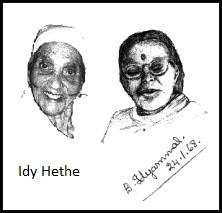
Mrs.Idyamma Bellie Gowder

[2-9-1912---13-7-2011]

“Harachu- bless me” I would say, bowing my head. You would place both your hands on my head and bless me with those beautiful words ” ondu nooru saavira aagili, endhendhu somi ninaga olliya haracha kottu, sogava kottu barali – let one become a hundred thousands..may God give you good health and happiness…”

Then with a faint smile,  and holding your hands, I would tell you,”Happy Birthday, mom..endhu ninna huttidha barasha, ardhaya – do you know that today is your birthday ?”

You would act surprised, ” athaya… is it so?…aesu barasha aathu – how many years?… ennu aesu kaala ebbadhu- how many more years to stay?”

We, all your children, grand children and great grand children along with other relatives, would have celebrated your 100th Birthday in grand style.

Mom, you chose to leave us just a year short of a century.

Gone to ‘another’ world but never forgotten.

But wherever you are, we know, your blessings are with us always.

You were and are the inspiration for everything.

We miss you, mom !

Traditions kept alive by these brave Badaga ladies

What is extremely gratifying and gives a lot of happiness is see some brave – hearts Badaga ladies wearing traditional Badaga Jewellery. One such lady is Subbi Hethe of Thogalatty [near Kattabettu] with the mookkuthi and kivi chinna [read all about Badaga Jewellery here]. I had the pleasure of meeting her at Honneri a couple of days back..

Thank you, Subbi Hethe

Bothered by FAKES ?

Click here or on the pix for a fantastic link from RBI to detect Fake Currency Notes

Image

“Bravo, Rajamma of Kethorai”

More thoughts on “Bravo, Rajamma of Kethorai”

[see the original post - Bravo, Rajamma of Kethorai  here ]

D.SENDHIL VIGNESHWAR   said on 11/08/2012

Hello maam/maa… I am proud to be your student.. the days when I was put up in a school where no one ever knows my language all I found was Hindi Hindi and Hindi.. You came IN to save me and help me.. now I stand still with my head held high, in MUMBAI.. managing with the Hindi that you first taught me..Proud to be your student maam

and Rajamma, who has made all of us proud replies :

Dear JP,

Nice to read your reply and the comment posted by my student. Teaching is not my job , it is my passion. 32 years in the same line, handled thousands of students. As an inspiring teacher, filled with empathy towards the underprivileged and the so called back benchers, I had stolen their hearts. I hold my head high and make my students too. Senthil is a sample.

All these years, never I have called any student nalayak/stupid/ incapable/ idiot… and on adjectives used towards slow learners.Never will I call also. It is nothing but empathy…IN God’s creation every child is unique , original and has some talent or the other.
It is the duty of the teacher to identify it and groom the child. ” A child’s mind is not a vessel to be filled,It is a lamp to be ignited.” Each child is master piece and the Master’s piece. I respect them and love them irrespective of their background, caste, creed and capability.  Jai Ho. 
 
With regards,
rajma.[

Photo from the Hindu

Rajamma, your reply makes us “DOUBLY PROUD OF YOU. BRAVO” – Wg Cdr JP

Badaga and Tamil

Badaga and Tamil

by   Dr.R.K.Haldorai

‘Even people with considerable education are often wholly unable to answer certain quite simple questions about their language. For most people language is primarily a tool to be used, rather than a subject for close and critical attention’ (Gleason 1974:1).Actually in a society which has unlettered language like Badaga, the study of language plays a major role to understand its ethnology, tradition, ethos, culture, tribal character etc., Other than language the society has very little records to show its antiquity etc., In many places we have to deduce certain things through language only. So it is inevitable to study the Badaga language at least to some extent when we try to say something about Badaga society.

Badaga is one among the 26 languages of the Dravidian family. Badaga, a tribal language of the Dravidian family preserved more of its archaic features. Its prolonged isolation might be the cause for this. However to understand these features we have to compare them with the ancient forms found in any other Dravidian language. Among Dravidian languages Tamil, Kannada, Telugu and Malayalam are literary languages. They have recorded history. And also these languages were studied thoroughly by experts. Being that is the case; there is no doubt that we can have a clear picture of the Badaga terms when we compare them with the corresponding terms of the languages of the Dravidian family.

‘Tamil language being probably earliest cultivated of all the Dravidian idioms, the most copious and that which contains the largest portion and the richest variety of indubitably ancient forms, it is deservedly placed at the head of the list’ (Caldwell 1856:6).‘Tamil has usually been considered to be the Dravidian language which has preserved most traces of the original forms of speech from which all other Dravidian dialects are derived. It seems certain that no other Dravidian language has developed the common Dravidian principles with so great consistency as Tamil’ (Linguistic Survey of India, vol.iv. p.283).

‘Words of Dravidian origin occurring in all the languages are without any great difference of form. The original Dravidian speech seems to have split up in to these languages. Tamil is probably nearer to the original tongue than any other member of the group and it has preserved the older forms of the Dravidian roots knowledge of it is essential to the proper study of the South Indian languages’ (Brown, Telugu-English Dictionary,Int.).

Of course there are hundreds of common words in Badaga and Kannada. On the other part Kannada adopted Sanskrit words enormously. Whereas Sanskrit borrowing is less in Badaga and Tamil. Anyhow there are few borrowed items in Tamil too. In that case, we have to compare Badaga with indigenous things of Tamil and not with borrowed ones. I hope, then, we shall have a clear idea about Badaga when compare with Tamil. E.g. the word habba (festival) is found in Kannada and Badaga. But the prior form paruvam (season, the festival celebrated in a particular season) is found only in Tamil. In the same way the word maduve (marriage) is in Kannada and Badaga. But its older form vaduvai is attested in Tolkaappiam, the earliest available grammar of Tamil. Badaga ganige (finger-ring, signet-ring) is nothing but Tamil kanaiyaazhi. Badaga oppottu is nothing but Tamil orupozhudu. Badaga korali batta (small millet,setaria italica) is Tamil kuraal tinai.  Badaga baambullu (andropogon schananthus) is Tamil vizhalpul. Badaga sarangana (orderly,nicely) is nothing but Tamil siiraaga. Badaga ugilu (finger nail) is in literary Tamil ugir

              Badaga                                           Tamil 

  • korambu (a last rite)               karumaandiram ;
  • beggaayi (wind alone)            verum kaatru ;
  • sutrigaayi (whirl wind)           suzhal kaarru       
  • sere mee (drizzle rain)             saaralmazhai ;         
  • hola (field)                                  pulam ;
  • gudu,guttu (plough share)     kozhu ;                       
  • kirugaayi (eastern wind)       kiizhkaarru ;
  • karambe (curry leaf)               kariveeppu ;              
  • netturu   (blood)                      neyttoor ;                 
  • manaarna(heartful)               manamaara ;          
  • maggilu (side)                          marungil ;                
  • koolu (flute)                              kuzhal ;                     
  • orage (equal age)                    oor agavai                     
  • paame (story)                           pazhamai ;                
  • hemmakka (women)              penmakkal
  • heroodayya (Lord Siva)        peruvudaiyaar
  • haayola (fertile land)             pazhanam
  • neegilu (plough)                      naanjil
  • angay (palm)                            agangai (agam+kai)
  • pottuguude(small basket)      puttukkuudai
  • emmehatty(buffalo camp)     erumaippatti
  • koomekallu(sharp stone)        kuurmaikkal
  • taave (fern)                               taagai ;                     
  • batte (cloth)                              vattudai
  • monakaalu (knee)                    muzhangaal
  • darsepetti(granary box)           davasappetti

Like these many single and compound words are better known by comparing with Tamil. Other than word level, to our wonder, the glimpse of Badaga culture, tradition etc., are seen in Tamil literature. The thing is, we have to study it in depth to get the relevant points. For example, the good old marriage system of the Badagas was depicted in Sangam (aganaanuuru 86 and136) literature. Kannagi worship is similar to Badagas’ Hethe worship. The Tamil word peyaran or peeran (grand’son) indicates the usage of christening grandfather’s name to grandson. In the same way peyartti or peetti indicates the usage of naming grandmother’s name to granddaughter. To our astonishment, this practice is still vogue in Badaga. In Badaga society a new born male child gets first his grandfathers’ names(father’s father and mother’s father).In the same way a new born female child gets first her grandmothers’ names (father’s mother and mother’s mother).

In ancient Tamil society there was no caste system. The concept of karma was not there. It advocated neither vegetarianism nor sobriety (absent from toddy consumption). In the same way the society didn’t encourage renunciation. These are all relevant to Badaga society even today. The ancestor worship is common to both Badagas and ancient Tamils. More or less the religious activities are same for both Badagas and ancient Tamils. However the Badagas preserved and maintained the good old systems in every sphere of their life due their prolonged isolation. In this background, I hope the study of Tamil literature, grammar etc., will help us to describe Badaga thoroughly.

[Exclusive article]

Should we be really PROUD?

Here is an email from Vinoth Kumar that calls for our attention :

The points     raised by

Vinoth are very important.

“Are we living in a fools’ paradise? and not able to look beyond what we see?”

Wg.Cdr JP


Hello Sir,
This is regarding the word “PROUD” used by members in our BBM (Badagas of Blue Mountain). People have been using the word “proud” number of times, for ex, proud to be a badaga, proud to be from niligiri etc. Yes, no doubt we are all proud of ourselves being a badaga, but let us assess what have we done for making our community more proud. Obama acquired the presidency by using the word “change”, it was a big hit which elevated him to the highest profile in world. Now his tenure as president is gonna end and what has changed in US? nothing, coz he did not work towards what he meant. The word change is no more special now.

“NO ONE HAS CLIMBED A HILL JUST BY LOOKING AT IT”.

We have to climb up the hill to reach the peak. We have lot of issues in our community which need immediate attention. Rather we saying ourselves proud, let us work towards making us more proud. We have lot of well educated people with good practical knowledge which is vital than being theoretical. I request all of you to come forward and share your ideas about our community and regarding your sector which might help our community in one otherway.

We only speak about the good things in our community, lets discuss about the bad and make it good or at least better. I feel the below topics need to be given priority.

1. ECONOMY AND REAL ESTATE BUSSINESS:
“Haasanoor oogi haala kudupudhuna, nilagiri neera kudiyaaku”, meaning nilagiri water is better than hassnoor milk which is known for its thickness and nutrient content. In Nilgiris, Every grain of soil is fertile and every blade of grass is green even in summer. Why are we running towards coimbatore and buying properties in exhorbitant prices? I accept we have to move to other cities because employment oppurtunities are less in our district. Its good we make our presence in other places by buying land, but not at the cost of selling what we have in our native. I know its not easy to maintain a tea estate as there is shortage of labor and moreover everyone wants to be a white collar worker than a blue collar. Apart from tea, the other crops like potato, garlic, carrot, radish, beetroot etc have become like lottery bussiness, it depends on luck than your hardwork. Partly, we can blame the El Nino and govt policies which is responsible for this debacle, at the end we are the losers. Lets forget the govt and do something on our own. We should stop following what our forefathers did five decades back. They had proper seasons, now there is no seasons, its summer 3/4th of the year and rest is winter. We have to change the crop pattern or even the crops. We should try semi arid crops or the arid crops like jatropha or croton. New roads have to be build to reach farms which are far. People who stay in cities please lease the land nearby village to the ones who do farming in villages rather than selling it to someone from outside for construction of villas. Either you can plant trees in farms which are far from villages which might help to please the rain gods and, in case, if govt allows logging in future you can make a kill out of it.

Requested people: Agri experts to study crop pattern and panchayat presidents to lay new roads.

2. HEALTHCARE:
Overall healthcare facilities have improved in our community and access to hospitals are better than earlier. Asthma was the only curse for our community in the past, but now its overtaken by other diseases, namely diabetes and cancer because of our sedentary lifestyle. It depends on individual, so I dont want to comment much on it. Organ donation, a topic raised by Mahalakshmi, thank you. Awareness has to be created in wide scale regarding this. This has to be done by all of us, should explain it properly to our family members and convince them.

Requested people: All of us.

3.MARRIAGE:
This is a critical and sensitive issue which has to be dealt carefully. First let us assess what is the reason for increasing intercaste marriages and increasing pecentage of unmarried people in our community. We cannot blame education, job outside our place, or the empowerment of our girls, coz now its a necessity for well being. The main factor to be blamed is we not being a social animal within our community. A decade back, people use to attend festivals and family occasions without a miss where girls and boys from different families meet, proposals happen easily. Now a days festivals are fading, people rarely meet others from village. We can give a number of reasons, travelling, leaves, or exams… but its mainly due to lack of interest. Regarding intercaste marriage as i commented in another thread, i will support it because due to exposure its normal for a girl or boy to fall in love with a person from another community and we are matured and responsible to take a decision on our own. Another reason for me to support intercaste marriage, if a girl or boy marries from another community, he or she will not be allowed to come into village, and at last we being nuclear families, the whole family has to leave the village, its a minus for our community.

I thank Mahalakshmi for your comment on another thread, i respect your views, but on a longer run, this will not favor our community. Think like china in longer run than like india being a procrastinator.

Requested people: All of us.

4.DEBT:
Badagas WERE humble and down to earth, now its the opposite, people are becoming egoistic, as a result disputes are common. I know many who sell their property in native to buy a plot in coimbatore because his neighbor or a relative bought a plot in CBE. People in villages are into debt trap, kandhu vaddi (now a days saala is not at a concern), blame the climate pattern.

There are many more problems to be discussed, lets do it and find solutions for them, rather venting only the issues.

All of you might think I am a critic pointing only the negatives in our community, I dont bother, my only wish is our community as a whole should be a proud community without issues. As I said let us discuss the problems, the solution, a plan, and a strategy to achieve it.

Thank you,
Vinoth Kumar
[vina.vinasa@gmail.com]

Bagadas are amazing people on Earth


Dear JP,

I am a Christain from South Tamil Nadu. Of course, I visit your site frequently. Let me tell you something, which may be surprising to you.

I was born in a very orthodox Christian family. Now I am 33 years old. I was a very strong beliver of christianity. I never missed praying and reading Bible a day. I was so close to God. I thought I should die for Christ.

I thought Christians were the best people in the world until I met a Badaga 1.5 years back. I was simply moved by that person’s character, hospitality, discipline, Sincerity, affection, honesty, cleanliness, decency and boldness. I have many Hindu friends, but I was only impressed after meeting a Badaga. I suddenly thought thinking, Jesus has asked us to have the above characters and a Badaga has got all these characters, whereas I have not met a single Christian with all these characters. So what is the use of following Christianity?

From that day, I never read Bible, never pray to Jesus and never go to church. My whole community, including my wife and parents were surprised with my change. They never knew that a Badaga was behind that. And I promise you that I and my Badaga friend never spoke about christianity.

The change came to me from my inner soul. No one changed me.

Now I feel daily that I should have born in that community. I felt that it is a curse for not being born in Badaga community. My ambition is to become rich and serve the badaga community. I want to join the community and be one among them.

But the messages in your website creates ‘a bit of a bad feeling’ among Badagas on Christians. What will people like me do?

I want to learn Badaga language. I need a book. I heard that 2 people in Coonoor has written in Tamil. I searched entire coonnor. But in vain. Can you please help me on this regard. Thanks – AR


I was quite amazed to receive this email from AR

[I sincerely thank him for permitting to put this on our websites].

Two things strike me to be extraordinary. AR’s frankness and his ‘unabashed appreciation of Badagas’.

AR, hope  all Badagas will possess “character, hospitality, discipline, sincerity, affection, honesty, cleanliness, decency and boldness”  and live like the person you have described and bring changes in others.

‘This particular individual’  makes  us all very proud.

And here are a couple of clarifications. I wonder why you feel that I do not like Christians and that my views create ‘a bit of bad feelings’.I am a proud Hindu but have great respect to all other religions. Some of my best and closest friends are Christians.

The only thing I am against is the forcible conversion of many Badagas to Christians which is threatening the very fabric of the Badaga Society [supposed to be endowed with all the great qualities you attribute to them].

There are a couple of books to ‘learn Badaga’ by Dr.Haldorai and here are some of his 

Books Published on Badaga  : 

1. badagu oru diravida moli* (Badaga a Dravidian Language) (Tamil)
2. badagu molip palamoligal (Badaga Proverbs)  (Tamil and English meanings)
3. Badaga –English  Self  Instructor (English)
4. A Practical Key to the Badaga Language (English)

for the complete list of books go here

Thanking AR once again and hope we Badagas also live up to possess  such great qualities. – Wg Cdr JP

Hi JP,

Saw the Posts. Christians read Bible and Pray to have these characters. But without even knowing of Jesus, your people have these characters. Really I miss you all. One day you will definetely find me serving the Badaga community.

After learning Badaga language, I will mail to you in Badaga language. That will be my next mail to you. But it will take some time. May be even 6 months. Bye till then.

Thanks – AR

FREEDOM

AUGUST FIFTEENTH

Independence day.
Freedom from occupation of the land
by aliens.Celebrations.
But what about freedom
from exploitation of gender and hunger
from fights over caste and religion
from inequality based on creed 
and region
&

Corruption

India, the great land of legends
when are you going to be really FREE?

Badagas who make us proud

This article is reproduced as I consider Ms.Rajamma as a role model and inspiration to generations. Many comments on this post are a proof of the esteem her students hold her in.

She is another Badaga woman who has made us all very proud.

D.SENDHIL VIGNESHWAR sent these comments Bravo, Rajamma of Kethorai on 11 Aug 2012

hello maam/maa… i am proud to be your student.. the days when i was put up in a school where no one ever knows my language all i found was hindi hindi and hindi.. u came IN to save me and help me.. now i stand still with my head held high, in MUMBAI.. managing with the hindi that u first taught me..Proud to be ur student maam.

Kethorai Rajamma, who made all  those who had known her , especially the Badagas, very proud by winning an award from the President of India, recently has written to say,

Dear Mr.JP…,
My earnest greetings..Your efforts for the beautiful bagadas of the the most beautiful Nilgiriis make me elated beyond Doddabetta’s height…May the sway of tall dignified trees, the tinkling water falls, the smiling colourful flowers and the hugging chill breeze shower wonderful and abundant blessings to you by laying a green carpet welcome by the tea plantations. God bless you..
With regards,
Kethorai Rajma

Thank you ever so much for these kind words. If I could achieve a small percentage of what you have achieved [that has been recognised by all], then I am truly blessed. With the warmest of regards, JP

Rajamma of Kethorai village has made us proud once again. She won an award from the President of India.

Santhosh Kumar JB has sent the info and the link in ‘The Hindu’ and we have great pleasure in sharing the same with all Badagas.

It was not before the age of 15 that she was first taught the English alphabet. Now, 35 years later, she is a successful teacher in the same subject and is getting ready to leave for New Delhi to receive the Dr. Radhakrishnan Best Teacher Award from President Pratibha Devisingh Patil.

The fact that R.Rajammal is the first generation learner from her family may not be uncommon. But that she belongs to the Badagar community from remote Kethorai Village of Kethi Village Panchayat in Nilgiris District and has come thus far is an inspiring story. People travelling on the famous Nilgiri Mountain Railway might have noticed the Kethi railway station Coonoor and Udhagamandalam. Her native village Kethorai is a good five-kilometre trek from there.

Ms. Rajammal teaches English and Science to primary students at Kendriya Vidyalaya (II) at Madambakkam near Tambaram. Recognising her rise from modest backgrounds, her contribution to teaching and the Guides movement, the Ministry of Human Resource Development selected her for the prestigious award.
“I am the eldest among five children. I still remember the hardwork of my parents who toiled through the day in tea plantations and small farms raising vegetables,” Ms. Rajammal recalled her childhood days at Kethorai. Five decades back, education in remote hilly areas was scarce but Rajammal made the best of it, excelling in academics till high school.

Being a first generation learner did come in the way but having imbibed the quality of sheer hard work from her parents M.Ramachandran and R.Saraswathi, she never gave up. “We used to walk eight kilometers to high school and back home. It was not before class nine that we were first taught the English alphabet,” Ms. Rajammal said.

As those were the days of college education immediately after S.S.L.C., they had very little time to master English and when she joined Providence College, Coonoor, she found it even more difficult in the initial days. However, with the help of her teachers and classmates, she finished her B.Sc in Botany in high grades and came to Chennai, where she managed to get the job as a teacher at St. Michael’s Academy in Adyar.

Deputation to Moscow

Seven years later, she joined the Kendriya Vidyalaya. After a nation-wide test, she was selected to go on a three-year deputation to Moscow where she served the KV school there. A compere for programmes at INS Rajali in Arakkonam and also during passing out parades of Central Industrial Security Force establishments, Ms. Rajammal has earned popularity for her motivational speeches and also for her work among the underprivileged sections involving school students.

Her association with welfare homes for the senior citizens, destitute women and children had its origins in her childhood. “I visit my native village at least six times a year and spend a long time during the summer vacation. I insist on the importance of education and encourage young girls never to give up till they succeed in life,” Ms. Rajammal said.

Actively involved in the Girl Guides movement, Ms. Rajammal has received the NCERT Award in 2003 for Innovative Teaching Practices in Environmental Studies and the Kendriya Vidyalaya Sanghatan Incentive Award in 2008.

She wants to be a role model for rural women, especially among her Badagar community. Ever indebted to the Kendriya Vidyalaya Sanghatan for the exposure that she has received, she said that she would be only too glad to serve KVS even after her retirement.

She lives in Madambakkam and can be reached at 2229 2403 and 98413 57720. E-mail: nilgiriraji@yahoo.com. nilgiriraji@hotmail.com

K. Manikandan

Badagas who make us proud

There are a few exceptional Badagas whose entrepreneurship and talents  can  take them to places anywhere in this globe. They succeed in whatever field they choose to go ahead with sheer hardwork and dedication.

These Badagas are, an inspiration to all of us.

Lingan Krishnan  [I have never met him so far] is one such person. I was quite surprised but very happy to see his email to me in which he had mentioned that he is a practising lawyer In the Bombay High Court. Wow, a Badaga high court lawyer in Mumbai, was my first thought. Surprise did not end there when I learnt that he is also an ex-fauji. He has started a Trust that can  be of immense help to Badagas.

Thank you L. Krishna. You make us proud!

Email from  Lingan Krishnan [lingan.krishnan@gmail.com], a Lawyer in Mumbai High Court

Hello Sir,

I belong to Adigaratty Village and was  born on 10 May,1946. I do not recollect my father’s face since  he breathed his last  when I was 8 years old. My mother, a poor soul, brought us  up (one elder brother and two younger sisters) and she too passed away  this year ie on 26th April, 2012. Every year, Theer Festival used to be celebrated in our village in a grand way, which continues even today. My mother used to compel me to attend the same but never I was able to do so.

About 20 years back, one day while discussing about the festivals, Mom was bit up set for  my not visiting the Hatty at least  once  a year, and requested me to at least contribute the Theer Festival expenses fixed by our village Gowdars every year.That particular day I decided to keep her wishes alive and promised her that I would  contribute for the festival not only for one year but till my mother’s last breath.

As per my mother’s wishes, my little contribution towards the festival has been going on for the last twenty years and now. My Mom is no more now, hence I decided to continue my contribution till my death. While going through your web site I felt my mother was sitting with me and forcing me to do something for the common needy people.. Thanks for the unforgettable memories flashed back in my mind while going through the wonderful initiations and inspirations exposed vide your web site.

With regards to my education and experiences.   have done M.A and LLB. Had put in 15 years service in the Army, In the Regiment of Artillery.  Joined  as Manager Administration in Lupin Laboratory and left Lupin after 13 Years of service to take up  the responsibilities of a GM with Cybertech Systems and Software Ltd through which I could visit US for six times.  I retired from Cybertech in the year 2007 after rendering 12 years of service and then started practicing Law.

In Bombay, we started Bombay Badaga Association in the year 1990 and I was the President for 7years. Under  my command, we conducted quite a number of Tours and Picnics beside various programmes.  We released a Souvenir in the year 1995, and the interesting things to be  noted here is that, our Souvenir had the messages of celebrities of Politics, Cricket, Films, Police Big Vigs and even Gazal Singers.

This combination  was my personal test and I had taken a month holiday from my job  to meet all those famous people ultimately with the aim of releasing an excellent Souvenir. Subsequently, the Souvenir got appreciated by Badaga Associations of Chennai, Balgalore, Coimbatore, Erode an many more individual personalities of our Baduga community.

Some how due to various exigencies of services, my service to the community  could not  go further.  Now, after 15 years of interval, my mind again started revolving round the Social Welfare Activities and as such I got a Trust named    SENIOR CITIZEN WELFARE ASSOCIATION,THANE (WEST) registered,  under which, I have plans to help the aged people in various grounds.  Further details on this will follow.

Based on this NGO I want to do some favours to the Badagas  staying abroad. Any thing required from Bombay like, transportation
facilities, escorting relatives, children and even sight seeing
arrangements can also be arranged by my NGO at Bombay. Any investment part in Moumbai or educational activities including placement etc can be arranged if any one needs it.

The support extended from our N.G.O is listed below.
  We plan to assist seniors in the following areas:

 1.       Supporting and escorting the seniors during exigency
2.       Medical  assistance through NGO doctors
3.       Creating opportunities for the Seniors to engage themselves
4.       Classes for Yoga and Meditation
5.       Providing hygienic food at reasonable rates
6.       Financial assistance to the seniors
7.       Assisting in legal matters
8.       Anything related to real estate
9.       Arranging Mumbai Darshan/ Visit to Essel world

The extension of our NGO is to support the needy youth (will be executed at the later stage)

1.   Public speaking / Language classes
2.   Hostel facility for working class (ladies and gents separately)
3. conducting coaching clases for appearing in the IAS/IPS/Service selection boards.

I really need your suggestions and guidance in this regards.

Regards
L.Krishnan

Ravi Belliraj writes

Mr. L. Krishnan, such a great person I ever met in my life. He was my best friend cum brother in 1990s in Mumbai. Myself also an ex. Member of Bombay Badaga Association in 90’s.
Thanks and Namaskara Krishnanji.
Ondu Saavira Aagi Arasa Kodali.
PROUD TO BE A BADAGA.

Aside
Exclusive

Casteless Badagas

by Dr. R.K.Haldorai

Badagas were not under the influence of caste system in any part of their history. In caste system a person’s social status was determined by his occupation. Although caste depended upon a person’s occupation it became hereditary in due course. So, it is inevitable to a person to live with a unalterable particular social status throughout his life. The traditional association between caste and occupation is far from dissolution.

Badagas apparently changed their occupations to suit the environment. They never developed stigma with any particular occupation. It is to be noted that the very name Badaga itself is not derived from any occupation. In India, most of the caste names are derived from occupations. Badagas major occupations were food gathering, hunting, buffalo rearing, millet cultivation (that too swift cultivation for some time) and cash crop cultivation. Among these a particular occupation was predominant at a particular time. And also all the sub groups of Badaga community engaged the same occupation.

Badaga population was very small up to the beginning of the twentieth century and they spread over the entire Nilgiri plateau. In that case, for a long period there were very few families in a hatty (hamlet) and all the families were descended from a same forefather. So, there was a social compulsion to venture occupations in common. The origin of the caste system in India is shrouded, but it seems, it originated some two thousand years ago. Caste system is associated with religion and people were categorized by their occupations. Badagas’ religious beliefs were primitive in nature, so the religious side of their social organisation was lacking to originate caste system Continue reading

Slow Dance

This is a poem written by a teenager with cancer. She wants to see how many people get her poem. This poem was written by a terminally ill young girl in a New York Hospital.

Badaga connection

A lot of Badagas have died due to the curse of cancer – including breast cancer. Many of them could have been saved had it been treated in the initial stages. Take care of your dear and near ones – Wg Cdr JP


SLOW DANCE

Have you ever watched kids On a merry-go-round?
Or listened to the rain  Slapping on the ground?
Ever followed a butterfly’s erratic flight?
Or gazed at the sun into the fading night?

You better slow down. Don’t dance so fast.
Time is short. The music won’t last.

Do you run through each day  On the fly?
When you ask How are you?  Do you hear the reply?
When the day is done  Do you lie in your bed
With the next hundred chores, Running through your head?

You’d better slow down.  Don’t dance so fast.
Time is short.  The music won’t last.

Ever told your child,  We’ll do it tomorrow?
And in your haste,  Not see his sorrow?
Ever lost touch,  Let a good friendship die
Cause you never had time,  To call and say,’Hi’

You’d better slow down.Don’t dance so fast.
Time is short. The music won’t last..

When you run so fast to get somewhere
You miss half the fun of getting there.
When you worry and hurry through your day,
It is like an unopened gift. Thrown away.

Life is not a race. Do take it slower
Hear the music.  Before the song is over.

——————-

This poem is supposed to be from a special girl who will soon leave this world due to cancer. This young girl has 6 months left to live, and as her dying wish, she wanted to send a letter telling everyone to live their life to the fullest, since she never will. She’ll never make it to prom, graduate from high school,or get married and have a family of her own.

PS : From the net it is seen that this poem’s original author is David L Weatherford

CULTURAL HERITAGE

CULTURAL HERITAGE

by  Dr.R.K.Haldorai [exclusive article]

The innate philosophy of the life of ‘naaku betta’ (the people who live in the hilly region, Badagas) can best be understood from the tradition bound age old hatties (hamlets). The hatty (hamlet,village) is a group of persons as well as an aggregate of land holdings. The village life is highly characterized by various rites and rituals. The village life of Badagas had attracted the serious attention of the scholars even during the colonial administration of the British. Few indigenous scholars’ contribution in this regard is remarkable. The result of these studies have got significant role in reconstructing society’s lost glory and reviving cultural heritage.

The Badagas are an ethnic and linguistic minority tribal group with a distinct culture and heritage of their own. The socio-cultural life of Badaga village is largely influenced by customs and traditions with profound antiquated background. This can be explored and analysed through holistic approach of the regional condition based on certain universal thoughts and ideas as well as unified activities.

The history of a society is largely the history of the thoughts and deeds of masterminds. These men of mighty will, vision and wisdom impart new hopes, new life and new direction to a society. In fact the ancestor of Badagas imparted humanism and compassion to their society that was enmeshed in a complexity of rituals. For example, one can note how a salutation passes between two when they meet each other. The younger stands in front of the elder inclines his head slightly and says bandiya, ayya, mamma etc., (grandfather, uncle etc., you have come). The elder replies ‘badak, badak’ (blessing, blessing) and rests his right or both of his hands on the top of the younger. Though the word ‘badak’ usually means ‘live’ here it is used in the sense ‘flourish, prosper or live long’. Uttering these words the elder reveals his felicitation to younger without any prejudice. Whereas the younger shows his profound reverence to the elder. The elders took up with joy the task of shaping the future generation and discharged their duties in an exemplary manner. The elders of the village settled disputed arising among the village folk who were well acquainted with the norms. Justice was meted out at the very place where the dispute took place. It was inexpensive and immediate.

Continue reading

Badaga Food Habits

Badagas usually grow vegetables in their small patch(es) of land called ‘HOLA’ (see photo) for their regular use apart from other commercial crops like potato, cabbage, carrot and cauliflower etc. These would also include many varities of beans, peas, greens, corn etc. Every variety of avere(bean) has a specific (sometimes unique) badaga name. No Badaga wedding meal is complete without ‘Avare & Gaasu udakka’ [beans & potato curry]. Incidentally, Badagas do not serve non-vegetarian (meat) dishes on the wedding day , main meal is called – ‘maduve hittu‘. Another great trait among these simple peasant people is called ‘nattu‘ – a sort of gift (again mainly the home grown vegetables & grains) given to relatives, friends and guests.

Tea
Tea Leaves… the crop on which Badaga ‘economy’ depends so much..


The agricultural produce, food, dishes, eating habits and some interesting recipes of Badagas.

Apart from badaga.org, I am thankful to N.Bellie, R.Ramachandran (Kekkatty) and others for their imputs. A lot of info is from Prof.Paul Hockings’s books.

I have tried to discuss and describe, not only of authentic recipes on Badaga dishes but also on their agricultural produce, known in Badaga language as BAE - like for example Badagas used to grow wheat, barley, millet – GHODUME, GANJE, ERAGI, BATHA -etc but have almost completely stopped now.

The food, eating habits, preparations of some dishes as well as the ingredients used are covered. along with the methods used in cooking (like in a mud pot known as MADAKE in traditional fire place - OLE)


It must be mentioned that though many masala powders are available in the market, the Badagas use a specially prepared curry powder known as ‘ BADAGARU MAASU HUDI’ in their preparations.

I remember my childhood days when the dried GANJE / GHODUME (barley/wheat) used to be spread in the fore court of the houses called KERI (street) , between two groups of Hatti HEMMAKKA (ladies) squatted opposite to each other with GANJE DHADIS (sticks of about four feet long and an inch thick) systematically & alternatively beating to remove the chaff. The rhythmic ‘tak tak’ noise would be accompanied by some folk lore Badaga songs. This is known as GANJE SACHODHU.

How can anyone forget the GANJE that would be HURUTHU - fied (fried) in a HURI MADDAKKE (mud pot with a hole on its side) through which a HURI KOL (a short stick with cloth tied at one end as a ball) would be inserted and the contents stirred constantly for uniform frying?

Huri Maddakke


The fried ganje called GANJIKKE would be taken with BELLA (jaggery) and THENKE (coconut). The taste of this would increase if hurutha keerai is added. Used to be a very common snack during the “kodai” season when no one can venture out on account of severe wind and rain.

This ganjikke would be powdered in a ‘ BEESA GALLU ‘ or ‘BEESARAN KALLU’ ( grinding stone ‘flour mill’) that was a permanent feature in the EDHA or NADU MANE and stored for furture use. People who go on long journeys (in olden days travel was by foot only) took this powder along with them, a very handy and healthy meal. This powder would be mixed with hot water to make a gruel. Salt and jaggery could be added to taste.

 [Reproduced. Read more ]

Gone but not forgotten

You were everything for us for all those glorious 99 years and 8 months.

When we were preparing to celebrate the ‘century’, you chose to leave this earth just a couple of months earlier but to bless us all from the heaven far above.

Elle idhale’yu engava kumbidichu

[Bless us all from where ever you are]

First Death Anniversary (13-7-2012)


Idyammal Bellie Gowder
Born September 05, 1912
Hubbathalai, The Nilgiris
Died July 13, 2011 (aged 99)
Parents Rao Bahadue HJ Bellie Gowder and Nanji Hethe
Sister of Rao Bahadur HB Ari Gowder
Spouse B.K.Bellie Gowder [Bearhatti]


MOM 5.jpg

[Autographed pencil sketch of Mom by JP in 1964 while she was reading Femina ]

“I know my mother looks much older than what she is but those wrinkles have the charm of their own. They indicate the signs of her great endurance; and the hard life she has to lead through to bring her children to lead a life that is respected and regarded by others” – JP 24-1-68

Dear Hands

[Grace Noll Crowell]

My mother’s hands were beautiful,
They are not always smooth and white
They were so busy making dull
And lusterless things clean and bright.

They reached so often to caress
A hurt child crying in the night
They moved as quick as fluttering birds
Among the cups and spoons at tea

They did a thousand lovely things
And did them all so graciously
There is no way to sum them up
The countless things she did for us.

[photo of  Idy Hethe's hand by her grandson Abhi Ari -2010]

This slideshow requires JavaScript.

Burning Issues

Kumar’s [vina.vinasa@gmail.com]  comments in the page http://badaga.wordpress.com/burning-issues/

First regarding Karthick, I wil better say go ahead with your idea. Compatibility is a big issue with all the communities. If you are sure that you have good understanding with the girl, nothing should bother you. Marriage is the biggest burning issue in badagas. As youngsters are well educated and have more exposure, its common to fall in love with another community person. 10 to 20 is the growth period and 20 to 30 is the fertile period in a human life. But today there are lot of 30 plus badaga girls and boys yet to get married. Just think what will happen to all in another 5 to 10 years?.. Marriage is an important aspect in a person’s life, without marriage life never gets fulfilled, but at the same time it should not happen for namesake and run around for divorce. I am not against our culture, it has to be preserved, but not at the cost of our life. As someone quoted, did we forget badaga after learning english??

To our respected elders and the chairpersons of YBA, its time for you people to think hard and do some reforms in our society regarding marriages and functionality in our community. India is reeling under recession in financial terms and our community is reeling under marriage recession. Politics has intruded all the villages and has affected us badly, forget about who rules the country and think about how to solve the issues in our community. I dont know how many of you know about the arrest of 200 plus people from our community in Tirupur, I dont want to discuss in detail. Elders please think in a practical manner, LIVE AND LET OTHERS LIVE.

FOOD FOR THOUGHT:

Its good to see many from our community work in IT and R&D fields, but for the people in our villages, mother nature has given us abundance of opportunities in our own place. Cost of labor, fertilizer price, and el nino has affected agriculture and tea farming very badly. Let us be smart, try alternate crops like jatropha curcus or croton, these are cash crops used to extract biodiesel. i learnt that an acre can produce 3000 ltrs of biodiesel per year and cost of 1 liter is 34. It is grown extensively in Nagaland and Burma, so i think it should adapt our climate condition (any agri experts, pls share your thought). Dairy farming is another option for us. Than working in places like Tirupur and get lured by others for money, its better to try some alternative crops in our own place.

Badagas who make us proud

The World at Your Feet is a celebration of the richness and variety of  [U.K] Plymouth’s history and its role in relation to migration to other parts of the world.

“An interview with Vinitha Rajkumar the owner and founder of Rhythm Indian school of dance, Giving us information about her migration story and the part she plays in The World At Your Feet project here in Plymouth”.

Wg.Cdr JP adds :Vinitha Rajkumar, a Badaga, is married to Dr.Rajkumar Krishnan (Naihatty), daughter of (late) Mrs.Menaka (Hubbathalai) and Dr.K.M.Raju (Kerkandi,Kekkatti) and grand daughter of Mrs.Idyammal Bellie Gowder, sister of Dr.Vivek Raju (South Africa) and Vinod Raju (Coonoor) and also my niece.

http://www.youtube.com/watch?v=gLXPTCmyVwE

We are proud of you Vinitha!

[SLIDESHOW]


Rao Bahadur HB Ari Gowda – 41st death anniversary

Rao Bahadur HB Ari Gowder

Bowing our heads in silent reverence for all that he had done to our community…
so that we can hold our heads high !

hbag-with-turban-edited.jpg

[December 4, 1893 – June 28, 1971]

Rao Bahadur H.B.Ari Gowder, the first Badaga graduate, first Badaga M.L.C & M.L.A for a long time who had brought many reforms in/to Badaga Community including ‘prohibition’ (no alcohol - kudi) to Nilgiris in British days itself as alcoholism was playing havos with the tribals [as it is doing with the populace of the Nilgiris now].

Ari Gowder lead the Indian contingent (yes, “INDIAN CONTINGENT) to World Scouts Jumbore held in Europe in the 1930s.

Being a great philanthropist he had done a lot for the betterment of Badagas. He was the one who established Nilgiri Co-Op Marketing Society at Ooty, to save the small farmers-especially Badagas- from the exploits of middlemen & traders at Mandis in Mettupalayam. He was the President of NCMS for more than 30 years, till his death and NCMS was considered one of the best co-op societies in India during his days. His statue has been erected in the NCMS compound in appreciation of his great work.

The bridge constructed in 1939 at Kakkanalla, Masinagudi linking  Tamil Nadu state  with Karnataka state was named Ari Gowder Bridge.

Since he donated the land, the road in front of Mambalam Railway Station in Chennai (Madras) is named after him (known as Arya Gowder Street).

Ari Gowder was held in great esteem and considered as the ‘ Uncrowned King – Nakku Bettaga Raja‘  by Badagas.

The Hindu, 29th June,2012

Badagas pay homage to Ari Gowder

D. Radhakrishnan

He was instrumental in establishingNilgiris Cooperative Marketing Society

For many Badagas, all roads in this hill station led to the Nilgiris Cooperative Marketing Society (NCMS) off the Government Botanical Garden Road here on Thursday.

The beeline was made to garland a bust of H.B. Ari Gowder which adorns the threshold of the multi-purpose hall of the society.

The occasion was the death anniversary of Gowder. Adverted to as the uncrowned king of the Badagas, Gowder was born on 4th December 1893. He died on June 28 1971.

Speaking to The Hindu, senior members of the community recalled that he was a well-known philanthropist, who walked tall not only among the Badagas but also others. He was instrumental in the NCMS coming into being in the 1930s to keep at bay middlemen and unscrupulous traders in the plains.

For over three decades, he was its president and for long it was considered as one of the best of its kind. In recognition of his significant contribution, his bust was unveiled on May 25, 1987.

Gowder, who hailed from Hubbathalai village, near Aruvankadu, was a widely acknowledged leader of the community who had done a lot to lift the Badagas socially and economically.

While a bridge constructed in 1939 linking the Nilgiris with Karnataka is named after Gowder, a road near the Mambalam railway station in Chennai also bears his name.

As the first Badaga graduate, MLC and MLA, Gowder had introduced a number of reforms among the people, including abstention from alcohol. Among those who paid homage to the late leader were representatives of various Badaga associations, political leaders and employees of the NCMS.

from wikipedia

H. B. Ari Gowder

Continue reading

IDENTIFICATION OF BADAGA

IDENTIFICATION OF BADAGA
Dr.R.K.Haldorai,
[haldoraitamil@gmail.com     9444503414 ]

                 The word Badaga at the outset reflects the Badaga language speaker. The speaker’s loyalty and solidarity are intrinsically involved in it. It expresses a historically transmitted perception by which the Badaga speech community develops itself. The cultural elaboration of the word seems to be unassailable.

Badaga signifies the speech community and the participant membership of an individual. In another sense, there is a very close link between the word and the homeland, the Nilgiri District. Often it is used as a synonym to the nativity. It is used in accordance with inclination of its people with the homeland. Presumably, there is something more to being a Badaga than simply living in the Nilgiri District. Not all living in the Nilgiri district are Badaga speakers. But clearly the word reflects not only the nativity but also the linguistic identity. This applies in equal measure to the inner and outer identities.

With the ethnic entity, the Badaga speech community depends on fundamental unity, shared culture, shared values, shared ideals and shared attitudes, which are reflected in the shared language. The word Badaga embraces the inheritance of cultural landscapes. It is a cultural laden symbol. This is a very sensitive index of the Badaga culture. The meanings of self and other are involved in it. It reflects traditional self image with an emphasis on linguistic and native sensibility. Both are inseparable to the people of the Nilgiri District who have the credit of Badaga inheritance. So it is an attachment to their home land and language, and they feel pride in it. It is by which outsiders identify them.

As for as Badaga studies concern we have to deduce more from language information about historical contacts, social structure, religious beliefs and practices, folklore and so on. To our dismay the language part was not analyzed properly by scholars and its importance was not understood by the native speakers for a long period. However during the closing decades of the twentieth century two scholars, one from Annamalai University (Dr.R.Balakrishnan) and another from French (Dr.Christiane Pilot Raichoor) had done extensive study on Badaga and analyzed its distinctive characters. Through that they established its independent language status. Following them I analyzed Badaga language and described its independent language status with more such details.

I am in total agreement with Dr.Haldorai. We have not given due importance to Dr.C.P.Raichoor and may be to Dr.R.Balakrishnan. Dr.Raichoor is the co – author of Badaga – English Dictionary along with Prof.Paul Hockings.

The more I go through Dr.Haldorai’s books, especially on Badaga Language, it is clear that he has put in a lot of efforts. I feel we should encourage his efforts by buying his books. – Wg Cdr JP

Nelikolu Charitable Trust

An invitation from Dr.R.K.Haldorai whose book “BADAGAR PANPAADU – படகர் பண்பாடு ” is being released on 9-5-13 at YBA, Ooty.

NK

Click for enlargement